
Reviewer–Author Power Imbalance in Academic Publishing: Navigating Authority, Bias, and Fair Evaluation
Reading time - 7 minutes
Introduction
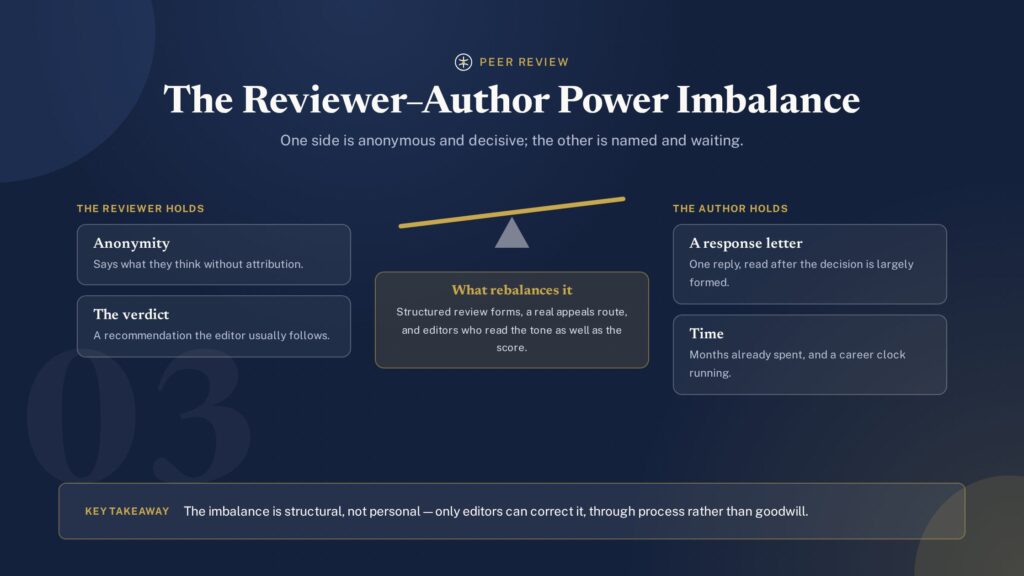
Academic publishing relies heavily on peer review as a mechanism to validate, refine, and legitimize scholarly work. While the system is designed to ensure quality and rigor, it also creates an inherent power imbalance between reviewers and authors. Reviewers act as gatekeepers—often anonymous, influential, and decisive—while authors, particularly early-career researchers, may find themselves in a vulnerable position. Understanding and addressing this imbalance is essential for building a more equitable and trustworthy publishing ecosystem.
Understanding the Power Dynamics
At its core, peer review places reviewers in a position of authority. They evaluate the validity, originality, and significance of a manuscript, and their recommendations can determine whether a paper is accepted, revised, or rejected. Authors, on the other hand, must respond to critiques, justify their work, and often make substantial changes based on reviewer feedback.
This dynamic becomes more pronounced when:
- Reviewers are senior experts and authors are early-career researchers
- The review process is single-blind or double-blind but still influenced by writing style or citations
- Editorial decisions heavily rely on reviewer recommendations
While this structure is intended to maintain standards, it can sometimes lead to unintended consequences, including bias, overreach, or discouragement.
Forms of Power Imbalance
The imbalance between reviewers and authors can manifest in several ways:
- Excessive or Unreasonable Demands
Reviewers may request additional experiments, analyses, or citations that go beyond the scope of the original study. While some suggestions improve quality, others may reflect personal preferences rather than essential revisions. - Tone and Communication Issues
Harsh, dismissive, or overly critical language can undermine authors’ confidence. Anonymous reviewing, while protective, can sometimes reduce accountability in communication. - Bias and Subjectivity
Reviewers may consciously or unconsciously favor certain methodologies, theoretical frameworks, or even research groups. This can disadvantage innovative or interdisciplinary work that challenges established norms. - Gatekeeping Behavior
In some cases, reviewers may delay or block publication of competing research, particularly in highly competitive fields. This raises concerns about conflicts of interest and ethical boundaries.
Impact on Authors
The consequences of this imbalance are not merely procedural—they can significantly affect researchers’ careers and well-being.
- Early-career researchers may feel pressured to comply with all reviewer requests, even when they disagree, due to fear of rejection.
- Researchers from underrepresented regions or institutions may face additional challenges in asserting their perspectives.
- Innovative research may be suppressed if it does not align with reviewer expectations.
Over time, these dynamics can contribute to a culture where conformity is rewarded over creativity, and where the publication process becomes more about negotiation than scientific merit.
The Role of Editors
Editors play a crucial role in moderating the reviewer–author relationship. They are not merely intermediaries but active decision-makers responsible for ensuring fairness and balance.
Effective editorial practices include:
- Evaluating reviewer comments critically, rather than passing them on unfiltered
- Identifying unreasonable or biased feedback and guiding authors accordingly
- Providing clear, independent decisions that are not solely dictated by reviewers
When editors actively manage the process, they can mitigate power imbalances and create a more constructive review environment.
Strategies for Authors
Authors are not powerless in this system. There are several ways they can navigate reviewer feedback effectively:
- Respond Strategically, Not Submissively
Authors should address all comments respectfully but are not obligated to accept every suggestion. Clear, evidence-based rebuttals are a legitimate and important part of the process. - Use Structured Response Letters
Organizing responses point-by-point demonstrates professionalism and helps editors assess the validity of both reviewer comments and author replies. - Seek Clarification When Needed
If a comment is unclear or contradictory, authors can request clarification through the editor rather than making assumptions. - Maintain Professional Tone
Even when feedback is harsh, maintaining a calm and respectful tone strengthens the author’s position and credibility.
Rethinking Reviewer Responsibility
Reducing power imbalance also requires a shift in how reviewers perceive their role. Reviewing should be seen not as an exercise of authority, but as a collaborative effort to improve research.
Best practices for reviewers include:
- Providing constructive, specific, and actionable feedback
- Avoiding unnecessary demands or personal preferences
- Being mindful of tone and language
- Declaring conflicts of interest transparently
Training and guidelines can help reinforce these principles, especially for new reviewers.
Structural Solutions for Balance
Beyond individual behavior, systemic changes can help address reviewer–author power imbalances:
- Open Peer Review Models
Increasing transparency by revealing reviewer identities or publishing review reports can improve accountability and reduce harsh or biased feedback. - Reviewer Guidelines and Accountability
Journals can implement stricter guidelines and monitor reviewer performance over time. - Appeals and Mediation Mechanisms
Providing clear pathways for authors to challenge unfair reviews ensures that decisions are not final without scrutiny. - Diversifying Reviewer Pools
Including reviewers from varied backgrounds, career stages, and regions can reduce bias and broaden perspectives.
Toward a More Equitable Review Culture
The goal of peer review is not just to filter research, but to refine and strengthen it. Achieving this requires a cultural shift from hierarchy to collaboration. Reviewers, authors, and editors must work together with mutual respect, recognizing that each plays a vital role in advancing knowledge.
Addressing reviewer–author power imbalance is not about diminishing the authority of reviewers—it is about ensuring that this authority is exercised responsibly, fairly, and transparently. By doing so, academic publishing can move closer to a system that truly supports innovation, integrity, and inclusivity.
In the evolving landscape of scholarly communication, balance is not just desirable—it is essential.