
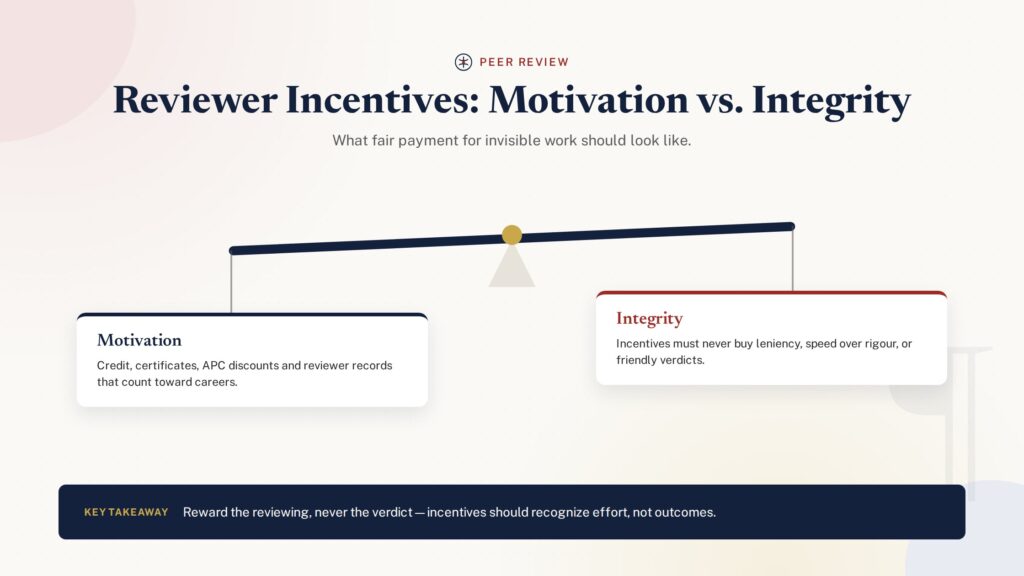
Reviewer Incentives in Academic Publishing: Balancing Motivation, Ethics, and Quality
Reading time - 7 minutes
Introduction
Peer review remains the backbone of academic publishing, yet it relies heavily on voluntary contributions from researchers who are often already overburdened. As submission volumes rise and reviewer fatigue becomes more pronounced, journals and publishers are increasingly exploring incentive systems to attract and retain qualified reviewers. However, introducing incentives—whether monetary or non-monetary—raises important ethical, practical, and quality-related questions. How can the system reward reviewers without compromising the integrity of the review process? This blog explores the evolving landscape of reviewer incentives and the need for a balanced, ethical approach.
The Growing Need for Reviewer Incentives
The traditional model of peer review is built on academic reciprocity: researchers review others’ work as part of their scholarly duty. While this norm has sustained the system for decades, it is showing signs of strain. Increasing manuscript submissions, tighter deadlines, and limited recognition for review work have led to declining reviewer availability and engagement.
In this context, incentives are seen as a way to:
- Encourage timely and high-quality reviews
- Recognize the intellectual labor of reviewers
- Reduce reviewer fatigue and burnout
- Attract diverse and early-career reviewers
However, the introduction of incentives must be handled carefully to avoid unintended consequences.
Types of Reviewer Incentives
Reviewer incentives can broadly be categorized into monetary and non-monetary forms.
- Monetary Incentives
Some journals and publishers offer financial compensation, honoraria, or discounts on article processing charges (APCs). While this approach directly acknowledges the value of reviewers’ time, it raises concerns about:
- Bias and conflict of interest: Paid reviewers may feel pressured to provide favorable or expedited reviews.
- Inequality: Not all journals can afford to pay reviewers, potentially creating disparities across disciplines and regions.
- Motivation shift: Financial rewards may shift the motivation from scholarly contribution to transactional engagement.
- Non-Monetary Incentives
These include recognition, certification, career benefits, and access-related perks. Common examples are:
- Public acknowledgment (e.g., annual reviewer lists)
- Certificates or digital badges
- Reviewer profiles and metrics
- Discounts on journal subscriptions or conference access
- Opportunities for editorial board membership
Non-monetary incentives are generally considered more aligned with academic values, but they must still be meaningful and credible to be effective.
Ethical Considerations in Incentivizing Reviewers
Introducing incentives into peer review raises several ethical questions that must be addressed through clear policies and governance.
- Preserving Objectivity and Independence
The core principle of peer review is unbiased evaluation. Any incentive system must ensure that reviewers remain independent and are not influenced—consciously or unconsciously—by rewards. Transparency in incentive structures is essential to maintain trust. - Avoiding Perverse Incentives
If incentives are tied to speed or quantity, reviewers may prioritize quick or superficial reviews over thorough and constructive feedback. This can degrade review quality and harm the scholarly record. - Ensuring Equity and Inclusion
Incentive systems should not disproportionately benefit certain groups (e.g., researchers from well-funded institutions). Inclusive design is necessary to ensure fair access and participation across global research communities. - Transparency and Disclosure
Journals should clearly disclose their incentive policies to authors, reviewers, and readers. This includes the type of incentives offered and any potential implications for the review process.
Designing Effective and Ethical Incentive Systems
To strike the right balance, publishers and journals should consider the following best practices:
- Prioritize Recognition Over Compensation
Non-monetary incentives that enhance a reviewer’s academic profile—such as verified review records, certificates, and public acknowledgment—are often more sustainable and ethically sound. - Link Incentives to Quality, Not Just Speed
Evaluation mechanisms should assess the depth, clarity, and usefulness of reviews rather than just turnaround time. Editorial feedback and scoring systems can help maintain standards. - Integrate Incentives into Academic Credit Systems
Institutions and funding bodies should recognize peer review as a valuable scholarly contribution. Integrating review work into promotion and tenure evaluations can provide long-term motivation. - Use Tiered or Hybrid Models
A combination of incentives—such as recognition, access benefits, and occasional financial rewards—can cater to diverse reviewer motivations while minimizing risks. - Maintain Editorial Oversight
Editors should continue to monitor review quality and intervene when necessary. Incentives should complement, not replace, editorial judgment.
The Role of Technology in Supporting Incentives
Digital platforms are playing a key role in enabling scalable and transparent incentive systems. Reviewer dashboards, performance analytics, and verified review records allow journals to track contributions and reward reviewers more effectively. Integration with researcher profiles can further enhance visibility and credit.
However, technology must be used responsibly. Over-reliance on metrics or automated scoring can oversimplify the complex nature of peer review and introduce new biases.
Looking Ahead: A ثقultural Shift in Valuing Peer Review
Ultimately, the challenge of reviewer incentives is not just operational—it is cultural. Academic publishing must move toward a system where peer review is genuinely valued as a core scholarly activity, not an invisible obligation.
This requires collaboration across stakeholders:
- Publishers to design ethical and transparent incentive systems
- Institutions to recognize and reward review contributions
- Researchers to engage responsibly and uphold review standards
Conclusion
Reviewer incentives are no longer a peripheral consideration—they are central to the sustainability of academic publishing. While incentives can help address reviewer fatigue and improve engagement, they must be designed with careful attention to ethics, equity, and quality.
A balanced approach that emphasizes recognition, transparency, and alignment with academic values can strengthen the peer review system without compromising its integrity. As the publishing landscape continues to evolve, thoughtful incentive models will play a crucial role in ensuring that peer review remains rigorous, fair, and sustainable.