
Desk Rejection Explained: Top Reasons Journals Reject Papers Early
Reading time - 7 minutes
A desk rejection is a manuscript turned down by the editor without being sent to peer review. It usually arrives within days, often with a short and unrevealing note, and it accounts for a large share of all rejections at selective journals.
It is also the most fixable kind of rejection, because most desk rejections are about fit and presentation rather than about whether the science is any good.
What desk rejection actually means
Your paper reached an editor, who read enough of it to conclude it should not occupy reviewers’ time, and returned it. No external reviewer saw it. No judgement was made on whether your findings are correct.
That last point is the one authors most often get wrong. A desk rejection is a statement about this paper at this journal — scope, format, framing, basic standards. It is not a verdict on the work.
Why journals desk reject at all
Reviewers are the scarce resource in publishing. A selective journal receives far more submissions than it can review, and every manuscript sent out consumes several hours of unpaid expert time. Screening protects that resource.
It also protects you. A rejection in four days is materially better than the same rejection in four months, because it is four months you can spend at a journal that wants the paper.
The common reasons
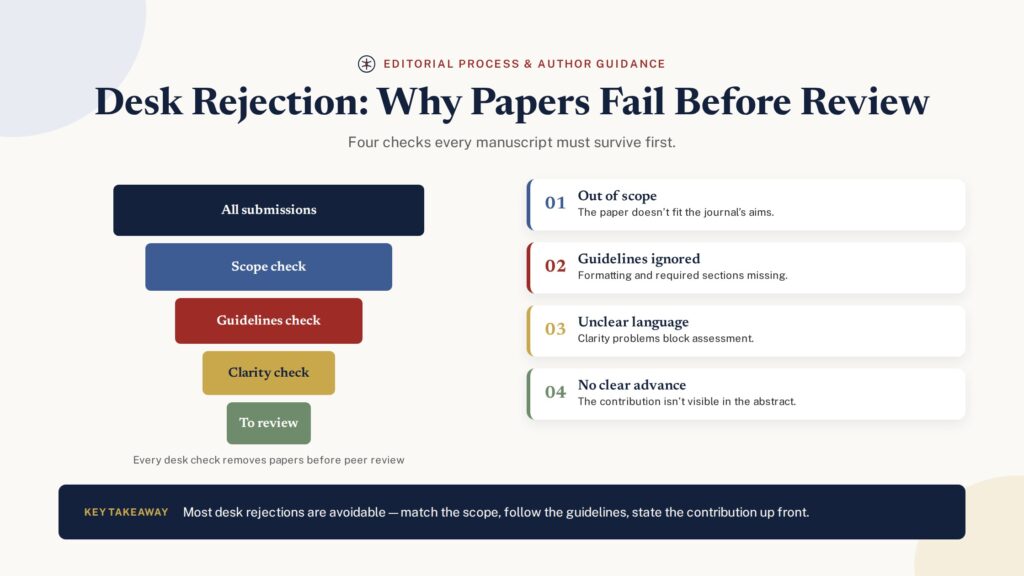
- Out of scope. The commonest reason by some distance. The work is sound but the journal does not publish it — wrong field, wrong methodology, wrong readership.
- Insufficient novelty or significance for this title. Note the qualifier. The same paper can be too incremental for one journal and a good fit for its sister title.
- An unclear research question. If an editor cannot state what you were asking after reading the abstract and introduction, a reviewer will not do better.
- Visible methodological problems. Ones an editor can see without expert review — no control, an underpowered sample, a design that cannot support the claim.
- Presentation and language. Prose so unclear that the science cannot be assessed. This is a legitimate desk-reject reason at most journals and a fixable one.
- Formatting and compliance. Missing ethics approval, no trial registration, absent declarations, wildly wrong length or reference style. Purely administrative, and entirely preventable.
Desk rejection vs peer review rejection
These two outcomes carry very different information, and reading them the same way wastes time.
| Desk rejection | Peer review rejection | |
|---|---|---|
| Who decided | Editor alone | Editor, advised by external reviewers |
| Typical timing | Days to about two weeks | Weeks to several months |
| What you receive | A short note, often templated | Reviewer reports, sometimes detailed |
| What it usually means | Wrong journal, or not presentable yet | The science, methods or contribution fell short |
| What to do | Reselect the journal; fix presentation | Use the reports to revise before resubmitting elsewhere |
| Worth appealing? | Rarely — scope is the editor’s call | Occasionally, if a review contains a demonstrable error |
The practical difference: a desk rejection gives you almost no information about the work, so do not over-interpret it. A peer review rejection gives you free expert feedback, so use it.
High-impact vs mid-tier screening
The bar moves with the journal, and so does the reason you are likely to be screened out.
At high-impact titles, desk rejection rates are high and the binding constraint is usually significance. Editors are asking whether the finding will matter to a broad readership, and most sound papers fail that test. Being desk rejected here is close to routine and carries little signal about quality.
At mid-tier and specialist journals, screening is lighter and the reasons shift towards fit and compliance — scope mismatch, missing declarations, presentation. A desk rejection here is more likely to be telling you something you can actually act on.
The implication for journal selection: if you are rejected on significance at a flagship title, the next step is usually a more specialised journal rather than a rewrite. If you are rejected on compliance at a specialist title, fix the paper before it goes anywhere.
How fast desk rejections arrive
Most land within one to two weeks, and same-week decisions are common at journals with dedicated editorial staff. Some arrive within 48 hours.
Silence past about three weeks usually means the manuscript cleared screening and is out for review, or that reviewer invitations are proving hard to fill. Neither is a reason to write in before the journal’s own stated timeline has passed — and that timeline is normally on the journal’s website.
Decoding the rejection note
Desk rejection letters are short and templated, and the phrasing is more informative than it looks. Four formulations cover most of them.
| What the letter says | What it usually means | Your next move |
|---|---|---|
| “Not a good fit for the scope of this journal” | Scope. Nothing about quality. | Reselect. Do not revise, do not appeal. |
| “Does not reach the priority required” / “of interest to a specialised readership” | Significance for this title. Often a soft steer towards a specialist journal. | Go more specialised, usually without rewriting. |
| “Does not meet our submission requirements” | Compliance — something is missing or misformatted. | Find and fix it before submitting anywhere. |
| “We are unable to consider your manuscript further” with no reason | Genuinely uninformative. Usually scope or volume. | One brief query is acceptable; otherwise move on. |
A letter naming a specific fixable problem is the most useful outcome available short of review. A letter that names a sister journal is a real recommendation, not a courtesy — transfers usually carry your submission date.
How to make desk rejection less likely
- Read the aims and scope, then read three recent papers from the journal. Scope statements are written broadly; the actual published record tells you what they take.
- Make the contribution explicit in the abstract. An editor should be able to state your claim and why it matters after the first paragraph.
- Run the compliance checklist before submitting — ethics approval, registration, declarations, data and code statements, reference style, word limit.
- Use the cover letter properly. Say what the paper shows and why it fits this journal. It is the only place you get to argue for scope.
- Fix the language first if it needs fixing. Unclear prose is a documented desk-reject reason, and no reviewer ever sees past it.
- Ask a colleague outside your subfield to read the abstract. If they cannot say what you did, an editor in a hurry will not either.
What to do when it happens
- Read the note for the actual reason. Scope, significance and compliance point to three different next steps.
- Do not appeal a scope decision. Fit is the editor’s judgement and appeals on it almost never succeed.
- Reselect on evidence. Look at where comparable papers actually appear rather than at impact factor alone.
- Fix what was named before resubmitting anywhere. A compliance failure will repeat at the next journal.
- Resubmit quickly. There is nothing to revise if the reason was fit, and the paper ages while you hesitate.
Frequently asked questions
Is a desk rejection bad for my record? No. Journals do not share rejection histories, and there is no register of them.
Can I resubmit the same paper to the same journal? Only if you were invited to, or if you have substantially changed the paper and the journal permits it. Otherwise no.
Should I ask the editor why? A brief, polite request for clarification is acceptable if the note gave no reason at all. Expect a short answer or none; editorial offices are triaging.
Does a fast rejection mean they did not read it? Not necessarily. Deciding that a paper is outside scope takes a competent editor a few minutes, and doing it quickly is the service.
How many desk rejections are normal? At selective journals, a majority of submissions never reach review. Most working researchers collect several.
What to take from this
Treat a desk rejection as routing information, not as a grade. Find the stated reason, decide whether it is about fit or about the paper, fix what is fixable, and send it on quickly. The authors who lose most to desk rejection are not the ones who get them — they are the ones who spend a month being discouraged by one.
Related reading: journal editorial decisions and how to respond to each, how to write an effective cover letter, and how to read a journal’s aims and scope.