
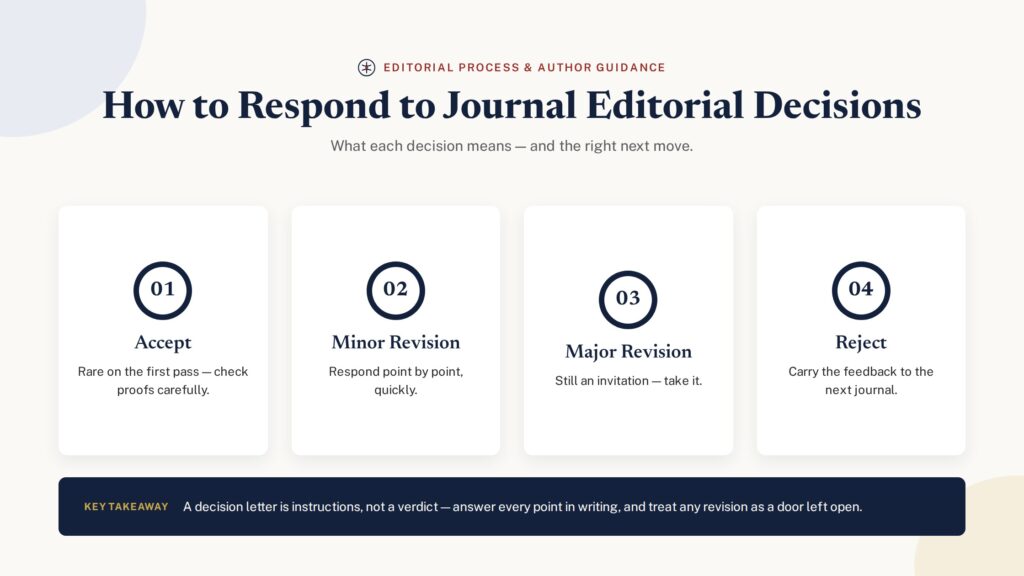
How to Respond to Journal Editorial Decisions
Reading time - 6 to 8 minutes
Journal editorial decisions arrive as a single line at the top of an email — accept, minor revision, major revision, revise and resubmit, reject — followed by pages of reviewer comments. That one line determines what you do next, and it is routinely misread. “Revise and resubmit” is not a revision. “Accept with minor revisions” is not an acceptance. A rejection that invites a new submission is not the same as a rejection that closes the door.
This guide covers the eight decisions a manuscript can receive, what each one actually signals about your paper, how to write the response letter, and the narrow circumstances in which appealing is worth your time.
The eight editorial decisions, and what each one means
Decisions fall into two groups: those made by the editor alone before peer review, and those made after reviewers have reported. Knowing which group you are in tells you how much of the verdict is about fit and how much is about the science.
Before peer review — the editor decides alone
| Decision | What it means | What to do |
|---|---|---|
| Return without review (desk rejection) | The paper failed initial screening: out of scope, below the journal’s basic standards, or language quality too poor to review. | Read the stated reason. If it is scope, reselect the journal. If it is language or presentation, fix that before resubmitting anywhere. |
| Transfer recommended | The work is sound but wrong for this title. Common inside large publisher portfolios. | Transfers need your consent. Accepting keeps the reviews and submission date; declining means starting over elsewhere. |
| Sent for peer review | Not a decision so much as a gate cleared. Typically two or three reviewers are invited. | Nothing. This is the longest wait in the process. |
After peer review
| Decision | What it means | What to do |
|---|---|---|
| Accept as submitted | Publication approved with no changes. Genuinely rare — most authors never see it. | Nothing but proofs. |
| Accept with minor revisions | Conditional. Small, specific fixes. Usually no second round of external review. | Make the changes quickly and precisely. This is the strongest realistic outcome — but it is not yet an acceptance, and editors do reject papers whose minor revisions were done carelessly. |
| Major revisions | The contribution is of interest, but something substantial is unresolved — methods, analysis, framing or evidence. | Revise thoroughly and expect a second review round, often by the same reviewers. Budget weeks, not days. |
| Reject and resubmit | Formally a rejection, with an invitation. The paper re-enters as a new submission with a new ID and a fresh review round. | Treat it as a major rebuild, not an edit. Reference the original submission number in your cover letter. |
| Reject | The journal will not reconsider the work. | Use the reviews — they are free expert feedback — and submit elsewhere. |
Three decisions authors routinely misread
“Reject and resubmit” is better news than it looks. It sits in the rejection category for editorial statistics, but an editor who did not want the paper would simply reject it. The invitation is real. What it signals is that the required work exceeds what a revision round can reasonably hold.
“Minor revisions” is not an acceptance. The conditional matters. Editors return papers at this stage when the author treated the request as a formality — changes made in name only, or a response letter that asserts a change was made without pointing to it.
“Major revisions” is not a soft rejection. Authors abandon papers at this stage far more often than the odds justify. A major revision means reviewers engaged seriously enough to specify what would make the paper publishable. That is a considerably better position than starting again at a new journal with a new set of reviewers.
How editors actually reach the decision
Reviewers advise; the editor decides. Understanding the difference explains several things that otherwise look arbitrary — including why two positive reviews can still produce a rejection.
A handling editor weighs four things that reviewers do not see:
- Fit against the journal’s scope and readership, which reviewers are not asked to judge and often do not know.
- The reviews against each other. A reviewer who writes three lines carries less weight than one who engages with the methods in detail, regardless of the recommendation each ticked.
- Whether the objections are fixable. A flaw in the design cannot be revised away; a flaw in the reporting can. This distinction decides major revision versus rejection more often than severity does.
- Capacity. Selective journals reject sound papers because the queue is long, which is why “this is a solid study but not for us” is a real outcome rather than a polite fiction.
Two practical consequences. First, the recommendation boxes reviewers tick are inputs, not votes — an editor can reject with two “minor revision” recommendations if the paper does not belong in the journal, and can invite a revision over a “reject” if that reviewer’s objection is answerable. Second, the editor’s covering letter is the authoritative statement of what must change. Where it conflicts with a reviewer, follow the editor.
This is also why appeals on the grounds that “two of three reviewers were positive” rarely succeed. The count was never the mechanism.
Before you write a single word of the response
Four things, in order.
Wait. The Royal Society’s own guidance to authors is to leave time between receiving a decision and drafting a rebuttal, so the response is written after the initial disappointment rather than during it. A day is usually enough. Nothing in the process rewards replying within the hour.
Read the editor’s letter separately from the reviews. The editor’s paragraph is the decision; the reviews are evidence. When reviewers disagree, the editor’s letter usually says which points are binding. Authors who work only from the reviewer comments often answer the wrong questions.
Check the required format. Journals differ on whether the response goes in a table, a numbered list or a separate document, and whether a tracked-changes manuscript is required alongside a clean one. This is in the instructions for authors, and getting it wrong causes an immediate return from the editorial office.
Sort every comment into three piles: changes you will make, changes you will make partially, and changes you will decline. You must respond to all three. Silence on a comment reads as evasion.
How to structure the response letter
A response letter has six parts, and reviewers and editors read them in this order:
- Address the editor by name, with the manuscript title and tracking number. Omitting the number is the single most common administrative error.
- One short paragraph of thanks — brief and once only. Repeating gratitude before every response is noise.
- A summary of the main changes, four or five sentences, so the editor can see the shape of the revision without reading forty pages.
- Point-by-point responses, grouped as “Responses to Reviewer 1”, “Responses to Reviewer 2”. Quote each comment in full, then answer it.
- A location for every change — page, paragraph and line number, or continuous line numbering. “We have revised this” without a location forces the editor to hunt, and editors do not hunt.
- A professional close with corresponding author contact details.
A workable pattern for each comment:
Reviewer 1, Comment 3: “The sample size calculation is not reported.”
Response: We agree this was missing. We have added the calculation, including the assumed effect size and power, to the Methods (page 8, paragraph 2, lines 171–178).
Assume the reviewers will read the letter. On journals operating open or published peer review, so will everyone else.
How to disagree without losing the paper
Reviewer comments are recommendations to the editor, not instructions to you. You may decline any of them — but a declined comment needs a reason, stated plainly, and ideally a smaller change that addresses the underlying concern.
What works:
Response: We have not added the additional cohort, as the data were collected under a different consent framework and cannot be pooled. To address the reviewer’s underlying concern about generalisability, we have added a limitations paragraph setting out which populations these findings do and do not extend to (page 19, lines 402–414).
Three habits to avoid: sarcasm, however well buried; pointing out that another reviewer disagreed, unless the editor invited you to; and dismissing a comment as a misunderstanding without asking why the misunderstanding occurred. If a careful expert reader misread your paper, other readers will too, and the presentation is worth fixing even when the substance is not.
Where reviewers contradict one another outright, the editor’s letter is the tiebreaker — and if it is silent, it is reasonable to write to the editorial office and ask which line to follow. We cover this in detail in our guide to responding to conflicting peer reviewer comments.
Before you hit resubmit
A short pass that catches most of what gets revisions returned:
- Every comment has a response, including the ones you declined.
- Every claimed change has a page and line number, and those numbers refer to the revised manuscript.
- Both files are attached if the journal wants them — tracked changes and clean.
- The manuscript number and title are in the letter.
- No reviewer is referred to by what another reviewer said.
- Someone who is not an author has read the letter for tone. A supervisor or colleague will catch defensiveness you cannot see in your own draft.
- The deadline is met, or an extension was requested before it passed.
When an appeal is worth it
Appealing a rejection is legitimate, and occasionally successful, but the grounds are narrower than most authors assume. Disagreeing with the reviewers’ judgement is not in itself a ground. What publishers ask for is evidence of a specific fault in the process:
- A factual or technical error in a review — the reviewer misstated what your data show, or applied a standard that does not apply to your design.
- A reviewer conflict of interest.
- Substantial new data or information that was not available at the time of review.
An appeal letter must state the disagreement point by point, present the new evidence, and stay professional throughout. Contact the editorial office rather than the handling editor directly. Note two constraints that publishers state openly: most consider one appeal per manuscript, and appeals are queued behind new submissions — so expect it to be slow. Taylor & Francis, for instance, states that editors will consider one appeal per article and that decisions on appeals are final.
The realistic question is whether the months an appeal may take are better spent submitting to a journal that wants the paper. Usually they are. Appeal when the review contains a demonstrable error that changes the verdict — not when it contains an opinion you dislike.
After you resubmit
A minor revision usually goes back to the editor alone and can be decided in days or a few weeks. A major revision typically returns to the original reviewers, and a second round can take as long as the first. A reject-and-resubmit starts the clock over completely.
Second-round decisions are usually shorter and more specific. If reviewers raise entirely new issues at this stage — points they could have made the first time — it is reasonable to say so politely in your response and ask the editor to adjudicate.
Frequently asked questions
How long should I take over a revision? Journals usually state a deadline — often 30 to 90 days depending on the scale — and most will extend it if you ask before it expires. Asking is unremarkable; missing it silently is not.
Do I have to make every change a reviewer asks for? No. You have to respond to every comment. Declining is acceptable when you explain why and, where possible, address the underlying concern another way.
What if I disagree with the editor rather than the reviewers? Write to the editorial office, state the specific point, and keep it to one message. The editor made the decision; the reviewers only advised.
Can I ask which reviewer said what? Reviews are usually anonymised and the journal will not identify reviewers. You can ask the editorial office to clarify an ambiguous comment.
Is a desk rejection worth appealing? Rarely. Desk rejections are usually about scope or fit, which an appeal cannot change. Our guide to desk rejection covers how to tell a scope problem from a quality problem.
Should I mention that a previous journal rejected the paper? Only if the new journal asks, or if you are accepting a transfer, where the submission history travels with the manuscript anyway.
What to take from this
The decision line tells you which process you are in; the reviews tell you what to do inside it. Most authors lose time in two places — abandoning papers at major revision, where the odds are genuinely good, and appealing rejections on grounds that are really disagreements. Read the editor’s letter as the decision, treat the reviews as evidence, answer every comment with a location attached, and reserve appeals for demonstrable error.
For the publisher’s own view of what an appeal must contain, the Taylor & Francis appeals and complaints policy sets out the grounds and the one-appeal rule explicitly. If your decision letter was a rejection before review, start with what a desk rejection actually means; if you are drafting the submission that follows, see how to write an effective cover letter.