
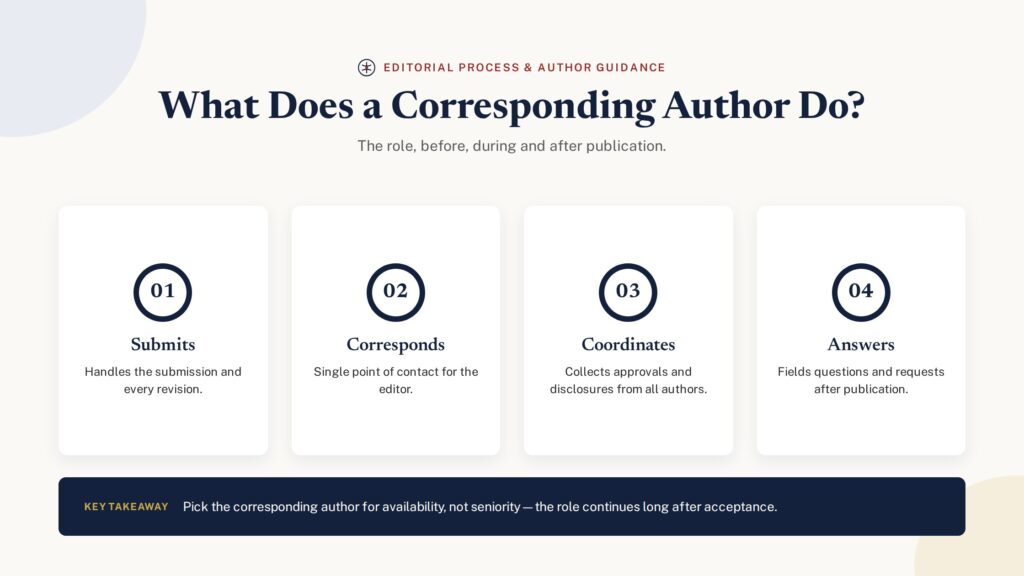
The corresponding author is the one person on a paper who handles all communication with the journal — at submission, through peer review, and after publication. It is an administrative and accountability role, not a rank. It does not mean first author, senior author, or the person who did the most work.
That distinction is the source of most confusion about the role, and of a surprising amount of real trouble: publishing agreements signed on everyone’s behalf, article charges invoiced to one person, and data requests arriving years later at an email address that no longer exists.
What the corresponding author actually is
The International Committee of Medical Journal Editors defines the role as taking “primary responsibility for communication with the journal during the manuscript submission, peer-review, and publication process”. Three duties follow from that:
- Completing the journal’s administrative requirements — authorship details, ethics approval, trial registration, and disclosures of relationships and activities.
- Being available during submission and review to answer editorial queries promptly.
- Remaining available after publication to respond to critiques of the work and to cooperate with requests from the journal for data or additional information.
ICMJE is explicit that the role confers no special status, and that tasks may be delegated to co-authors. The correspondence stops with you; the credit does not start with you.
Corresponding author vs first author vs senior author
These are four different things, and a single person can hold several of them at once.
| Role | What it signals | Who usually holds it |
|---|---|---|
| First author | Did the largest share of the work. A credit position. | The lead researcher, often a PhD student or postdoc |
| Senior / last author | Supervised or secured funding for the work. A credit position, by convention rather than rule. | The group leader or PI |
| Corresponding author | Handles communication and administration. An operational role. | Either of the above, or whoever will still be reachable |
| Guarantor | Accepts overall responsibility for the integrity of the work. Used mainly in medical journals. | Usually the senior author |
Conventions differ sharply by field. In much of biomedicine the senior author corresponds; in parts of physics and computer science the first author does. Neither is more correct, and reviewers and readers should not be inferring contribution from the asterisk — though in practice some do, which is why the role is occasionally fought over.
Separately, being corresponding author does not exempt anyone from the authorship criteria. You still have to qualify as an author on the merits — substantial contribution, drafting or critical revision, final approval, and agreement to be accountable for the work.
What the job involves, stage by stage
Before submission
- Confirm every author agrees on the author list and the order, in writing, before you submit. Order disputes after acceptance are painful and often unresolvable by the journal.
- Check affiliations match between the manuscript and the submission system.
- Collect conflict-of-interest declarations, funding statements and ethics approvals from everyone.
- Confirm the target journal’s policies on preprints, data availability and authorship changes before you submit rather than after.
During review
- You are the sole point of contact. Editorial queries come to you and are expected back quickly.
- You circulate reviewer comments to co-authors and coordinate the response — including reaching agreement where co-authors disagree about how to answer.
- You submit the revision and the response letter on everyone’s behalf.
At acceptance
- You sign the publishing agreement or licence on behalf of all authors. Read it; you are binding people who may not have.
- You are typically the person the article processing charge is invoiced to, and the one whose institutional affiliation determines eligibility for open-access agreements and waivers.
- You check the proofs. Errors you miss are published.
After publication
- Reader queries, data requests and criticism arrive at your address, potentially for years.
- If an integrity question is raised, you are the journal’s first contact and are expected to notify co-authors and coordinate a response.
- If a correction or retraction becomes necessary, you handle that correspondence too.
Who should take the role
The practical test is not seniority. It is: who will still be contactable, and willing to act, in five years?
That argues for the permanent staff member over the student finishing next month, and for an institutional address over a personal one. A paper whose corresponding author has left academia, with a dead university email and no ORCID, is materially harder to correct, reproduce or defend.
Where the lead researcher is early-career, a reasonable compromise is common: they correspond during review, to gain the experience and the visibility, and a permanent colleague is listed for post-publication contact where the journal allows two addresses. Confirm the journal permits it — many do not.
What you are on the hook for that your co-authors are not
This is the part most people accept without reading, and it is the reason the role deserves a deliberate decision rather than a default.
- The publishing agreement. You sign for everyone. If a co-author later objects to the licence, the signature is still yours.
- The money. Article processing charges are normally invoiced to the corresponding author, and open-access eligibility usually follows the corresponding author’s institution. Publishers will not let you swap the role afterwards to qualify for a waiver — Taylor & Francis, for instance, states this explicitly.
- The paper trail. Authorship changes require written consent from every affected author, collected by you and submitted on a formal change form.
- The long tail. Data requests, reproducibility queries and post-publication criticism all route to you by default, indefinitely.
When the role causes a dispute
Four situations account for most corresponding-author conflicts, and none of them are resolved by the journal.
A supervisor insists on corresponding for work they did not lead. Legitimate if the reason is continuity — they will be there and the student will not. Less so if the reason is visibility. The honest conversation is about which of those it is, and it is easier before submission than after.
An early-career researcher wants the role for their CV. Reasonable, and increasingly common. Weigh it against whether they can realistically answer a data request three years into a different career. A durable second contact usually resolves this.
Someone discovers they were listed without agreeing. This is authorship misconduct, not an administrative slip. It goes to the institution, not the editor.
The role is switched to capture an open-access discount. Publishers anticipate this and refuse it, because eligibility follows the corresponding author’s institution.
The constant across all four is the COPE position that editors cannot adjudicate authorship disputes. A journal can pause a submission, require written consent from every author, or publish a correction — but the substantive question of who deserves what goes back to the authors’ institutions, which is a slower and more formal process than almost anyone wants. Settling it in the group beforehand is not merely polite; it is the only fast route available.
Changing the corresponding author
Before acceptance this is usually straightforward: write to the editorial office with the agreement of all authors. After publication it is a different matter.
A COPE case addressed exactly this — authors asked to change the corresponding author five months after online publication, giving no clear reason. The journal contacted all authors; only one replied, saying the wrong name had been entered at submission and missed at proof stage. The editorial board declined the change.
The principles the COPE Forum set out are worth knowing before you ask:
- Journals should require a satisfactory explanation before considering the request at all.
- All co-authors should be copied into the correspondence.
- Editors cannot resolve authorship disputes themselves — those go back to the institutions.
- If a change is approved after publication, a correction is published and linked to the original article, stating the reason.
In other words, a post-publication change leaves a permanent public note. That is a good reason to get the field right at submission.
When you change institution or leave research
Your obligation to be reachable outlives your contract. Three things reduce the damage:
- Register an ORCID and keep it current. It survives institutional email, name changes and career moves, and is increasingly the identifier journals fall back on.
- Add a durable second contact where the journal allows it — a co-author who is staying put.
- Tell the journal when your address changes for papers likely to attract queries. Most publishers will update contact details on request without a correction notice, since this is a metadata change rather than an authorship change.
“I got an email about a submission I’m listed on”
Co-authors routinely receive automated notifications — that a submission has been received, that a revision has been requested, or that they must confirm their authorship — and are unsure whether action is needed.
These are generated by the submission system to make sure no one is listed without their knowledge. If the message asks you to confirm authorship or disclose conflicts, you must respond; the manuscript may not progress otherwise. If it is purely a status update, no action is required. Either way, if you did not know you were on the paper, take it up with the corresponding author before confirming anything — being added without consent is a recognised form of authorship misconduct, and confirming makes it harder to unwind.
A pre-submission checklist
Ten minutes here prevents most of what goes wrong later:
- Every author has seen the final version and agreed to the author list and the order, in writing.
- Everyone qualifies as an author on the criteria — nobody is on for courtesy, nobody who wrote it is off.
- Affiliations match between manuscript and submission system.
- Conflict-of-interest, funding and ethics statements collected from all authors.
- You have checked whether the journal allows two corresponding authors, and used it if you need it.
- Who is paying any article charge is agreed and confirmed with whoever controls that budget.
- Your ORCID is registered, linked and current.
- The contact email will still work after you change job.
- You have actually read the publishing agreement you will be signing for everyone.
Frequently asked questions
Can a paper have two corresponding authors? Many journals allow it, some do not, and a few allow it only with a stated reason. Check before submission; it cannot always be added later.
Is the corresponding author the most important author? No. It is an operational role. Hiring and promotion committees in most fields read first and last position for contribution, not the correspondence marker.
Does the corresponding author have to be the one who submits? Not necessarily — some groups have an administrator submit — but the corresponding author is the one the journal will write to and hold responsible.
What if the corresponding author stops responding? Journals will usually try co-authors next. If a paper stalls because the corresponding author is unreachable, any author can contact the editorial office directly and explain.
Do I get the APC bill personally? The invoice goes to you, but payment is normally arranged through your institution or grant. Sort out who is paying before submission, not at acceptance.
Can I refuse the role? Yes. It is a job, not an honour, and it should go to whoever can actually do it.
What to take from this
Treat the corresponding author field as a decision rather than a formality. The person in it signs the licence for everyone, receives the invoice, and remains the contact for critique and data requests long after the work is finished. Pick someone who will still be reachable, get written agreement on the author list and order before submitting, register an ORCID, and remember that fixing the field after publication takes a published correction.
The authoritative statement of the role is in the ICMJE recommendations on defining the role of authors and contributors.
Related reading: ghost and guest authorship, recognising contributors beyond the author list, researcher IDs and ORCID, and how to respond to journal editorial decisions.