
Authorship lists are supposed to reflect who actually did the intellectual work behind a paper. Ghost authorship and guest authorship both break that promise, just in opposite directions, and both are treated as research misconduct by journals that follow ICMJE or COPE guidance.
What is ghost authorship?
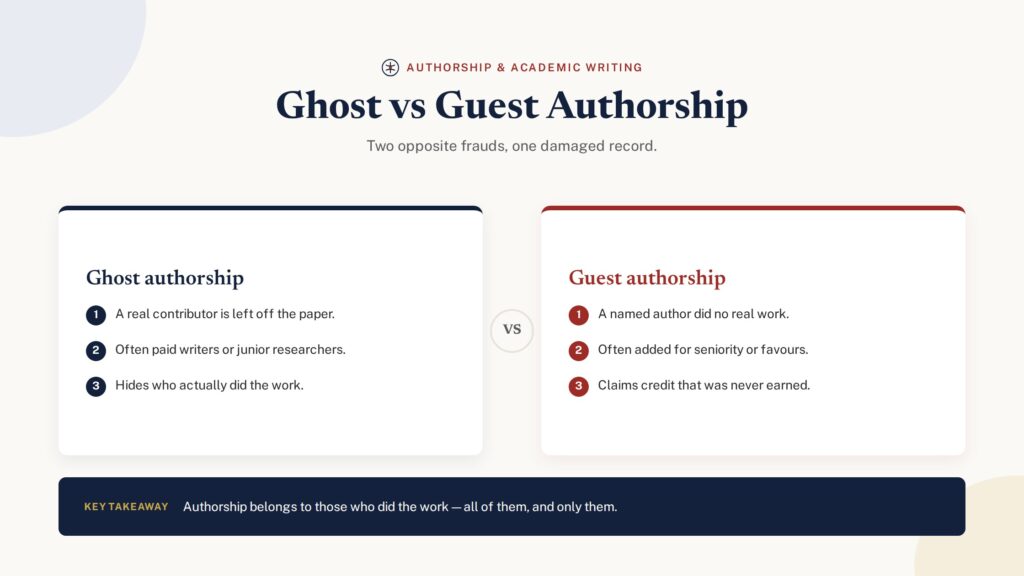
Ghost authorship happens when someone who made a substantial contribution, often writing the first draft, is left off the author list entirely. It is most common in industry-funded clinical trials, where a medical writer employed by a sponsor drafts the manuscript and a named academic “author” reviews and signs off without disclosure of the writer’s role.
Why it is a problem
Readers cannot evaluate potential conflicts of interest if the person who shaped the argument and language is invisible. It also shields sponsors from accountability if the paper is later found to misrepresent trial data.
What is guest authorship?
Guest authorship (also called honorary or gift authorship) is the reverse: someone is added to the author list despite contributing little or nothing, usually a senior figure added for prestige, a department head added by convention, or a collaborator added as a favor.
Why it persists
Guest authorship survives because it looks harmless. It inflates a senior researcher’s publication count, smooths lab politics, and rarely gets challenged since no one involved has an incentive to object.
Why both violate authorship criteria
- ICMJE requires every author to meet all four criteria: substantial contribution, drafting or revising the manuscript, final approval, and accountability for accuracy.
- Ghost authors meet the contribution criteria but are denied credit and accountability.
- Guest authors are given credit and accountability without meeting the contribution criteria.
- Both distort the scientific record’s account of who is actually responsible for the work.
How journals and institutions respond
Most major journals now require a signed contribution statement at submission, using frameworks like CRediT, and ask corresponding authors to confirm that everyone listed meets authorship criteria and that no one who qualifies has been excluded. Institutions treat confirmed cases as research misconduct, with consequences ranging from correction notices to formal disciplinary action.
How to keep your author list defensible
- Decide authorship criteria at the start of the project, not after the manuscript is drafted.
- Document each person’s contribution using a CRediT taxonomy statement.
- Disclose medical writers, statisticians, or other non-author contributors in the acknowledgments.
- Ask anyone added late in the process what specific criterion they meet.
- Revisit the author list before submission and remove anyone who cannot defend their inclusion.
Frequently asked questions
Is a funding acknowledgment enough for a guest author?
No. Securing funding alone does not meet ICMJE’s contribution criteria unless it is paired with substantial intellectual input into the design, analysis, or writing of the paper.
Can a medical writer ever be listed as an author?
Yes, if their contribution meets all four ICMJE criteria, including drafting the manuscript and taking accountability for it. If it does not, their role should be disclosed in the acknowledgments instead.
What should I do if I suspect ghost or guest authorship in a paper I am reviewing?
Raise it with the handling editor before completing your review. Most journals have a process for querying the author contribution statement separately from the scientific review.
Last updated: August 8, 2026.
For related reading, see our guides on author contribution statements and the CREDIT taxonomy and managing multi-author research papers. Our guide on how to choose the right journal also covers submission requirements that touch on authorship disclosure.
Guest and ghost authorship are about who appears on the list. A separate question is who handles the paper once it is submitted — see the corresponding author role and its responsibilities.