
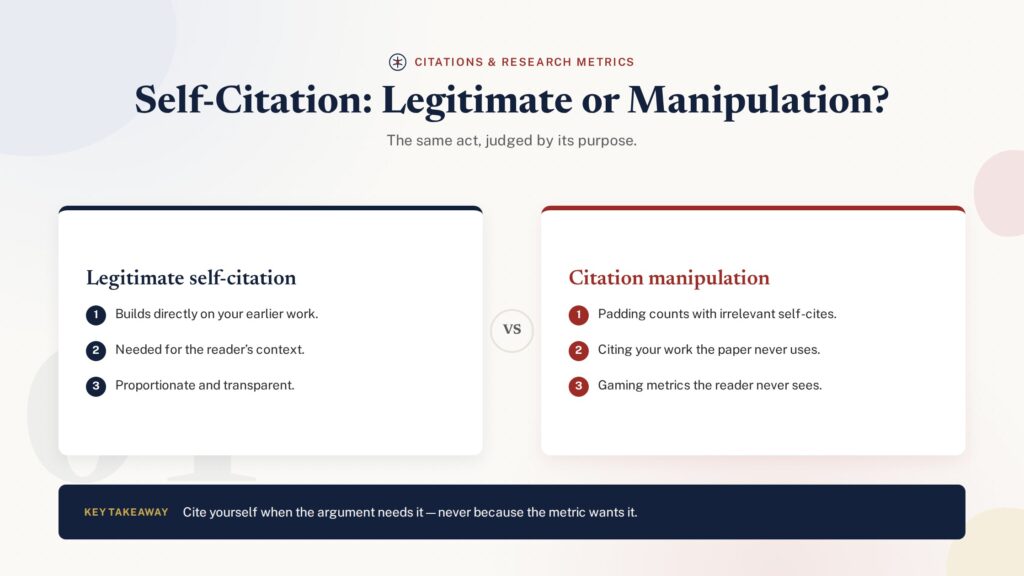
Citing your own earlier work is a normal, expected part of research writing — you’re building on what you’ve already established, and pretending otherwise would be strange. The problem isn’t self-citation itself. It’s when self-citation stops reflecting genuine intellectual continuity and starts existing to inflate a citation count, and increasingly, journals and funding bodies have specific thresholds for where that line sits.
What counts as self-citation
Self-citation is any reference to your own previously published work, whether that’s a paper you authored solo or one where you were a co-author. It also extends to citing your close collaborators’ work in a way that mutually boosts both parties’ metrics, sometimes called reciprocal or cartel citation when it’s coordinated.
Most researchers self-cite without thinking about it as a distinct category. A methods paper referencing your earlier methodology paper, or a follow-up study citing the original findings it extends, is completely ordinary. Publishers generally don’t flag individual instances. What gets scrutinized is the rate, not the act.
Why researchers self-cite legitimately
There are real reasons self-citation happens at a higher rate for some researchers than others, and none of them are misconduct:
Career stage and field maturity matter. A researcher ten years into a specific subfield has more of their own foundational work to build on than someone publishing their third paper. Longitudinal or programmatic research, where each paper is a deliberate continuation of prior work, also naturally produces more self-citation than one-off studies.
Some fields are simply smaller. In a narrow subfield with few active researchers, citing yourself and your regular collaborators can make up a larger share of total citations just because there isn’t a large body of unrelated work to draw from instead.
When it becomes a red flag
Publishers and citation databases don’t have one universal number, but a few benchmarks show up repeatedly in editorial policy and research on the topic:
Self-citation rates above roughly 20-25% of a paper’s total references start attracting attention from editors and indexing services, though the exact figure varies by field and publisher. What matters more than any single number is the pattern: a sudden spike in self-citation rate compared to a researcher’s own history, or self-citation concentrated in ways that look designed to game a specific metric (like citing yourself heavily in the two years before an h-index calculation) reads very differently from a steady, field-typical rate.
Coercive citation is a related but distinct problem: when an editor or reviewer asks an author to add citations to the editor’s or reviewer’s own work as a condition of acceptance. This isn’t self-citation by the author at all, it’s citation manipulation by someone else with power over the publication decision, and most major publishers now have explicit policies against it.
Citation cartels — small groups of researchers who systematically cite each other’s work regardless of relevance, specifically to inflate everyone’s metrics — are the most serious version of this problem. Unlike ordinary self-citation, cartels are usually detected through network analysis: citation patterns that show reciprocal, disproportionate citing among a fixed group of authors across many papers.
How journals and databases catch it
Most major citation databases and journal management systems now calculate self-citation rate automatically as part of standard editorial metrics, the same way they’d flag plagiarism or duplicate submission. Clarivate’s Journal Citation Reports, for example, publishes a journal-level self-citation rate, and unusually high rates can affect whether a journal keeps its impact factor listing at all.
None of this means self-citation is tracked to catch individuals in bad faith by default. It means the data exists, and a rate that looks anomalous compared to field norms is far more likely to draw a manual review than it would have a decade ago.
How to keep your citation practice clean
Cite because a reference genuinely supports the point you’re making, not because it’s convenient or familiar. If you’re choosing between your own earlier paper and someone else’s equally relevant work, there’s no rule against citing your own — but if you notice you’re consistently reaching for your own work over better-fitting alternatives, that’s worth a second look.
Keep the citation additions transparent during revision. If a reviewer or editor asks you to add specific citations, especially their own, you’re allowed to push back or ask the editor to intervene — most journals have a process for exactly this situation, precisely because coercive citation requests do happen.
If you’re unsure where your own rate sits, most reference managers and some journal submission systems will show you a rough self-citation percentage before submission. It’s a five-minute check that can save an awkward conversation with an editor later.
Frequently asked questions
Is there an official rule for how much self-citation is too much?
No single universal threshold exists across all publishers and fields. Editors generally look at whether the rate is consistent with a researcher’s field and career stage rather than applying one fixed cutoff.
Can self-citing hurt my paper’s chances during review?
An unusually high rate can prompt a reviewer or editor to ask for justification, but it rarely leads to outright rejection on its own unless it’s paired with other signs of citation manipulation.
What should I do if an editor asks me to cite their own work?
You can decline if the citation isn’t genuinely relevant, and most publishers have a channel (often the editor-in-chief or an ethics committee) to report pressure to add irrelevant citations as a condition of publication.
Last updated: August 12, 2026.
For related reading, see our guides on corresponding author responsibilities and ghost authorship vs. guest authorship. If you’re building out your own citation practice as part of a broader submission strategy, our AI journal matching tools breakdown covers the adjacent question of where to submit in the first place.
Self-citation isn’t the only submission-stage ethics line authors can accidentally cross. Sending the same manuscript to more than one journal at once is another — see Simultaneous Submission to Multiple Journals: Why It’s Off-Limits for what’s actually allowed.
Self-citation isn’t the only way authors reuse their own prior work — reusing their own writing, not just citations, raises a related but distinct ethics question. See Text Recycling: When Reusing Your Own Words Counts as Self-Plagiarism for where journals draw the line.