
Copying from someone else’s paper is an easy rule to understand. Copying from your own earlier paper feels like it should be fine — it’s your writing, after all — but journals treat unattributed text reuse, or “text recycling,” as its own distinct ethics issue, separate from and closely related to self-citation and salami slicing.
What Text Recycling Actually Means
Text recycling is reusing substantial passages of your own previously published writing in a new manuscript without disclosure or citation. It ranges from a reused paragraph describing your lab’s standard protocol to duplicating an entire literature review across two papers with only minor edits.
Where Journals Actually Draw the Line
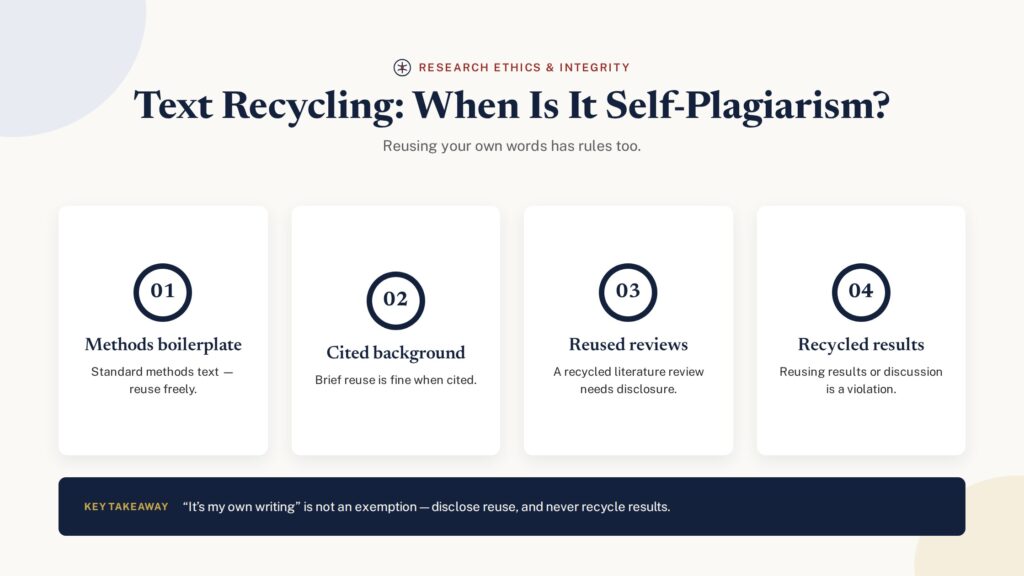
According to COPE’s guidance on text recycling, the ethical concern isn’t the reuse itself — it’s whether the reuse is disclosed, proportionate, and doesn’t misrepresent the new paper as more original than it is. Most editors distinguish:
- Generally acceptable without special disclosure: boilerplate methods descriptions of a standard, unchanging procedure; brief background sentences establishing well-known context; properly cited restatement of your own prior findings.
- Requires disclosure or rewriting: substantial reused passages from your literature review or discussion sections, especially when the new paper doesn’t meaningfully build on the reused material.
- Treated as a serious violation: reusing large sections of results or discussion to present essentially the same contribution as new, which overlaps with duplicate publication.
Why It’s Treated Differently From Ordinary Plagiarism
Self-plagiarism doesn’t steal credit from another author, but it can still mislead readers and inflate a researcher’s apparent output — the same underlying concern behind salami slicing. A literature review recycled wholesale across three papers makes each individual paper look more original than it is, and can make a research record appear larger than the actual body of new work it represents.
Common Mistake: Assuming Any Self-Reuse Is Automatically Fine
The most frequent misunderstanding is treating “it’s my own writing” as a blanket exemption. It isn’t. The deciding factor for most editors is whether the reused material is boilerplate versus substantive, and whether it’s disclosed — not who originally wrote it.
Frequently Asked Questions
Is reusing my own methods section considered self-plagiarism?
Usually not, if it describes a standard, unchanging procedure — this is the most commonly accepted form of text reuse.
Do I need to cite my own earlier paper if I reuse text from it?
Yes, for anything beyond boilerplate — cite your own prior work the same way you would cite another author’s.
How much text overlap is too much?
There’s no fixed percentage; editors look at whether the reused material makes the new paper appear more original than it is.
Is text recycling the same as duplicate publication?
No, but they overlap — duplicate publication is reusing an entire paper’s findings as if new; text recycling is reusing passages of writing, which can shade into duplicate publication if taken far enough.