
Introduction
Getting a decision letter back from a journal is rarely a simple “yes” or “no.” Most manuscripts that eventually get published go through at least one round of revision, and the letter you send back to the editor — your response to a journal decision letter — often matters as much as the changes themselves. A well-organized, respectful response letter can turn a cautious “major revision” into an acceptance. A defensive or disorganized one can sink a paper that had a real chance.
This guide walks through exactly how to structure a response to decision letter journal editors will find easy to act on, with a template you can adapt for any field. It pairs well with our guide to the peer review timeline if you want to understand how long each round typically takes.
What Is a Response to a Decision Letter?
A response letter (sometimes called an author response letter or rebuttal letter) is the document you submit alongside your revised manuscript. It addresses every point raised by the editor and reviewers, one by one, and explains what you changed — or, where you disagree, why you didn’t.
Editors use this letter to quickly verify that reviewer concerns were taken seriously before sending the paper back out for another round of review.
Before You Start Writing
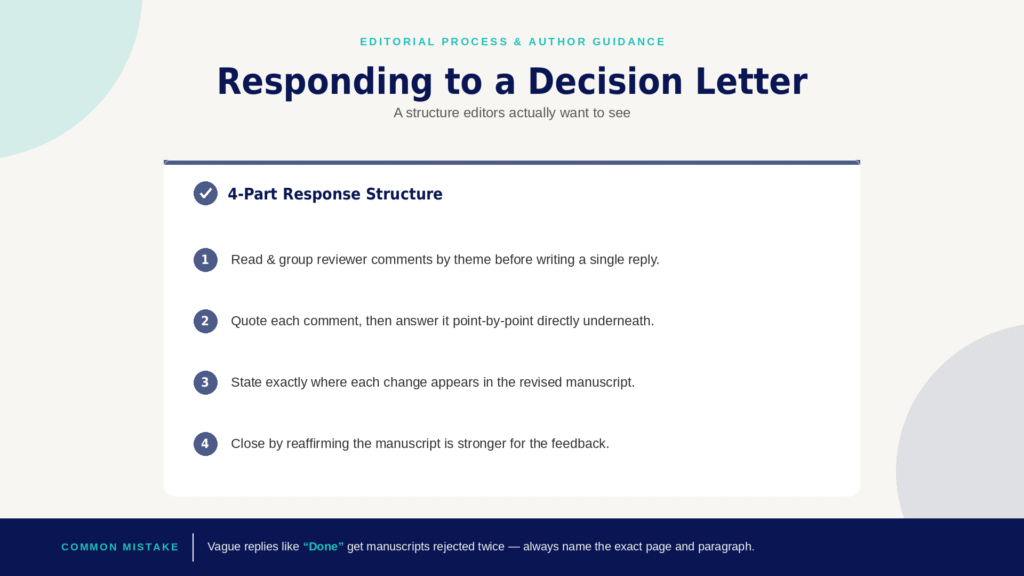
Read the decision letter and every reviewer report twice before drafting anything. Group the comments into themes — methodology, clarity, missing citations, statistical concerns — rather than responding to each reviewer in isolation. This makes it easier to spot overlapping requests and avoid contradicting yourself across responses.
Structure of a Strong Response Letter
Most accepted response letters follow the same shape:
- Opening paragraph: Thank the editor and reviewers, and briefly summarize the nature of the revisions.
- Point-by-point response: Quote or paraphrase each comment, then respond directly underneath it.
- Manuscript location: State exactly where the change appears (e.g., “Page 6, paragraph 2”).
- Closing paragraph: Reaffirm that the manuscript is stronger for the feedback and thank the team again.
How to Respond When You Disagree
Not every reviewer comment needs to be accepted. When you disagree, explain your reasoning with evidence — a citation, a re-analysis, or a clarification of what the study actually claims. Avoid dismissive language like “the reviewer is mistaken.” Instead: “We appreciate this point; however, our design specifically controlled for X, as described in Section 2.3.”
Common Mistakes to Avoid
The most frequent reasons a revised manuscript gets rejected on the second round are not the science itself — they’re the response letter. Avoid vague responses like “Done” with no explanation, ignoring a comment because you disagree with it, and burying changes so the editor can’t find them in the manuscript.
Frequently Asked Questions
How to write a response to the reviewers of your manuscript?
Address every comment individually, state clearly what you changed, and point to the exact location of the change in the revised manuscript.
How to respond to journal rejection?
If revisions weren’t invited, a rejection is usually final for that journal. Read reviewer comments carefully, revise the manuscript, and consider a different journal rather than appealing unless you believe there was a factual error in the review.
What is a response letter?
It’s the document accompanying a revised manuscript that answers each reviewer and editor comment point by point.
How do I respond to a published letter to the editor?
That is a different scenario — a public reply to a letter published about your work — and follows the journal’s own correspondence submission process rather than the peer review response process described here.
Conclusion
A response to a journal decision letter is a persuasion document as much as a scientific one. Organize it clearly, address every point, and make it effortless for the editor to see exactly how the manuscript improved. If your manuscript was rejected outright rather than invited for revision, read our guide on desk rejection to understand your options, and see the peer review report template to understand the reviewer’s side of the process. For broader ethical guidance on the review process, the Committee on Publication Ethics (COPE) is a useful reference.