
Introduction
Most journals ask authors to supply four to eight keywords alongside their manuscript, and most authors treat the request as an afterthought — typed in during the last five minutes before submission. That’s a missed opportunity. Keywords are how indexing databases, search engines, and even journal editors’ own systems categorize and surface your paper. Knowing how to choose journal keywords properly can measurably affect how often your work gets found.
Why Keywords Matter More Than Authors Think
Keywords feed into indexing systems like PubMed’s MeSH terms, Scopus, and Google Scholar. They can also determine which reviewers an editor assigns, since many journals match submissions to reviewers partly by keyword overlap. Weak or generic keywords can mean your paper is matched to the wrong expert reviewers, or simply doesn’t surface in a relevant search.
The Four Types of Keywords to Include
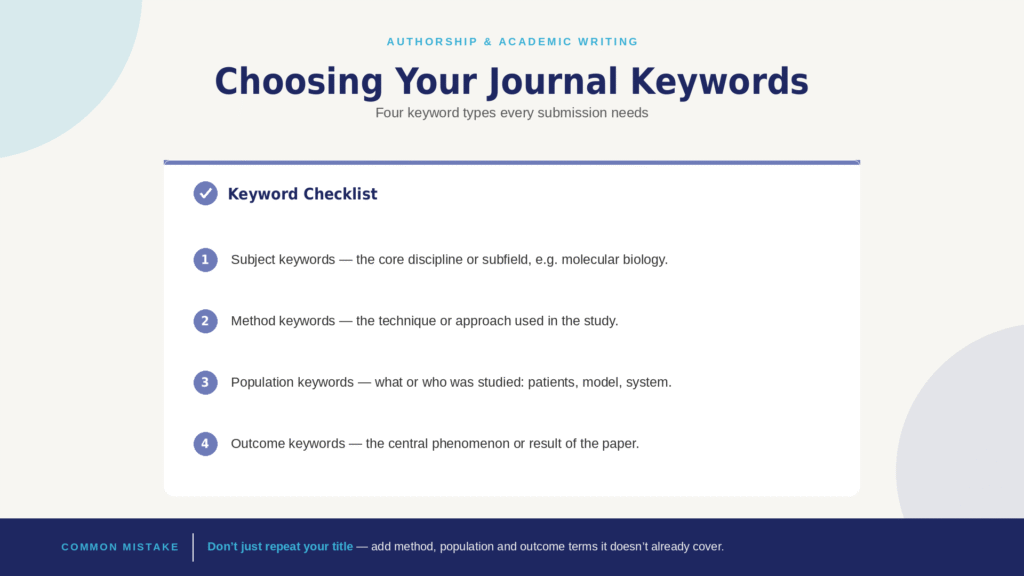
A well-rounded keyword set usually draws from four categories:
- Subject keywords: the core discipline or subfield (e.g., “molecular biology”).
- Method keywords: the technique or approach used (e.g., “randomized controlled trial”).
- Population or system keywords: what or who was studied (e.g., “adolescent patients”, “zebrafish model”).
- Outcome or concept keywords: the phenomenon or result the paper centers on (e.g., “insulin resistance”).
How Many Keywords Should You Use?
Most journals request 4–8 keywords, though some biomedical journals specify a minimum. Avoid the temptation to jam in every possible term — an overloaded keyword list dilutes relevance and can look like keyword stuffing to indexing algorithms.
Practical Steps to Choose Better Keywords
Start with your title and abstract, since indexing systems weight these heavily. Pull two or three keywords directly from title terms, then add terms from your methods and results sections that don’t already appear in the title. Check the journal’s own keyword guidelines — many biomedical journals require MeSH-controlled vocabulary, searchable through the National Library of Medicine’s MeSH browser, rather than free text.
Finally, search your chosen keywords in the journal’s own archive or in Google Scholar. If a keyword returns thousands of unrelated results, it’s too broad to be useful; if it returns almost nothing, it may be too narrow or non-standard for your field.
Keywords and Journal Selection
The same keyword exercise doubles as a journal-selection check. If your draft keyword list doesn’t overlap meaningfully with the keywords used in a target journal’s recently published papers, that’s a signal the journal may not be the right fit for your submission.
Frequently Asked Questions
How to select a journal to target for submission of a manuscript?
Compare your manuscript’s scope, methods, and keywords against a journal’s aims and scope page and its recently published articles, not just its impact factor.
What are the four main types of keywords?
Subject, method, population/system, and outcome/concept keywords, as outlined above.
How many keywords per 1000 words?
There’s no fixed ratio — journals specify a flat count (usually 4–8) regardless of manuscript length.
How to choose good keywords?
Draw from your title and methods, avoid duplicating title terms unnecessarily, check discipline-specific controlled vocabularies like MeSH, and verify each term actually returns relevant results in a real search.
Conclusion
Choosing journal keywords well takes ten extra minutes and can meaningfully change how discoverable your published work becomes. Treat it as part of the submission strategy, not a formality. Once your manuscript is submitted, review our guide on corresponding author responsibilities, and if reviewers come back with revisions, see how to structure a response to a journal decision letter.