
Introduction
Traditional peer review happens before a paper is published — but it isn’t the only kind of scrutiny research undergoes. Post-publication peer review (PPPR) is an ongoing, public evaluation of a paper after it’s already in print, and it has become one of the most important accountability mechanisms in modern academic publishing.
What Is Post-Publication Peer Review?
Post-publication peer review is the process of evaluating, critiquing, or verifying a published paper’s methods, data, or conclusions after it has appeared in a journal. Unlike traditional pre-publication review, it’s typically open: comments are attributed, public, and often visible alongside the original article.
How PPPR Differs From Traditional Peer Review
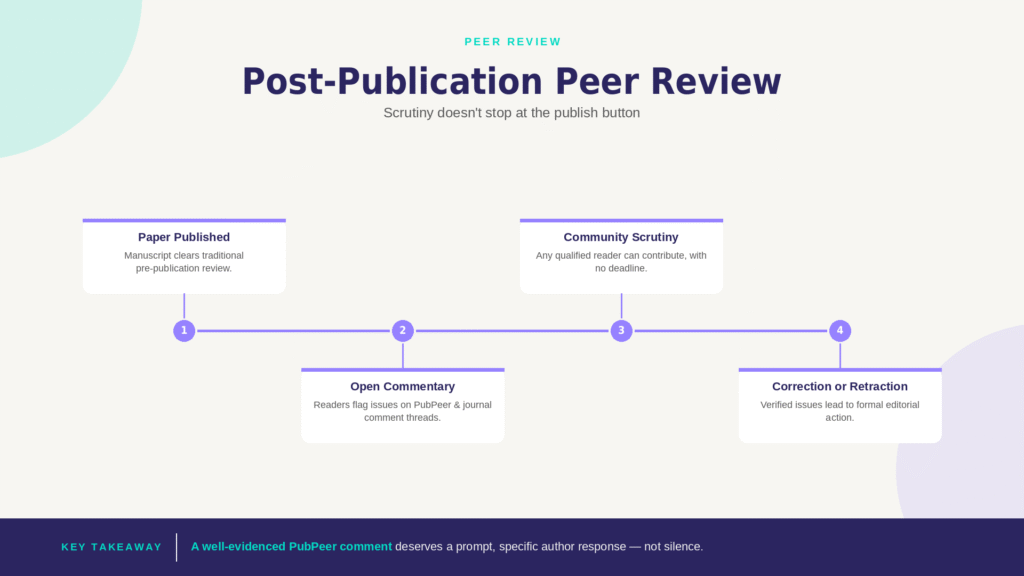
Traditional peer review is a closed, time-limited gate that a manuscript must pass before publication — usually two or three reviewers, often anonymous, working within a matter of weeks. Post-publication review has no deadline and no fixed number of reviewers: any qualified reader can contribute, sometimes years after the original publication date, and often after the finding has been cited widely.
Where Post-Publication Review Happens
Several platforms have built entire communities around this practice. PubPeer is the best known — a site where readers can leave anonymous or attributed comments on any published paper, often flagging image duplication, statistical anomalies, or methodological concerns. Journals themselves increasingly host formal commenting systems, and preprint servers frequently carry public comment threads that continue well past formal publication.
Where Post-Publication Review Happens
Several platforms have built entire communities around this practice. PubPeer is the best known — a site where readers can leave anonymous or attributed comments on any published paper, often flagging image duplication, statistical anomalies, or methodological concerns. Journals themselves increasingly host formal commenting systems, and preprint servers frequently carry public comment threads that continue well past formal publication.
Why It Matters
Pre-publication peer review, however rigorous, is performed by two or three people under time pressure. Post-publication review draws on the collective expertise of an entire field, and it has caught errors, undisclosed conflicts of interest, and outright misconduct that made it past the original review process. Several high-profile corrections and retractions in recent years originated from PPPR discussions rather than the original reviewers.
Criticisms and Limitations
PPPR isn’t without problems. Anonymous commenting can enable bad-faith attacks as easily as legitimate criticism. There’s no formal process for authors to respond within the same venue in many cases, and PPPR carries no guaranteed editorial oversight — a comment can be wrong, too, and without a review process of its own it can spread just as fast as a legitimate correction.
How Authors Should Engage With It
If your published paper receives a substantive PPPR comment, respond promptly and specifically — ignoring a well-evidenced critique tends to do far more reputational damage than addressing it. Where a comment reveals a genuine error, contact the journal about a formal correction rather than relying on the platform comment alone to resolve it.