
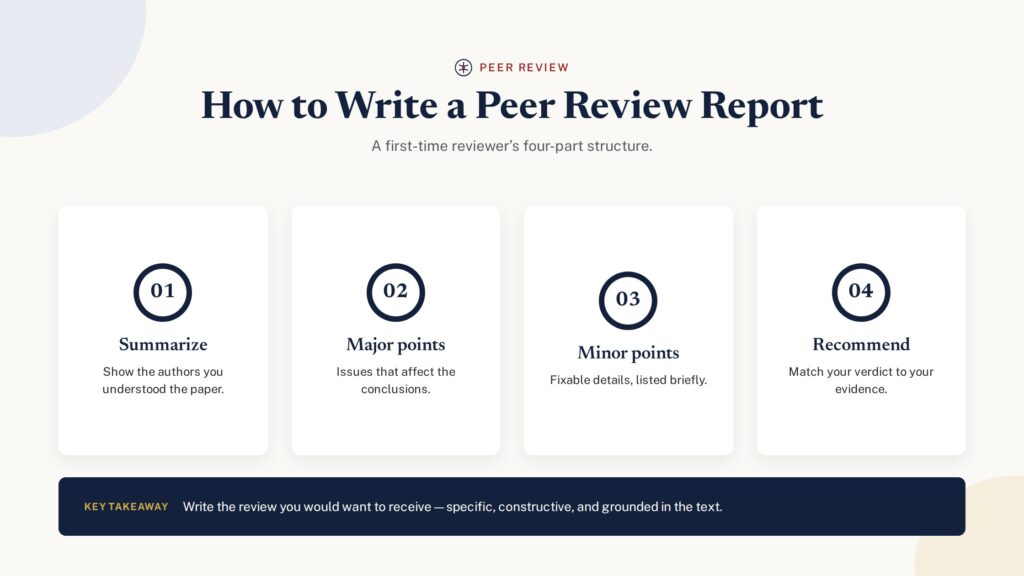
A peer review report should summarize the manuscript, separate major issues from minor ones, and end with a clear recommendation (accept, minor revision, major revision, or reject). Reviewers who structure their report this way make it far easier for editors and authors to act on the feedback.
What should a peer review report include?
- A short summary of the manuscript’s purpose, methods, and main findings.
- An overall assessment of strengths and weaknesses.
- Major comments: issues that affect the validity or interpretation of the work.
- Minor comments: smaller issues like typos, unclear wording, or missing references.
- A clear final recommendation.
Step 1: Start with a short summary
Open with two or three sentences summarizing what the manuscript is about and what it claims to contribute. This shows the editor and author that you engaged with the work, and it sets a constructive tone before you raise any concerns.
Step 2: List your major comments first
Major comments cover anything that affects the soundness of the study: methodological flaws, unsupported conclusions, missing controls, or unclear reasoning. For each one, explain why it matters and, where possible, suggest what would resolve it. Number your points so the author can respond to each one directly.
Step 3: Add minor comments separately
Minor comments are things that don’t affect the paper’s core conclusions but still improve it: typos, unclear phrasing, formatting inconsistencies, or references that need updating. Keep these in their own labeled section so they don’t get mixed in with the substantive issues above.
Step 4: End with a clear recommendation
Close your report with one clear recommendation so the editor knows exactly where you stand:
- Accept: the manuscript is ready to publish as is.
- Minor revision: small changes are needed, but the core work is sound.
- Major revision: significant issues need to be addressed before it can be reconsidered.
- Reject and resubmit: the work has potential but needs substantial rework and a fresh review.
- Reject: the manuscript has fundamental flaws that can’t be fixed through revision.
Common mistakes first-time reviewers make
- Writing vague comments like “methods are weak” without saying which part or why.
- Mixing major and minor issues together instead of separating them.
- Giving a recommendation that doesn’t match the severity of the comments above it.
- Being harsh in tone rather than framing feedback as constructive suggestions.
A simple peer review report template you can copy
Use this as a starting structure for your next review:
- Summary: 2-3 sentences on the manuscript’s purpose and main findings.
- General assessment: a short paragraph on overall strengths and weaknesses.
- Major comments: numbered list, one issue per point, with a brief explanation and suggested fix.
- Minor comments: numbered list of smaller issues, referenced by page or line number where possible.
- Recommendation: accept, minor revision, major revision, reject and resubmit, or reject.
Frequently asked questions
How long should a peer review report be?
There’s no fixed length. A short, well-organized report with a handful of substantive points is more useful than a long one padded with minor observations. Focus on quality of feedback over word count.
Should I recommend rejection if a paper has major flaws?
Not automatically. Consider whether the flaws are fixable through revision. If the core question and methods are sound but execution needs work, major revision is usually more appropriate than rejection. Reserve rejection for fundamental, unfixable problems.
Can I review anonymously?
It depends on the journal’s peer review model. Under single-blind and double-blind review, your identity stays hidden from the author unless you choose to sign your report. Under open peer review, your name is typically shared alongside your comments.
Last updated: August 7, 2026.
For related reading, see our guide on peer review types explained to understand the model your target journal uses, and our guide on how to respond to conflicting peer reviewer comments if you’re on the receiving end of a review. Reviewers assessing a manuscript’s methodology may also find our guide on writing a strong limitations section useful for framing that feedback.
Before writing your report, check which model the journal uses — it determines what you can see and what you should avoid inferring. Our guide to single blind vs double-blind peer review explains the difference.