
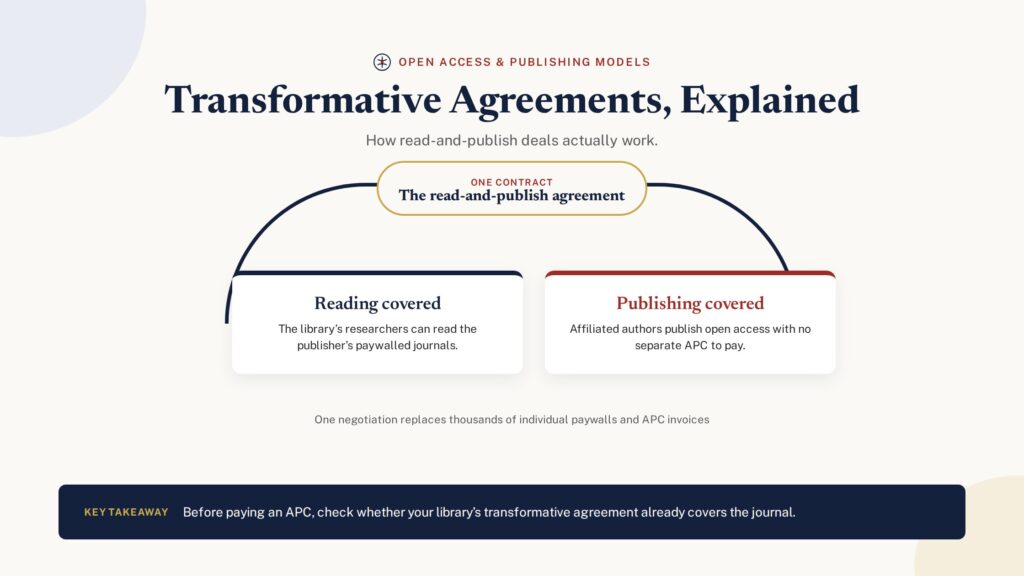
A transformative agreement (also called a read-and-publish deal) is a contract between a research institution or consortium and a publisher that bundles subscription access to paywalled journals with open-access publishing rights for the institution’s authors under one combined fee. It exists as a bridge between the traditional subscription model and full open access.
What is a transformative agreement?
A transformative agreement (TA) replaces two separate costs, a library’s subscription fee and an author’s article processing charge (APC), with one negotiated deal. The institution keeps reading access to the publisher’s paywalled content, while its researchers can publish open access without paying an APC out of pocket.
How do read-and-publish deals actually work?
Most transformative agreements share the same basic mechanics, though the specifics vary by publisher and consortium:
- The institution or a national/regional consortium negotiates one combined fee with the publisher, covering both reading and publishing.
- Corresponding authors affiliated with the institution can publish open access in participating journals with the APC waived or discounted.
- The institution retains subscription-style access to the publisher’s full journal collection.
- Agreements typically run 2 to 4 years and are renegotiated as the balance of reading versus publishing activity shifts.
For authors, the practical effect is simple: if your institution has a transformative agreement with a given publisher, you can often publish open access in that publisher’s journals at no direct cost to you, without applying for a separate APC waiver.
Why is cOAlition S stepping back from transformative agreements?
cOAlition S, the funder coalition behind Plan S, originally supported transformative agreements as a temporary bridge to full open access. However, the coalition announced that its member funders would stop funding publishing through transformative models after December 31, 2024. The reasoning: too many agreements were being renewed indefinitely without publishers actually shifting their underlying business model to open access. cOAlition S has since shifted its emphasis toward funding diamond open access and rights-retention strategies instead.
You can read more on this shift, including publisher responses like Cambridge University Press’s, in Cambridge’s coverage of the Transformative Journals programme.
Which publishers still offer transformative agreements in 2026?
cOAlition S stepping back from funding these deals does not mean transformative agreements disappeared. Many institutional and consortium-level agreements, especially those funded independently of cOAlition S members, continue on their existing multi-year terms. As of 2026, examples include the Association for Computing Machinery (ACM), whose agreements run through 2026 and include unlimited APC waivers plus full access to the ACM Digital Library for participating institutions, and PLOS, which offers a Flat Fee model extending through 2026 for participating libraries.
If you’re unsure whether your institution has an active agreement with a given publisher, check with your library’s scholarly communications office before assuming you need to pay an APC.
Transformative agreements vs. subscriptions vs. full open access
- Traditional subscription: institution pays to read; authors either publish behind the paywall for free or pay a separate APC to make their own article open access.
- Transformative agreement: institution pays one combined fee for reading access and open-access publishing; authors publish open access without a separate APC charge.
- Full open access (gold or diamond OA): no subscription exists at all; journals are open access by default, funded either by APCs (gold) or by institutions and societies directly with no author fee (diamond).
What should researchers and institutions consider going forward?
For authors, the practical guidance hasn’t changed much: check whether your institution has an active agreement with your target publisher before budgeting for an APC. For institutions and librarians, the broader trend is worth watching. With cOAlition S funders no longer backing new transformative deals, the pressure is shifting toward diamond open access models and rights-retention policies as the next phase of the transition.
Frequently asked questions
Is a transformative agreement the same as gold open access?
No. Gold open access means a journal charges an APC per article with no underlying subscription. A transformative agreement bundles subscription access and open-access publishing into a single institutional fee, so individual authors typically don’t see or pay an APC directly.
Do transformative agreements cost institutions more than a standard subscription?
It depends on the institution’s publishing volume. Agreements are usually priced against prior subscription spend and projected article output, so high-output institutions can end up paying more, while lower-output institutions may see savings compared to paying individual APCs.
Will transformative agreements still exist in five years?
Existing multi-year agreements will run their course, but with cOAlition S funders no longer committing new funding to this model after 2024, growth in new transformative agreements is expected to slow, with diamond open access and rights retention increasingly favored as the next step.
Last updated: August 7, 2026.
For related reading, see our guides on open access mandates and funder policies and open access publishing models explained. If you’re weighing where to submit under a transformative agreement, our guide on how to choose the right journal for your research covers the broader decision factors beyond cost.
Even under a transformative agreement, authors sharing their own accepted manuscript outside the deal still need to check one thing: the embargo period. See Journal Embargo Periods Explained for typical windows and how to find yours.