
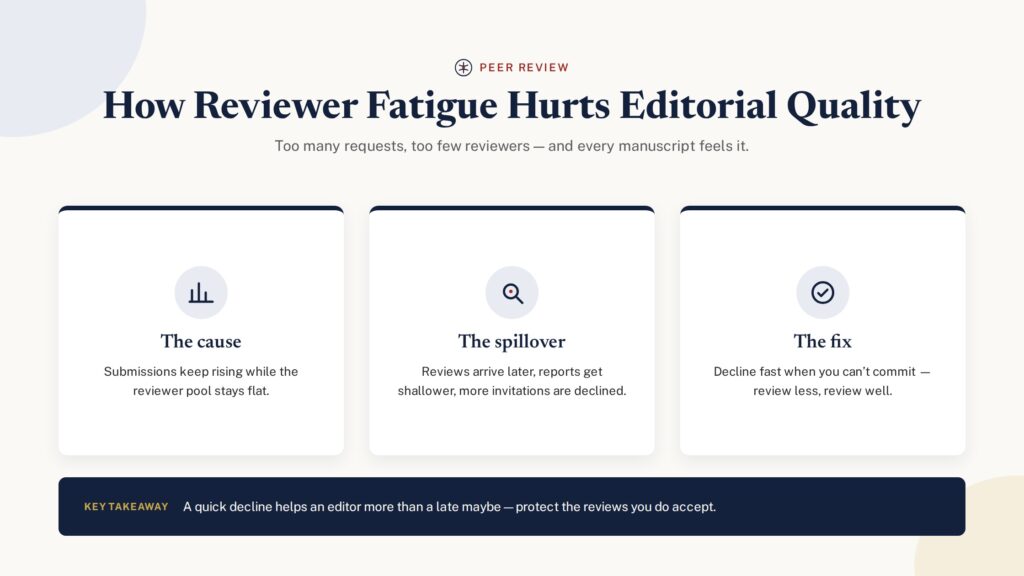
Reviewer Fatigue Spillover in Academic Publishing: How Overburdened Reviewers Affect Editorial Quality
Reading time - 7 minutes
Introduction
Peer review is often described as the backbone of academic publishing, ensuring that research is evaluated for rigor, originality, and credibility before entering the scholarly record. However, as submission volumes continue to rise globally, a less visible but increasingly critical issue is emerging: reviewer fatigue spillover. This phenomenon occurs when overburdened reviewers, stretched across multiple journals and commitments, begin to compromise on the depth, quality, and timeliness of their evaluations—often without intending to do so.
While reviewer fatigue itself has been widely discussed, its spillover effects—how exhaustion in one review assignment influences performance in others—remain underexplored. Understanding this ripple effect is essential for maintaining the integrity and reliability of the peer review system.
The Growing Burden on Reviewers
The academic publishing ecosystem relies heavily on a relatively small pool of active reviewers. As the number of submissions increases, particularly with the rise of interdisciplinary research and global participation, the demand for reviewers has outpaced supply. Many experienced researchers receive frequent review requests, often from multiple journals simultaneously.
This concentration of responsibility leads to cognitive overload. Reviewing is not a passive task—it requires careful reading, critical analysis, methodological evaluation, and constructive feedback. When reviewers are overloaded, the quality of these tasks inevitably declines.
What Is Reviewer Fatigue Spillover?
Reviewer fatigue spillover refers to the cumulative effect of reviewing multiple manuscripts under time pressure, where fatigue from one task negatively influences performance in subsequent reviews. Unlike isolated fatigue, spillover suggests a systemic issue—where the impact extends beyond a single manuscript to affect the broader review ecosystem.
For instance, a reviewer who has spent significant time on a complex manuscript may approach the next assignment with reduced attention, leading to shorter, less detailed feedback. Over time, this pattern can result in inconsistent review quality across journals and disciplines.
Impact on Review Quality
One of the most immediate consequences of fatigue spillover is the decline in review depth. Reviewers may focus only on surface-level issues—grammar, formatting, or obvious methodological flaws—while overlooking deeper concerns such as theoretical coherence or statistical robustness.
Another effect is increased variability in review outcomes. The same reviewer may provide thorough feedback for one manuscript and minimal input for another, depending on their workload and mental state. This inconsistency undermines the fairness and reliability of the peer review process.
Fatigue can also lead to delayed reviews, as overwhelmed reviewers struggle to meet deadlines. These delays slow down the publication process, affecting authors, editors, and the timely dissemination of research.
Editorial Consequences
The spillover effects of reviewer fatigue extend beyond individual reviews to influence editorial decision-making. Editors rely on reviewer reports to make informed judgments about manuscripts. When reviews are incomplete or inconsistent, editors face greater uncertainty.
This can lead to several outcomes:
- Increased reliance on fewer reviewers, further amplifying fatigue
- More frequent requests for additional reviews, delaying decisions
- Greater dependence on editorial judgment, potentially introducing bias
In some cases, editors may accept or reject manuscripts based on limited or uneven feedback, affecting the overall quality of published research.
Hidden Bias and Cognitive Shortcuts
Fatigue does not only reduce effort—it can also alter judgment. Overburdened reviewers may rely more on cognitive shortcuts, such as judging a manuscript based on the reputation of authors, institutions, or journals rather than the content itself.
This increases the risk of implicit bias, where decisions are influenced by factors unrelated to research quality. For example, well-known authors may receive more favorable reviews, while lesser-known researchers face stricter scrutiny.
Such biases are rarely intentional but can become more pronounced under conditions of fatigue, further compromising the fairness of the review process.
Systemic Nature of the Problem
Reviewer fatigue spillover is not an individual failing—it is a systemic issue rooted in the structure of academic publishing. The expectation that peer review is a voluntary, unpaid activity places significant pressure on researchers who must balance reviewing with their own work, teaching, and administrative responsibilities.
Additionally, the lack of coordination between journals means that the same reviewers may be repeatedly approached without awareness of their existing workload. This fragmented system exacerbates fatigue and its spillover effects.
Potential Solutions
Addressing reviewer fatigue spillover requires coordinated efforts from journals, publishers, and the academic community.
One approach is better workload distribution. Journals can expand their reviewer pools by including early-career researchers and underrepresented groups, reducing the burden on a small set of individuals.
Another solution is reviewer tracking systems that monitor how frequently individuals are invited to review. By sharing data across publishers, it may be possible to prevent overloading the same reviewers repeatedly.
Flexible deadlines and realistic expectations can also help. Allowing reviewers more time to complete assignments may improve the quality of feedback and reduce stress.
Incentivization is another avenue. Recognizing and rewarding reviewers—through formal acknowledgment, certification, or career incentives—can improve engagement and motivation.
Finally, editorial triage plays a crucial role. By filtering out unsuitable manuscripts early, editors can reduce the number of papers sent for full review, easing the overall burden on reviewers.
The Role of Technology
Technology can support these efforts by streamlining workflows and identifying potential overload. Automated systems can flag when a reviewer has received multiple requests within a short period or suggest alternative reviewers based on expertise and availability.
However, technology should complement—not replace—human judgment. The goal is to support reviewers, not to accelerate the process at the expense of quality.
Rethinking Sustainability in Peer Review
Reviewer fatigue spillover highlights a broader challenge: the sustainability of the peer review system. As academic publishing continues to grow, relying on the same model without adaptation risks diminishing the quality and credibility of scholarly evaluation.
A more sustainable approach requires recognizing peer review as a critical component of research infrastructure—one that demands proper support, coordination, and acknowledgment.
Conclusion
Reviewer fatigue spillover is a subtle but significant threat to the integrity of academic publishing. By affecting the consistency, depth, and fairness of peer review, it undermines the very system designed to uphold research quality.
Addressing this issue requires systemic change—better workload management, improved coordination, and a cultural shift in how peer review is valued. Only by acknowledging and addressing the spillover effects of fatigue can the academic community ensure that peer review remains a robust and reliable foundation for scholarly communication.