
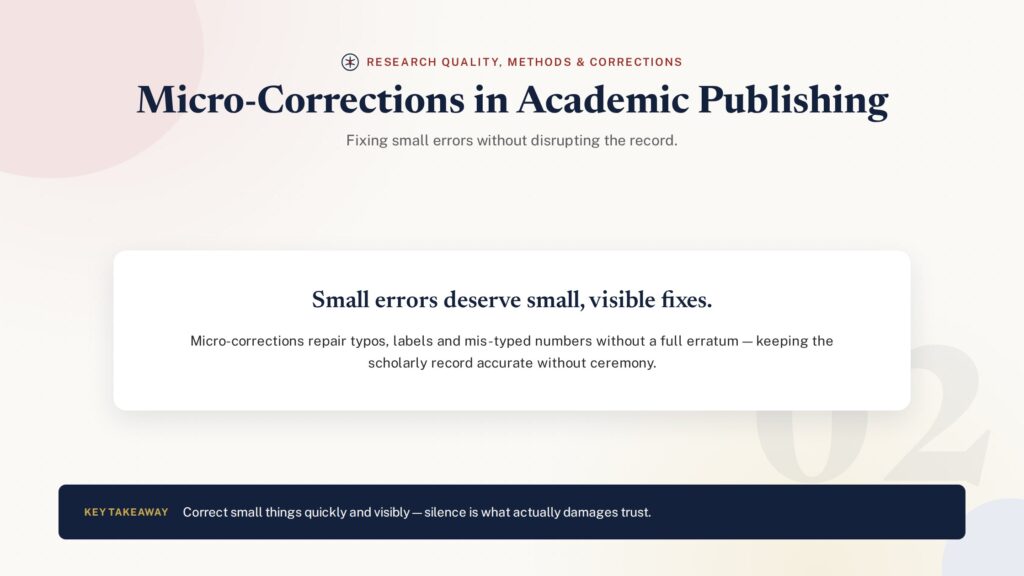
Micro-Corrections in Academic Publishing: Addressing Minor Errors Without Disrupting the Scholarly Record
Reading time - 7 minutes
Introduction
In academic publishing, the conversation around corrections is often dominated by major actions such as retractions, corrigenda, or expressions of concern. However, a significant portion of published research contains smaller, non-critical errors—minor inconsistencies, typographical slips, formatting issues, or slight data misalignments—that do not alter the overall conclusions of a study. These are increasingly being addressed through what can be termed micro-corrections: small, precise updates designed to improve accuracy without triggering formal correction mechanisms.
While these corrections may seem trivial, their growing prevalence highlights an important shift in how the academic community manages the integrity and usability of the scholarly record.
Understanding Micro-Corrections
Micro-corrections refer to subtle, targeted fixes made to a published article that do not require a full correction notice. These may include correcting a mislabeled axis in a figure, adjusting a minor numerical value that does not affect statistical significance, or fixing inconsistencies between the main text and supplementary material.
Unlike major corrections, micro-corrections are often integrated directly into the article, sometimes with minimal visibility. Their purpose is not to signal a flaw in the research but to refine the presentation and eliminate minor sources of confusion.
In a digital publishing environment, where articles can be updated more easily than in print, micro-corrections offer a practical way to maintain accuracy over time.
Why Micro-Corrections Matter
At first glance, small errors may appear inconsequential. However, their cumulative impact can be significant. Even minor inconsistencies can create confusion for readers, complicate replication efforts, or introduce friction in downstream research such as meta-analyses.
For example, a small discrepancy between a table and the text might not change the study’s conclusions, but it can raise doubts about data reliability. Similarly, a mislabeled figure could lead to misinterpretation, especially for readers who rely heavily on visual summaries.
By addressing these issues promptly, micro-corrections enhance the clarity and usability of research without escalating the situation into a formal correction process.
The Efficiency Advantage
One of the key benefits of micro-corrections is efficiency. Formal correction notices require editorial review, documentation, and publication workflows that can be time-consuming. Applying the same process to every minor error would place an unnecessary burden on journals and delay the correction of issues that could be resolved quickly.
Micro-corrections allow editors and publishers to act swiftly. Instead of waiting for a formal notice to be processed, small fixes can be implemented in near real-time, ensuring that readers encounter the most accurate version of the article.
This is particularly valuable in high-impact or frequently accessed papers, where even minor errors can affect a large audience.
Risks of Low Visibility
Despite their advantages, micro-corrections raise concerns about visibility and transparency. When changes are made without clear indication, readers may be unaware that an article has been updated. This can create challenges for citation consistency and reproducibility.
For instance, a researcher who accessed an earlier version of an article may base their work on information that has since been corrected. Without a visible record of changes, it becomes difficult to reconcile differences between versions.
This issue is especially relevant in collaborative and cumulative research environments, where even small discrepancies can propagate through multiple studies.
Defining Boundaries
A critical challenge in implementing micro-correction practices is defining their scope. Not all errors are suitable for this approach. The key distinction lies in whether the error affects the interpretation, validity, or reproducibility of the research.
Micro-corrections are generally appropriate for:
- Typographical and grammatical errors
- Formatting inconsistencies
- Minor data mismatches that do not affect conclusions
- Non-critical figure or labeling issues
However, errors that influence results, alter interpretations, or impact methodological transparency should always be addressed through formal correction mechanisms.
The difficulty lies in borderline cases. A seemingly minor numerical adjustment may have downstream implications in certain contexts, making it essential for editors to exercise careful judgment.
Best Practices for Responsible Use
To ensure that micro-corrections enhance rather than undermine trust, publishers must adopt clear and consistent practices.
One important step is transparent change tracking. Even if a formal correction notice is not issued, journals should maintain an accessible record of all updates, including timestamps and descriptions of changes. This allows readers to track the evolution of an article without disrupting the reading experience.
Another approach is in-article indicators, such as subtle notes or icons signaling that a section has been updated. These markers provide visibility without overwhelming readers with formal notices.
Author involvement is also crucial. Authors should be notified of proposed micro-corrections and, where appropriate, approve changes to ensure accuracy and accountability.
Finally, journals should establish clear editorial guidelines outlining what qualifies as a micro-correction and how such updates are managed. Consistency in policy helps prevent misuse and builds confidence among authors and readers.
The Role of Technology
Digital publishing platforms play a central role in enabling effective micro-correction systems. Features such as version control, automated change logs, and update notifications can support transparent and efficient correction workflows.
Some platforms are beginning to integrate these capabilities directly into the article interface, allowing readers to view previous versions or highlight changes. Such tools bridge the gap between static publishing models and the dynamic nature of digital research communication.
As these technologies evolve, they will likely make micro-corrections more standardized and widely accepted.
A Complement, Not a Replacement
It is important to view micro-corrections as a complement to, not a replacement for, formal correction mechanisms. While they are well-suited for minor issues, they should never be used to obscure or downplay more significant problems.
Maintaining this boundary is essential for preserving the credibility of academic publishing. When used appropriately, micro-corrections can enhance the precision and readability of research without compromising transparency.
Conclusion
Micro-corrections represent a nuanced approach to maintaining the accuracy of the scholarly record in a digital age. By addressing minor errors quickly and efficiently, they improve the overall quality of published research.
However, their success depends on careful implementation. Transparency, clear guidelines, and robust tracking systems are essential to ensure that even the smallest updates are visible and accountable.
As academic publishing continues to evolve, micro-corrections offer a practical solution to an often-overlooked challenge: how to keep research accurate without overcomplicating the correction process.
Related Posts:
- Breaking Down the "Preprint Hierarchy": Can Anyone Become a…
- Shadow Retractions in Academic Publishing: When Problematic…
- Invisible Edits in Academic Publishing: Balancing Accuracy and…
- Corrections, Errata, and Retractions: What's the Difference
- Retraction Stigma and Researcher Rehabilitation in Academic…