Research Quality, Methods & Corrections

Research methodology, reproducibility, corrections and retractions.

Corrections, Errata, and Retractions: What’s the Difference
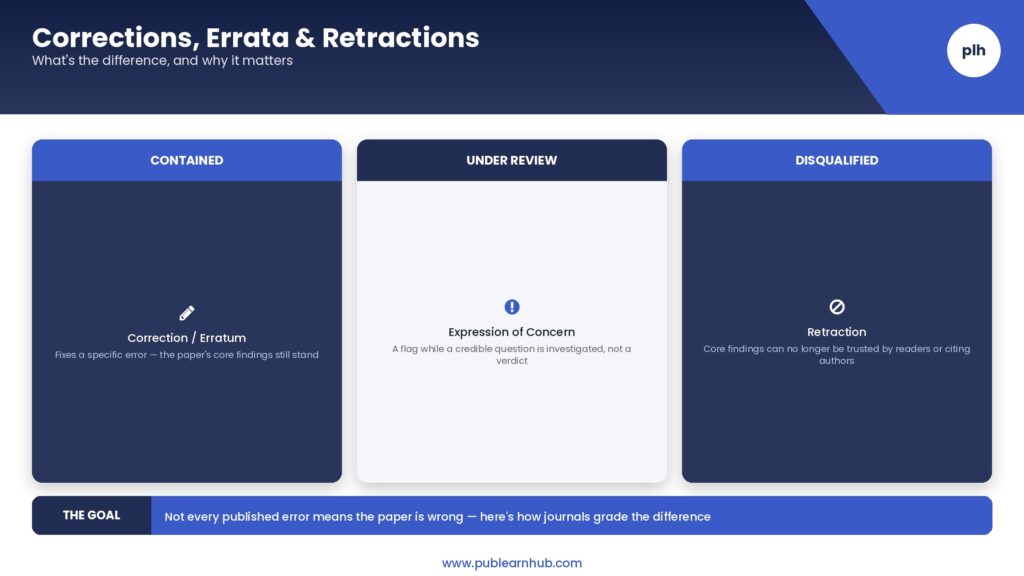
Infographic explaining corrections and retractions in research papers, showing three levels of severity: correction or erratum, expression of concern, and retraction.

Corrections and retractions are how the scientific record fixes itself after publication. A published paper isn’t necessarily a finished paper. Errors surface after publication more often than most readers realize, and journals have a specific, graded set of tools for handling them. The trouble is the terminology gets used loosely — “correction,” “erratum,” and “retraction” […]

Corrections, Errata, and Retractions: What’s the Difference Read More »
Micro-Corrections in Academic Publishing: Addressing Minor Errors Without Disrupting the Scholarly Record

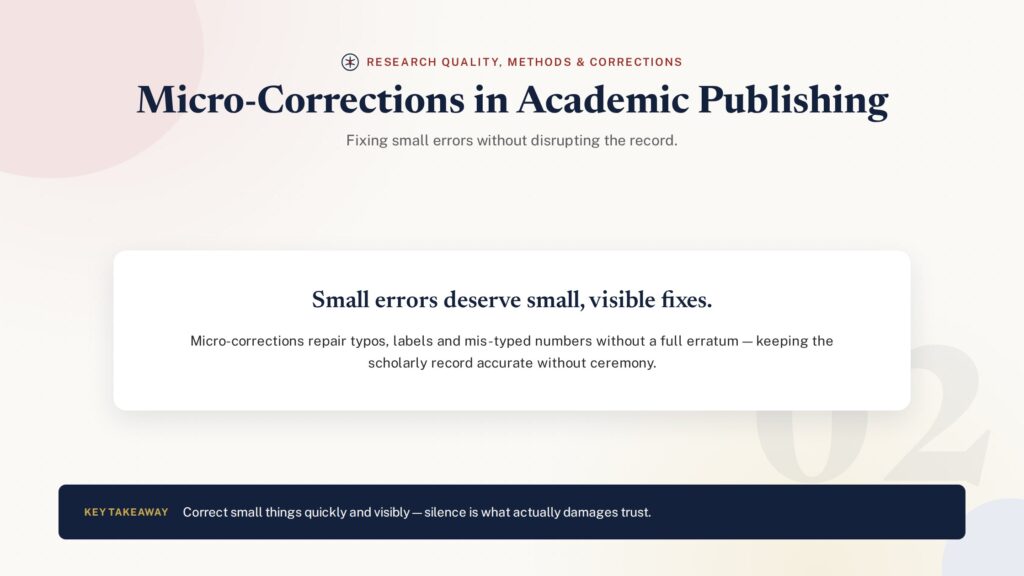
Micro-corrections in scholarly publishing title card - PublearnHub infographic

Micro-Corrections in Academic Publishing: Addressing Minor Errors Without Disrupting the Scholarly Record Reading time – 7 minutes Introduction In academic publishing, the conversation around corrections is often dominated by major actions such as retractions, corrigenda, or expressions of concern. However, a significant portion of published research contains smaller, non-critical errors—minor inconsistencies, typographical slips, formatting issues,

Micro-Corrections in Academic Publishing: Addressing Minor Errors Without Disrupting the Scholarly Record Read More »

Research Redundancy Detection in Academic Publishing: Identifying Overlap Without Stifling Innovation

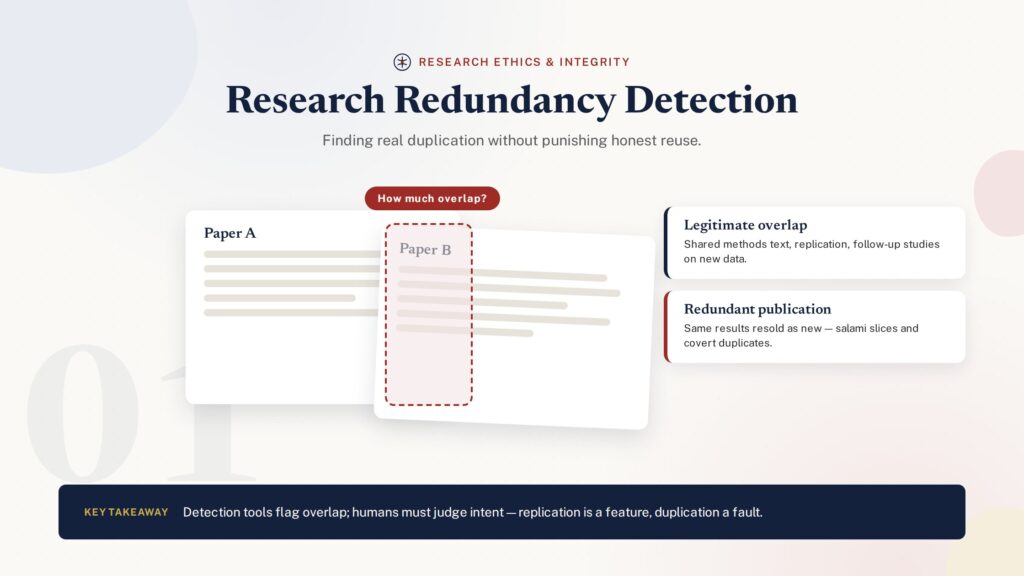
Two overlapping papers illustrating research redundancy detection - PublearnHub infographic

Research Redundancy Detection in Academic Publishing: Identifying Overlap Without Stifling Innovation Reading time – 7 minutes Introduction As the volume of academic publications continues to grow exponentially, one increasingly important challenge for journals and editors is managing research redundancy. While replication and validation are essential components of scientific progress, excessive or unintentional overlap between studies

Research Redundancy Detection in Academic Publishing: Identifying Overlap Without Stifling Innovation Read More »

Temporal Relevance in Academic Publishing: Managing the Shelf Life of Research Findings

Digital Archives and Their Importance in Academic Research

Temporal Relevance in Academic Publishing: Managing the Shelf Life of Research Findings Reading time – 7 minutes Introduction Academic publishing has traditionally treated research as timeless—once a paper is published, it becomes part of the permanent scholarly record. However, in reality, not all research remains equally relevant over time. Some findings age quickly due to

Temporal Relevance in Academic Publishing: Managing the Shelf Life of Research Findings Read More »

Shadow Retractions in Academic Publishing: When Problematic Research Remains Uncorrected

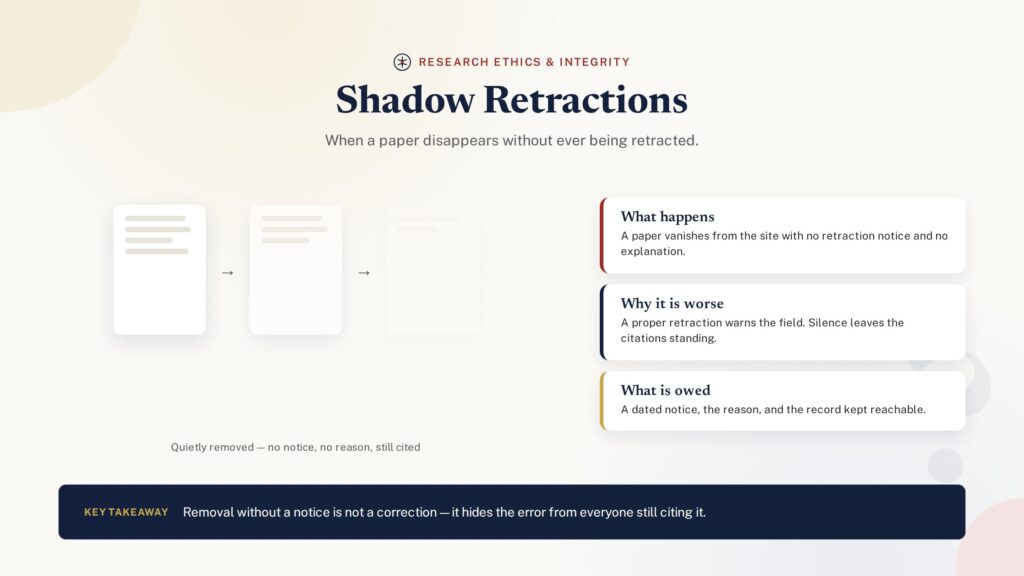
Illustration of a fading document representing shadow retractions of problematic research

Shadow Retractions in Academic Publishing: When Problematic Research Remains Uncorrected Reading time – 7 minutes Introduction Retractions are often seen as the ultimate mechanism for correcting the academic record. When a study is found to be flawed, fraudulent, or ethically compromised, a formal retraction signals to the scholarly community that its findings should no longer

Shadow Retractions in Academic Publishing: When Problematic Research Remains Uncorrected Read More »

Scholarly Publishing in Crisis Situations: Rapid Response Models for Emergencies, Disasters, and Global Health Threats

Digital Archives and Their Importance in Academic Research

Scholarly Publishing in Crisis Situations: Rapid Response Models for Emergencies, Disasters, and Global Health Threats Reading time – 7 minutes Introduction Academic publishing is typically designed for deliberation, rigor, and careful review. Yet crises—whether global pandemics, natural disasters, geopolitical conflicts, or climate-related emergencies—demand speed alongside reliability. When urgent decisions depend on emerging evidence, the traditional

Scholarly Publishing in Crisis Situations: Rapid Response Models for Emergencies, Disasters, and Global Health Threats Read More »

Registered Replication Reports in Academic Publishing: Strengthening Evidence Through Coordinated, Multi-Site Verification

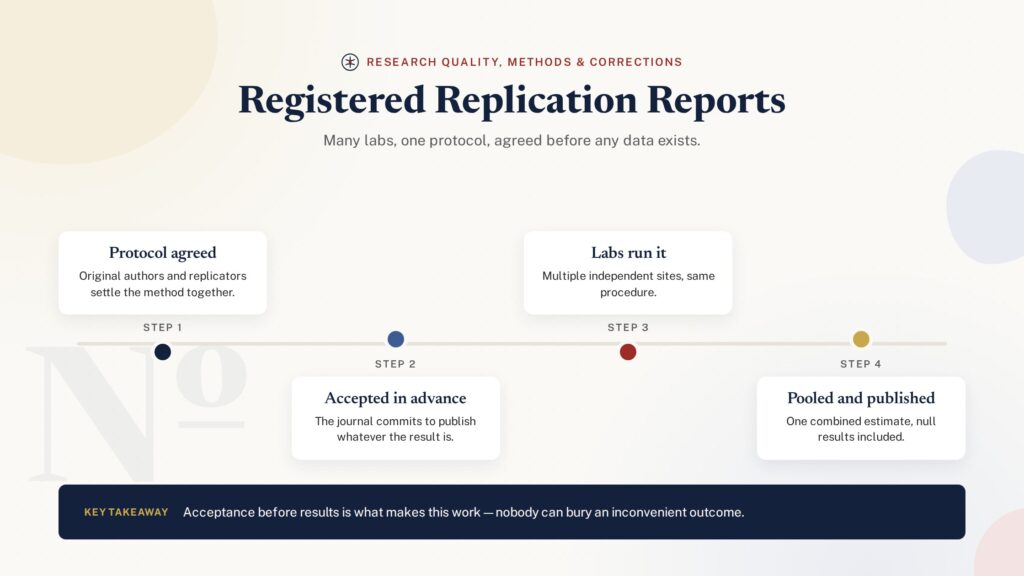
Timeline illustration of multi-site registered replication reports

Registered Replication Reports in Academic Publishing: Strengthening Evidence Through Coordinated, Multi-Site Verification Reading time – 7 minutes Introduction Concerns about reproducibility have reshaped conversations across scholarly disciplines. While individual replication studies and registered reports have gained traction, a more coordinated and powerful model is emerging: Registered Replication Reports (RRRs). By combining pre-registered protocols with multi-site

Registered Replication Reports in Academic Publishing: Strengthening Evidence Through Coordinated, Multi-Site Verification Read More »

Article-Level Quality Badges in Academic Publishing: Signaling Rigor Beyond Journal Prestige

Digital Archives and Their Importance in Academic Research

Article-Level Quality Badges in Academic Publishing: Signaling Rigor Beyond Journal Prestige Reading time – 7 minutes Introduction For decades, journal reputation has acted as a proxy for research quality. High-impact titles have been perceived as markers of rigor, while lesser-known journals often struggle for recognition—even when publishing robust scholarship. However, as academic publishing evolves toward

Article-Level Quality Badges in Academic Publishing: Signaling Rigor Beyond Journal Prestige Read More »

The Role of Lay Summaries in Academic Publishing: Making Research Accessible Beyond Academia

Digital Archives and Their Importance in Academic Research

The Role of Lay Summaries in Academic Publishing: Making Research Accessible Beyond Academia Reading time – 7 minutes Introduction Academic publishing has traditionally been written by experts for experts. Journal articles are dense, technical, and often inaccessible to readers outside a specific discipline. While this level of specialization ensures precision and rigor, it also creates

The Role of Lay Summaries in Academic Publishing: Making Research Accessible Beyond Academia Read More »

The Rise of Living Systematic Reviews: Keeping Evidence Syntheses Continuously Updated

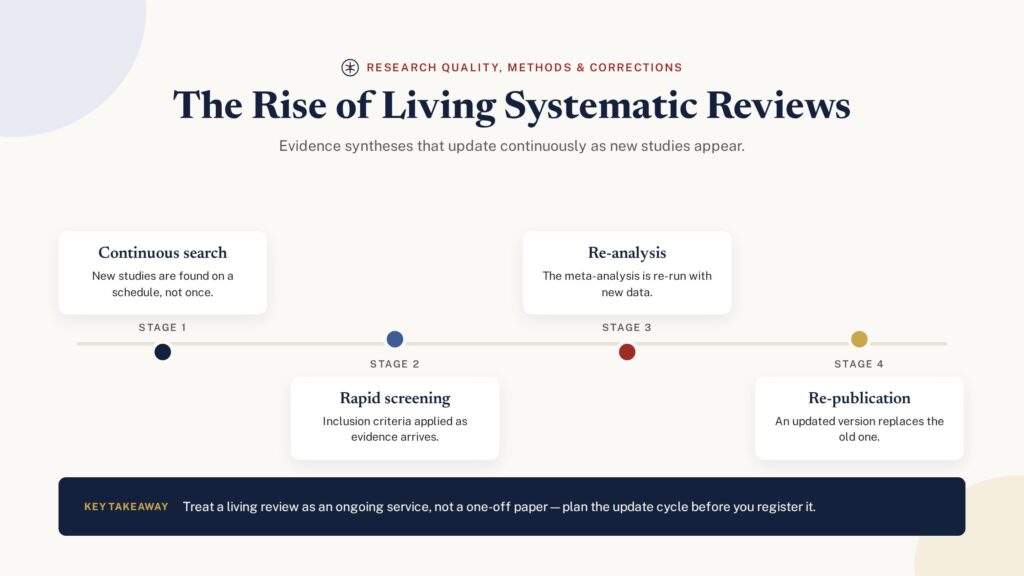
Living systematic review cycle: continuous search, rapid screening, re-analysis, re-publication

The Rise of Living Systematic Reviews: Keeping Evidence Syntheses Continuously Updated Reading time – 7 minutes Introduction Systematic reviews have long been considered one of the highest forms of evidence in academic research. By rigorously synthesizing findings from multiple studies, they help inform clinical guidelines, policy decisions, and future research directions. However, traditional systematic reviews

The Rise of Living Systematic Reviews: Keeping Evidence Syntheses Continuously Updated Read More »