
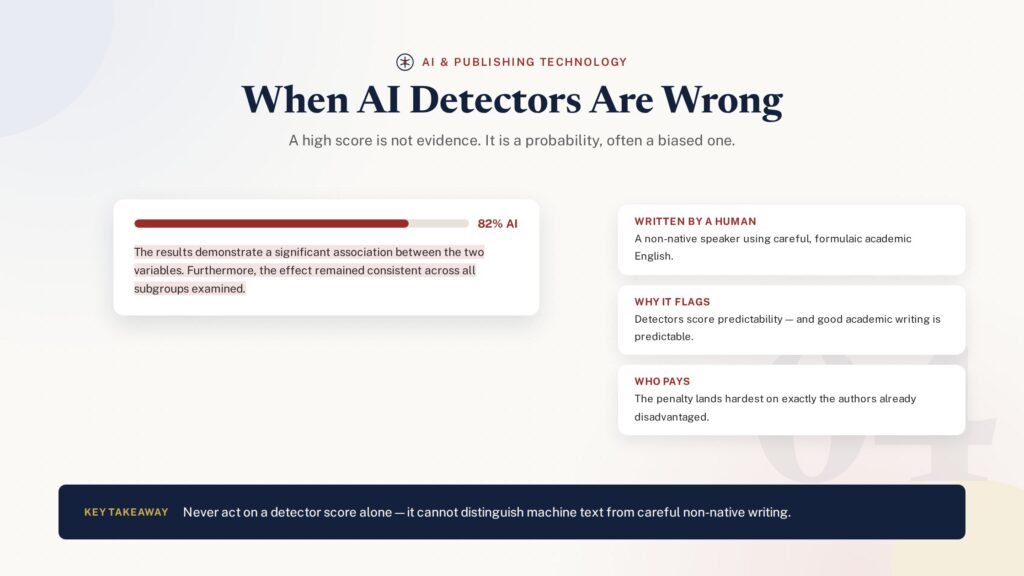
A high similarity score from a plagiarism checker feels like an accusation, but it isn’t proof of anything on its own. AI-driven plagiarism detectors compare text against enormous databases of prior publications, and they routinely flag passages that are not plagiarism at all. Understanding why false positives happen — and how to respond when your own paper gets flagged — matters more as more journals run automated checks before a human ever reads the manuscript.
What Actually Triggers a False Positive
- Standard methods language. Phrases like “informed consent was obtained from all participants” or “data were analyzed using a two-tailed t-test” appear near-identically across thousands of papers because there’s only one correct way to describe a standard procedure.
- Properly quoted and cited material. Some tools flag direct quotations even when they’re correctly attributed, because the matching algorithm doesn’t always parse citation context.
- Your own previously published work. If you’re citing or building on your own prior paper, the tool can flag it as a match without distinguishing legitimate self-citation from unattributed reuse.
- Common academic phrasing and field-specific terminology. Discipline-standard phrases and boilerplate (ethics statements, funding acknowledgments) recur across the literature by necessity, not by copying.
Why This Matters More With AI-Era Detection
Modern detectors increasingly use semantic similarity models rather than pure string matching, which catches paraphrased plagiarism more effectively — but it also broadens what counts as a “match,” since two authors describing the same statistical test in similar words can trigger a flag even with zero actual overlap in original wording.
How to Respond to a False Flag
- Read the actual similarity report, not just the score. A 25% score sounds alarming until you see it’s entirely methods boilerplate and correctly quoted material.
- Annotate each flagged passage. Note whether it’s a properly cited quote, standard terminology, or your own prior work, and be ready to explain this to an editor.
- Reply to the editor directly and specifically, rather than disputing the tool’s score in the abstract — editors expect and regularly receive these clarifications.
- Revise genuinely unoriginal passages anyway, even if the match is technically defensible, since reviewers may raise the same concern independently.
Common Mistake: Treating the Similarity Score as a Verdict
The single most common misunderstanding is assuming any similarity score above a threshold (commonly cited as 15–20%) automatically means misconduct. Editors and integrity offices are trained to read the underlying report, not just the number — the score is a screening signal, not a determination.
Frequently Asked Questions
What similarity percentage is considered “too high”?
There’s no universal cutoff; most editors use ~15–20% as a threshold to trigger a manual review, not an automatic rejection.
Can properly cited quotes still get flagged?
Yes — many tools flag text matches regardless of citation, leaving it to a human reviewer to confirm proper attribution.
Does self-citation count against my similarity score?
It can, since detectors typically don’t distinguish self-citation from third-party overlap automatically.
Should I dispute a flag if I know it’s a false positive?
Yes — respond to the editor with specific context for each flagged passage rather than staying silent.