
Generative AI tools have quietly become part of how a lot of papers get written, and journals have spent the last two years scrambling to catch up. Most now have some kind of AI disclosure policy, but the rules are inconsistent enough that authors are often left guessing whether a specific use — light copyediting, a literature summary, a generated figure — actually needs to be disclosed at all.
What counts as “using AI”
Not every AI-assisted step carries the same disclosure weight. Grammar and phrasing tools that polish sentences you already wrote are generally treated like spell-check — no disclosure expected, most journals agree. Where it gets murkier: asking a chatbot to draft a paragraph or section from scratch, having it summarize related literature, using it to generate or clean up code for an analysis, or producing figures and images with an AI tool. Each of these has a real chance of introducing errors, fabricated citations, or content the authors didn’t fully verify, which is exactly why journals want to know about them.
Why journals care
Two separate concerns sit behind these policies. The first is authorship integrity — AI tools cannot be listed as authors because authorship requires accountability for the work, and a chatbot can’t take responsibility for anything. The second is accuracy: generative tools are known to fabricate citations, misstate findings, and produce plausible-sounding but wrong technical content, so disclosure exists partly to flag where a human needs to have specifically double-checked the output.
What the major bodies actually say
The ICMJE (International Committee of Medical Journal Editors) requires that AI-assisted content be disclosed, typically in the methods section or acknowledgments, and explicitly states AI tools cannot be credited as authors. COPE (Committee on Publication Ethics) takes a similar position: authors remain fully responsible for accuracy, originality, and avoiding plagiarism regardless of what tools they used along the way. Most major publishers have since built AI-use questions directly into their submission systems, so the disclosure step is becoming a default checkbox rather than something authors have to remember unprompted.
How to actually write the disclosure
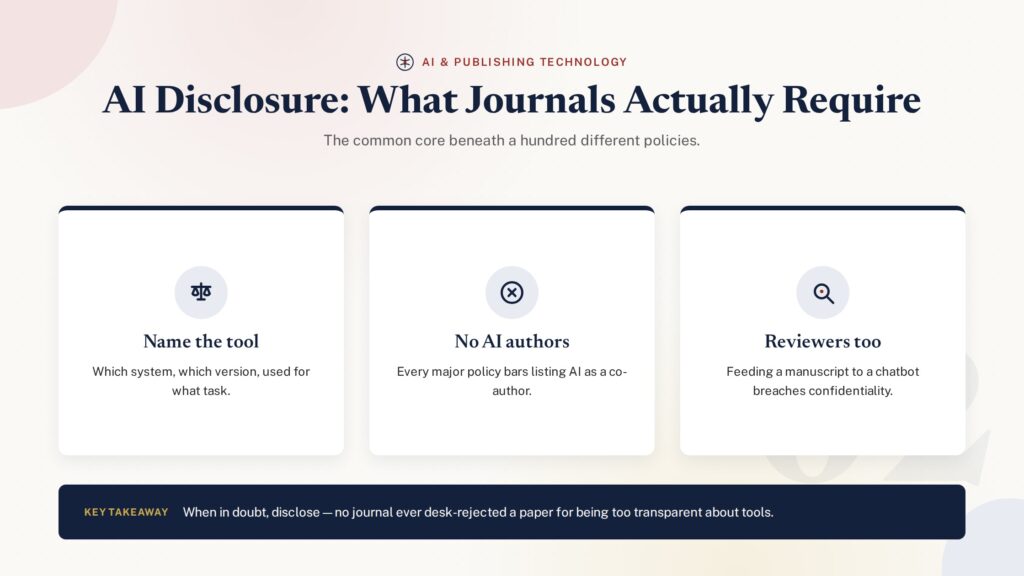
A useful disclosure statement names the specific tool and, where relevant, its version, states plainly what it was used for, and confirms a human author reviewed and verified the output. Something like: “The authors used [tool name] to assist with drafting the literature summary in Section 2. All content was reviewed, fact-checked, and edited by the authors, who take full responsibility for its accuracy.” Vague statements like “AI tools were used in this manuscript” tend to draw follow-up questions from editors precisely because they don’t say what was actually done.
What happens if you skip it
Consequences track the severity of what wasn’t disclosed. If an editor notices AI-typical phrasing or a citation that doesn’t check out during review, the most common outcome is simply being asked to add a disclosure statement and re-verify the flagged content before acceptance. Where the omission surfaces after publication — usually through a fabricated reference or clearly hallucinated content — journals can issue a correction, and in more serious cases, a retraction. As with other integrity issues, undisclosed AI use that’s later discovered is a permanent mark on the paper’s record, not something that quietly resolves itself.
The gray areas
A few situations still don’t have universal answers. Using AI purely for translation of your own already-written text is treated leniently by most journals, closer to a language tool than a content-generation one. Using AI to brainstorm a study design or suggest analysis approaches — without generating any manuscript text directly — sits in a genuinely unsettled space; when in doubt, disclosing costs little and avoids any later dispute.
Frequently asked questions
Can I use ChatGPT to help write my paper?
Yes, at most journals, as long as you disclose it, verify everything it produced, and don’t list the tool as an author. The paper’s accuracy remains entirely the authors’ responsibility.
Does using AI just for a literature search need disclosure?
Increasingly, yes, especially if the tool summarized or synthesized sources rather than just helping you locate them — verify every citation it surfaces, since fabricated references are a well-documented failure mode.
Can an AI tool ever be listed as a co-author?
No. Every major publishing body — ICMJE, COPE, and essentially all large publishers — explicitly excludes AI tools from authorship, since authorship requires accountability that a tool cannot hold.
Last updated: August 16, 2026.
For related reading, see our guide on AI journal matching tools. If you’re weighing how authorship responsibilities apply once a paper is drafted, our corresponding author responsibilities breakdown covers what comes next, and our peer review timeline explains what happens once you submit.
AI tools are also reshaping how originality itself gets checked before publication — and the checks aren’t always right. See When AI Plagiarism Detectors Get It Wrong for what actually triggers a false flag.