
Academic publishing has a phrase for it that sounds almost affectionate: salami slicing. It’s the practice of carving one study, one dataset, or one set of findings into the thinnest possible set of “publishable units” instead of writing it up as a single coherent paper. Done carelessly or deliberately, it can inflate a CV, waste reviewer time, and in its worst form, cross the line into research misconduct.
What salami slicing actually is
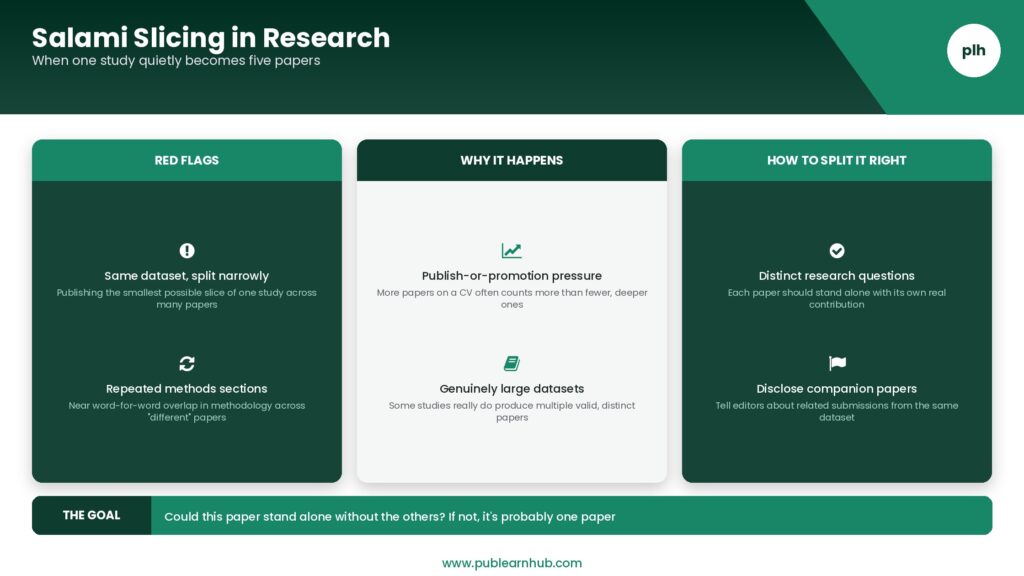
At its core, salami slicing means publishing results that could have been reported in one paper as two, three, or more separate ones, each contributing little beyond what a single, more complete paper would have said. The telltale signs are narrow, incremental papers drawn from the same dataset, methods sections that read nearly identically across “different” studies, and findings that only make full sense when read alongside the other slices.
It’s distinct from legitimate multi-paper research, where a large study genuinely produces several independent, substantive contributions — different research questions, different analyses, different audiences. The difference is whether each paper can stand on its own as a meaningful contribution, or whether it only exists to pad a publication count.
Why it happens
Most cases aren’t cynical fraud — they’re the product of incentives that reward paper count over paper depth. Grant renewals, tenure committees, and promotion reviews often count publications more readily than they weigh their individual substance, which quietly nudges researchers toward splitting work that would have been stronger combined. Some of it is more innocent: large, complex studies genuinely do produce enough distinct material for multiple real papers, and the line between “several real papers” and “one paper wearing several disguises” isn’t always obvious in the moment.
Time pressure plays a role too. A single comprehensive paper takes longer to write, review, and place than several smaller ones, and in fields where speed is rewarded, the smaller-and-faster option is tempting even without any intent to game the system.
Where the line actually sits
There’s no universal word-count or paper-count rule. What editors and ethics bodies (like COPE, the Committee on Publication Ethics) look at instead is substance: does each paper ask a genuinely different question, use a meaningfully different analysis, or serve a distinct readership? A paper reporting a trial’s primary outcome and a separate paper reporting a pre-registered secondary outcome on a different population can both be legitimate. Two papers that report the same outcome on the same population with cosmetically different framing usually aren’t.
Overlapping data isn’t automatically disqualifying — it’s expected in programmatic research. What matters is transparency: legitimate multi-paper studies disclose the connection, cite the companion papers, and don’t present overlapping results as if they were independent confirmations of a finding.
How journals and editors catch it
Editors increasingly cross-check submissions against a researcher’s other recent output, and plagiarism-screening tools that compare methods sections across a corpus of published work make near-identical boilerplate easy to spot. Reviewers familiar with a subfield also tend to recognize when they’re reading the third or fourth paper drawn from what’s obviously the same underlying dataset. Journals participating in COPE guidelines are expected to ask authors directly about related submissions and prior publications from the same study during the submission process.
What happens if you’re caught
Consequences scale with intent and severity. At the mild end, an editor might ask you to merge submissions or cite the related paper more prominently. At the serious end — especially where data or results were duplicated without disclosure — journals can retract the paper, and institutions can treat it as a research integrity violation with consequences for grants, promotion cases, and reputation. Retractions tied to salami slicing or duplicate publication are searchable and permanent; they don’t quietly disappear from a CV or a Google Scholar profile.
How to split a study legitimately
If a project genuinely supports multiple papers, a few habits keep it clean. Define each paper’s research question before you start drafting, not after, so the split is driven by science rather than by publication strategy. Disclose related and in-preparation manuscripts to editors during submission — most journals ask for this directly, and volunteering it before being asked reads far better than having it discovered. Cite the companion papers explicitly rather than letting readers infer the connection, and make sure each paper’s methods section is written for that paper’s specific analysis rather than copy-pasted from a sibling manuscript.
Frequently asked questions
Is it salami slicing if I publish a conference paper and then a fuller journal version later?
Not usually, as long as it’s disclosed and the journal version adds substantial new material — this is a well-established, accepted practice in many fields (particularly computer science), not a violation, provided you tell the journal about the earlier version.
Can co-authors get in trouble for a paper they didn’t realize was salami-sliced?
Yes, in principle — authorship carries responsibility for the integrity of the work, which is part of why it’s worth asking directly whether a paper you’re joining overlaps significantly with other work from the same team.
Does salami slicing ever get flagged automatically?
Increasingly, yes. Plagiarism and text-similarity tools that scan methods sections across an author’s publication history can surface near-duplicate language even when no one manually cross-checks it.
Last updated: August 15, 2026.
For related reading, see our guides on self-citation thresholds in academic publishing and corresponding author responsibilities. If you’re navigating peer review timelines for a paper split from a larger study, our peer review timeline breakdown covers what to expect at each stage.
Salami slicing fragments findings across papers; a closely related issue is reusing the same written passages — not just findings — across papers without disclosure. See Text Recycling: When Reusing Your Own Words Counts as Self-Plagiarism for what’s acceptable and what isn’t.