
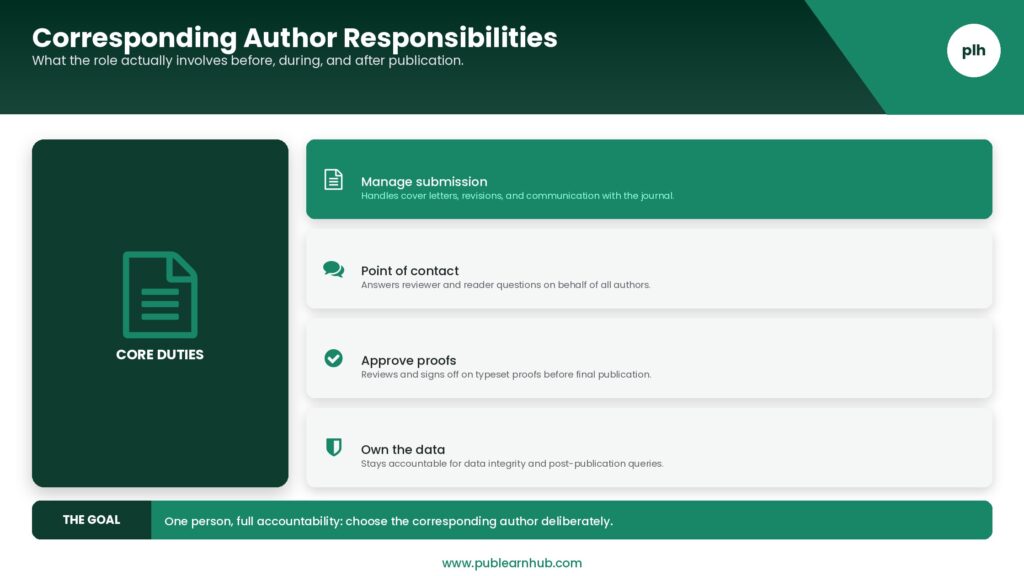
The corresponding author is the single point of contact between a journal and every co-author on a paper, responsible for submission, revisions, proof approval, and post-publication accountability. It’s an administrative and ethical role, not just a formality, and confusion about who holds it causes real problems during review and after publication.
What does a corresponding author actually do?
The corresponding author manages every interaction with the journal on behalf of the author team. That includes submitting the manuscript, responding to editor queries, uploading revised files, and communicating decisions back to co-authors. Journals list one corresponding author (occasionally two) specifically so there’s no ambiguity about who to contact.
Core responsibilities before and during review
- Submitting the manuscript and all required files through the journal’s system.
- Confirming that every listed author has approved the submitted version.
- Responding to editor queries about formatting, ethics forms, or missing information.
- Coordinating the response to peer reviewer comments across co-authors.
- Uploading revised manuscripts and the point-by-point response letter.
What changes after acceptance
Once a paper is accepted, the corresponding author’s job doesn’t end, it shifts. They typically review and approve the typeset proof, handle any last corrections to author names or affiliations, and serve as the contact listed on the published article itself. Readers, editors, and future collaborators will reach out to this person first, sometimes years after publication.
Accountability for data and materials
Many journals also expect the corresponding author to be the primary contact for data-sharing requests, code availability questions, and material transfer inquiries after publication. If a reader wants access to underlying data or has a question about methodology years later, the corresponding author is usually who gets that email.
Who should be the corresponding author?
There’s no universal rule, but the role typically goes to whoever is best positioned to answer questions about the work long-term. That’s often the senior researcher or lab lead, but it can also be a graduate student or postdoc who did the bulk of the work, provided they’ll remain reachable. What matters most is agreeing on this before submission, not defaulting to it by accident.
Common mistakes research teams make
- Naming a corresponding author who is about to leave the institution or change email addresses.
- Assuming the role automatically without discussing it among co-authors.
- Failing to loop in co-authors on revision decisions made under deadline pressure.
- Not updating the corresponding author’s contact details after publication.
Frequently asked questions
Can there be more than one corresponding author?
Yes. Many journals now allow co-corresponding authors, often used when two research groups contributed equally or when a lead author wants a long-term contact who will remain reachable after they move institutions.
Does the corresponding author get more credit than co-authors?
No. Corresponding authorship is an administrative and contact role, not a measure of contribution. Authorship order and contribution statements, not the corresponding designation, are what reflect who did the work.
What happens if the corresponding author becomes unreachable?
Most journals allow authors to request a change of corresponding author after publication, usually by contacting the editorial office directly. It’s worth doing proactively if the original contact changes institutions or email addresses.
Last updated: August 8, 2026.
For related reading, see our guides on author contribution statements and credit taxonomy and managing multi-author research papers. If you’re deciding where corresponding authorship fits into your submission checklist, our guide on how to write an effective cover letter covers the other submission-stage details editors expect.