
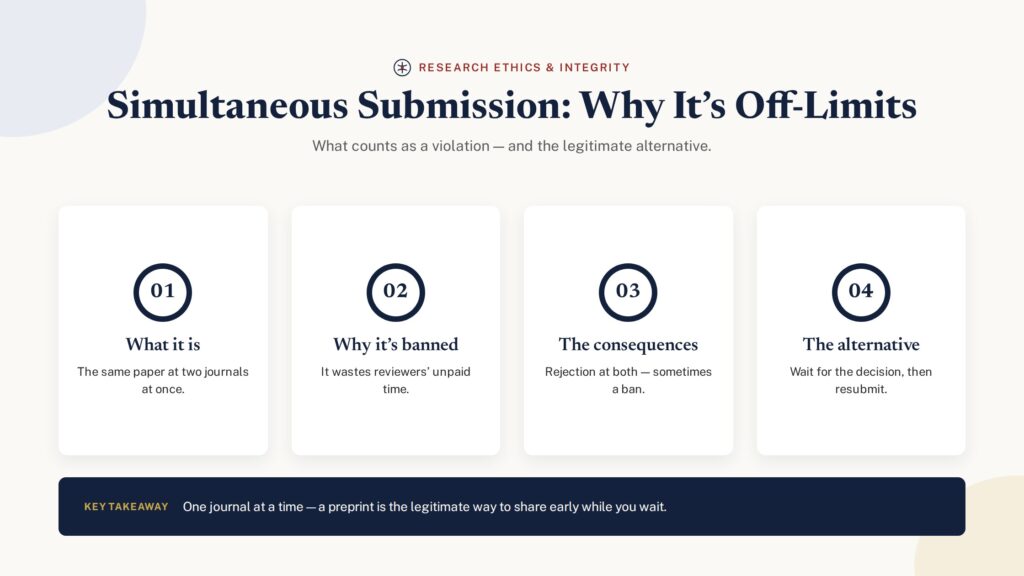
Waiting three months for a single journal decision feels painful enough — waiting three months twice, sequentially, for two separate journals can feel unbearable. So it’s tempting to send the same manuscript to two journals at once and let whichever one answers first win. Nearly every academic publisher explicitly prohibits this. Here’s what actually counts as simultaneous submission, why journals treat it so seriously, and the legitimate way to speed up a slow submission timeline instead.
What Counts as Simultaneous Submission
Simultaneous submission (also called concurrent or duplicate submission) means submitting the same manuscript — or a manuscript reporting substantially the same data and conclusions — to more than one journal at the same time, before either journal has issued a final decision. It doesn’t matter whether you disclose it to both editors or do it quietly; both are treated the same way by most editorial policies, though quiet dual submission is what actually triggers sanctions when discovered.
It’s a distinct violation from duplicate publication, which happens after acceptance — but the two are closely related, since an undisclosed simultaneous submission that succeeds twice becomes a duplicate publication.
Why Journals Prohibit It
Peer review runs on unpaid reviewer time. When two journals independently assign reviewers to the same manuscript, one journal’s review process is wasted the moment the author accepts an offer from the other — reviewers donated hours to evaluate a paper that was never going to publish with them. According to the Committee on Publication Ethics (COPE), this is precisely why publishers treat concurrent submission as a breach of the trust authors extend when they submit: it presumes exclusive consideration unless a journal’s policy states otherwise.
There’s also a scholarly-record risk: if both journals accept and publish, the same findings now appear twice, which can inflate a researcher’s output, confuse citation tracking, and in the worst case counts as duplicate publication — a form of research misconduct.
The Real Consequences for Authors
Getting caught mid-review usually means immediate rejection from both journals, not just one. If discovered after publication, journals can issue a correction, an expression of concern, or a full retraction. Some publishers escalate further: they notify the author’s institution, and a number of major publishing groups maintain internal flags for repeat offenders that can affect future submissions across their entire journal portfolio. For an early-career researcher, a retraction tied to a submission ethics violation is far more damaging to a CV than a slow, honest rejection ever would be.
What COPE and Publishers Actually Say
COPE’s guidance is direct: authors should not submit the same manuscript to more than one journal concurrently, and if a journal discovers this is happening, it’s entitled to reject the manuscript without further peer review. Individual publisher policies (Elsevier, Springer Nature, Wiley, and most society journals) restate this as a submission requirement — it’s typically one of the checkboxes authors tick during online submission, which means “I didn’t realize this was a rule” rarely holds up as a defense.
A narrower exception exists for linked or companion submissions, where an author discloses upfront that a related manuscript is under review elsewhere and both editors agree to coordinate — but this requires explicit disclosure and mutual editorial consent, not silence.
The Safe Alternative: Sequential Submission Done Right
If the real problem is submission speed, the ethical fix is sequencing, not duplication:
- Wait for a final decision or a formal withdrawal. If a journal is taking unusually long, most editorial systems let you check status or politely inquire after their stated review window — typically 60–90 days for a first decision.
- Withdraw formally before resubmitting. A polite withdrawal email to the handling editor closes the first submission cleanly, and you’re then free to submit to journal two without any overlap.
- Use preprints, which are a different policy entirely. Posting to a preprint server (arXiv, bioRxiv, SSRN, etc.) before or during peer review is explicitly allowed by most journals today, including many that strictly prohibit simultaneous journal submission. Preprints establish priority and invite early feedback; they are not a competing submission to a second journal for formal peer review.
- Ask about expedited or transfer options. A growing number of publishers offer cascading peer review — if journal A rejects a paper as out of scope rather than flawed, it can transfer the manuscript (and its existing reviews) to a sister journal, saving months without ever running two submissions in parallel.
Common Mistake: Confusing Preprints With Simultaneous Submission
The single most frequent misunderstanding authors have here is treating a preprint deposit as if it were a second “submission.” It isn’t. A preprint is not peer-reviewed and is not competing for a journal’s formal review process — check the target journal’s specific preprint policy (most publishers list this clearly in their author guidelines), but for the overwhelming majority of journals, a preprint alongside a single active journal submission is perfectly acceptable.
Frequently Asked Questions
Can I submit my paper to two journals at once?
No — nearly all academic publishers require exclusive submission, meaning your manuscript can only be under review at one journal at a time.
What happens if I get caught submitting simultaneously?
Typically immediate rejection from both journals if caught during review, or a correction/retraction and possible institutional notification if caught after publication.
Is posting a preprint the same as simultaneous submission?
No. Most journals explicitly permit preprints alongside a single active journal submission — check the specific journal’s preprint policy to confirm.
How long should I wait before resubmitting elsewhere?
Wait for the journal’s official decision, or send a formal withdrawal request if the review has run well past the journal’s stated timeline (commonly 60–90 days).
Can I submit to a different journal after being rejected?
Yes — once a journal issues a final rejection, the manuscript is free to be submitted elsewhere immediately.
Are there any legitimate exceptions?
Yes, linked/companion submissions with full disclosure to and agreement from both editors — but this requires explicit coordination, not silent dual submission.