
Reading time - 3 to 5 minutes
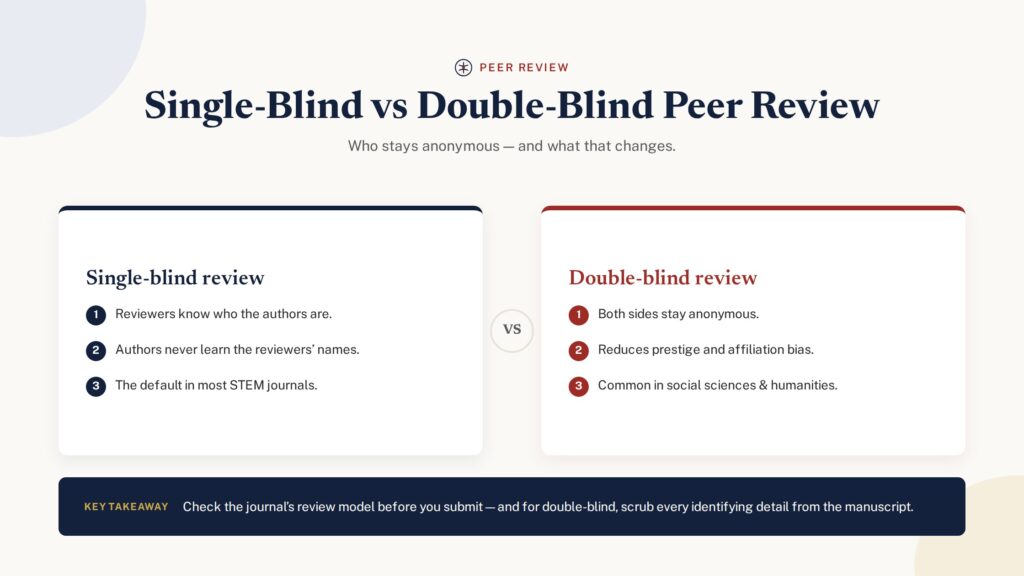
In single blind peer review, the reviewers know who you are but you do not know who they are. In double-blind review, neither side sees the other. That one difference in who can see a name has been measured in controlled experiments, and it changes acceptance recommendations by a margin large enough to matter to your career.
This guide explains both models, what journals now call them, what the evidence actually shows about bias, whether anonymity holds up in practice, and how to prepare a manuscript when the journal asks for an anonymised version.
The review models, side by side
| Model | Reviewer sees author? | Author sees reviewer? | Typical use |
|---|---|---|---|
| Single-blind (single-anonymous) | Yes | No | Still the most common model in the sciences and medicine |
| Double-blind (double-anonymous) | No | No | Long standard in humanities, social sciences and economics; spreading in STEM |
| Triple-blind | No | No | The handling editor is also blinded. Rare, and administratively demanding |
| Open | Yes | Yes | Identities disclosed; reports sometimes published alongside the paper |
| Transparent | Yes | Optional | Reports published, reviewer names optional |
| Post-publication | Varies | Varies | Review continues after publication, in the open |
One thing is constant across all of them: the editor always knows who you are. Even under double-blind review, the person choosing the reviewers and making the final call can see your name, your institution and your submission history. This matters for interpreting the research below, and it is the most common misunderstanding about what blinding does.
Why journals stopped saying “blind”
If a submission form offers “single-anonymous” and “double-anonymous” rather than single- and double-blind, these are the same two models under new names. Emerald, the Royal Society, IOP Publishing and others moved to the anonymous wording on the grounds that “blind” uses disability as a metaphor for ignorance.
The change is cosmetic in process terms and complete in practice terms: expect to see both vocabularies for some years yet, in the same field and occasionally on the same publisher’s site. Nothing about what you have to do differs.
How single blind peer review works
Your manuscript goes to reviewers with your name, affiliation and funding visible. Reviewer identities are withheld from you, before and after the decision.
The arguments made for it are practical. Reviewers can see whether you have the track record to have done what you claim, spot undeclared conflicts and self-plagiarism, and judge whether a method was plausibly executed by that group. It also requires no preparation from authors and no policing by editorial staff, which is a substantial part of why it remains the default in most of the sciences.
The argument against it is that everything a reviewer can see about you, they can also be influenced by.
The single blind peer review process, step by step
What actually happens between clicking submit and receiving a decision:
- Submission and technical check. Editorial staff confirm the file formats, ethics statements, declarations and reference style. Papers are returned at this stage for administrative reasons alone.
- Editorial screening. A handling editor reads for scope, novelty and basic soundness, and can reject without review. Your name and affiliation are visible throughout.
- Reviewer selection. The editor invites reviewers — usually two or three — from the journal’s database, the reference list, and sometimes your suggestions. Invitations often have to go out repeatedly before enough are accepted.
- Review. Reviewers see the full manuscript with your identity attached, and submit a written report plus a confidential recommendation to the editor. You never see the recommendation, only the report.
- Editorial decision. The editor weighs the reports against each other and against the journal’s scope, then issues one of the standard outcomes.
- Revision rounds. Revised manuscripts usually return to the original reviewers, who can see both the changes and your response letter.
Under double-anonymous review the sequence is identical, with one addition: the editorial office checks that your files are properly anonymised before step 3, and returns them to you if they are not. That check is a common source of delay, which is why the preparation section below is worth reading before you submit rather than after.
How double-blind review works
Author identifying information is stripped before the manuscript reaches reviewers. You prepare an anonymised file; the editorial office checks it; reviewers assess the work without knowing whose it is.
The intent is that a paper is judged on its content rather than its letterhead. The cost is real effort: anonymising a manuscript properly takes care, it can be undone by a single careless self-citation, and it sits awkwardly with preprints, which publish your name and your paper together by design.
Does hiding the author’s name change the decision?
This is the question with actual evidence behind it, and the answer is yes — measurably, for some author characteristics.
The controlled experiment. WSDM 2017, a computer science conference, ran a genuine controlled trial. Every paper received four reviewers: two drawn from a pool that could see author names, two from a disjoint pool that could not. The asymmetry held through bidding, reviewing and scoring.
The results, published in PNAS:
- Single-blind reviewers bid for 22% fewer papers, and preferentially bid for papers from top institutions.
- Once papers were allocated, single-blind reviewers were significantly more likely to recommend acceptance for papers from famous authors and prestigious institutions. The estimated odds multipliers were 1.63 for famous authors, 1.58 for top universities and 2.10 for top companies.
- For female authors the odds multiplier was 0.78, which was not statistically significant in that study alone — though the authors note a meta-analysis places the value in line with other experiments, where the gender effect does reach significance.
A second randomised trial, in a different field. Functional Ecology randomly assigned manuscripts to double-anonymous or single-anonymous review across 3,739 submissions between 2019 and 2022. Where reviewers could see author identities, papers from higher-income countries and from authors with higher English proficiency received higher ratings and were more likely to be invited to revise. Under double-anonymous review, outcomes were similar across those groups. Anonymisation had no measurable effect on gender differences in that trial. The British Ecological Society subsequently made double-anonymous review mandatory across its seven journals.
What the whole literature says. A 2024 systematic review in Scientometrics covered 29 comparative studies, six of them randomised. The institutional finding is the most consistent: single-blind review produced more favourable reviewer scores for top institutions, and double-blind review reduced that favouritism. Country effects run the same way — papers from high-HDI and English-speaking countries did better under single-blind review, and that advantage was equalised under double-blind. The gender evidence is genuinely mixed, with high-quality studies pointing in different directions.
The honest summary: the prestige effect is well supported; the gender effect is contested. And because editors are never blinded, double-blind review narrows the channel through which bias operates rather than closing it.
Does the anonymity actually hold?
Partly. The largest study to look at this examined 2,819 reviews across three computer science conferences (ASE, OOPSLA and PLDI in 2016), recording whether reviewers volunteered a guess at author identity and whether the guess was right.
- Reviewers attempted a guess in 13.6% to 30% of reviews, depending on the venue.
- When they did guess, they were right 72% to 85% of the time.
- Netting those together, 74% to 90% of reviews contained no correct guess at all.
Self-identified experts were more likely to attempt a guess, but no more likely to be correct. So anonymity is leaky rather than useless — it fails for a visible minority of submissions, usually the ones from well-known groups working on a continuing line of research, which is precisely where the prestige effect would have applied anyway.
Preparing an anonymised submission
Journals differ in detail, but the recurring requirements are these:
- Strip the manuscript file of author names, affiliations and any author photographs.
- Move funding, ethics and acknowledgement statements out of the PDF and into the submission form. They go back into the manuscript at revision, when non-anonymised source files are requested.
- Do not delete your self-citations — rephrase them. Replace “we have previously shown” with “as previously shown”. Removing the citations entirely damages the paper and is itself a signal.
- Check the file metadata. Author name is embedded in Word and PDF properties and survives a careless export.
- Keep the response letter anonymous too at revision, including any references to your own prior papers.
- Check named resources — a repository, dataset, registration or software named after your group undoes the rest of the work.
On preprints: posting a preprint publishes your name alongside the paper, so a reviewer who searches a distinctive phrase will find you. Most publishers accept this and ask reviewers not to go looking. If strict anonymity matters more to you than early posting, that is a genuine trade-off to decide before you submit, not after.
Which fields and journals use which model
Broadly, the split runs along disciplinary lines rather than quality lines. Double-anonymous review has been standard for decades in much of the humanities, the social sciences and economics. Single-anonymous review remains the default across most of medicine and the natural sciences, where the argument that reviewers should be able to see a group’s track record has historically carried more weight.
That boundary is moving, and the direction is one-way. The British Ecological Society made double-anonymous review mandatory across its seven journals after its own randomised trial. IOP Publishing has committed to double-anonymous review across its journal portfolio. The Royal Society offers double-anonymous peer review on its titles. Emerald has moved both its terminology and its policy in the same direction.
Nobody appears to be moving the other way, which is itself worth noting: publishers running controlled trials have tended to adopt the model afterwards.
Practically, this means you cannot infer the model from the field. Check the specific journal.
Finding out which model your journal uses
Check the journal’s instructions for authors, under peer review policy, before you write the cover letter. Three things are worth confirming: which model is used, whether it is mandatory or optional, and whether a separate anonymised file is required at submission or only on request.
Where a journal offers a choice, there is no universally correct answer. If you are early-career, at a less prominent institution, or writing from a country that is not well represented in your field’s literature, the evidence above suggests double-anonymous review is more likely to help than hurt you. If your group’s track record is the strongest argument for believing the result, single-anonymous review lets reviewers see it.
Frequently asked questions
Is double-blind review better than single-blind? Better at reducing the measured advantage of prestigious institutions and well-resourced countries. Not demonstrably better on gender, and not a complete fix, because editors still see everything.
Does the editor know who I am under double-blind review? Yes, essentially always. The handling editor selects reviewers and makes the decision with full knowledge of your identity.
What is triple-blind review? The editor is blinded as well. It is uncommon, because someone has to manage the workflow and conflicts of interest.
Can I ask for double-blind review at a single-blind journal? Generally no. The model is a journal policy, not a per-submission option, unless the journal explicitly offers a choice.
Does anonymising hurt my chances if my prior work supports the paper? It can. That is the real trade-off, and it is the reason the prestige effect exists at all — reviewers are using reputation as evidence.
What if I can tell who reviewed my paper? Say nothing to them. If you believe there is a conflict of interest, raise it with the editorial office rather than the reviewer.
What to take from this
Single blind peer review is faster and simpler and lets reviewers use everything they know. The experimental evidence is that some of what they know — your institution, your fame, your country — moves their recommendation independently of the work. Double-anonymous review measurably shrinks that effect for institutions and countries, holds for roughly three-quarters to nine-tenths of submissions, and does nothing about the editor.
Know which model your journal runs before you submit, anonymise properly if asked, and read the decision letter in that light. If you want the primary evidence, the WSDM controlled experiment is published as Reviewer bias in single- versus double-blind peer review in PNAS.
Related reading: how journal editors choose peer reviewers, open peer review, and what to do once the verdict arrives — journal editorial decisions explained.