
Reporting Guidelines in Academic Publishing Explained
Reading time - 7 minutes
Introduction
Incomplete or unclear reporting is one of the most common reasons manuscripts face rejection or major revision. To address this, journals increasingly require authors to follow reporting guidelines—structured frameworks that ensure research is reported transparently and consistently.
This article explains what reporting guidelines are, why they matter, how journals use them, and how researchers can apply them effectively to improve publication success.
What Are Reporting Guidelines?
Reporting guidelines are structured checklists or frameworks that specify:
- What information must be reported
- How methods and results should be described
- Minimum standards for transparency
They do not dictate how to conduct research—only how to report it.
Why Journals Require Reporting Guidelines
Journals use reporting guidelines to:
- Improve clarity and completeness
- Support reproducibility
- Reduce reviewer burden
- Enhance research credibility
Well‑reported studies are easier to review and trust.
Common Types of Reporting Guidelines
Reporting guidelines exist for:
- Experimental studies
- Observational research
- Qualitative research
- Systematic reviews
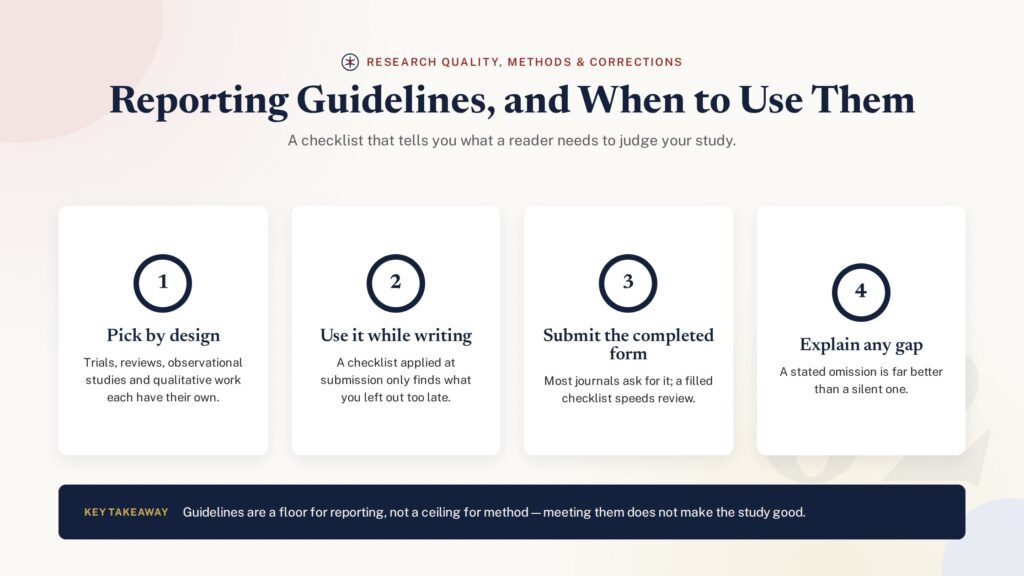
Authors must select guidelines appropriate to their study design.
How Reporting Guidelines Improve Peer Review
When guidelines are followed:
- Reviewers spend less time identifying missing details
- Feedback focuses on interpretation rather than reporting gaps
- Editorial decisions are faster and more confident
How Authors Should Use Reporting Guidelines
Best practices include:
- Consulting guidelines early
- Using checklists during manuscript drafting
- Submitting completed checklists if required
Guidelines should guide writing—not be added at the last minute.
Common Mistakes Authors Make
Avoid:
- Using incorrect guidelines
- Treating checklists as formalities
- Copying checklist language without substance
Superficial compliance is easily detected by reviewers.
Reporting Guidelines and Research Integrity
Transparent reporting:
- Reduces questionable practices
- Strengthens evidence synthesis
- Improves long‑term research value
Conclusion
Reporting guidelines are essential tools for modern academic publishing. By using them correctly, researchers improve clarity, transparency, and acceptance chances while contributing to a more reliable scholarly record.
Related Posts:
- Desk Rejection vs Peer Review Rejection: Key Differences Explained
- Desk Rejection Explained: Top Reasons Journals Reject Papers Early
- Breaking Down the "Preprint Hierarchy": Can Anyone Become a…
- How to Write a Peer Review Report: A Step-by-Step Template for…
- How to Respond to Journal Editorial Decisions