
Ethical Risks of Hyperauthorship in Academic Publishing: Credit Dilution, Accountability Gaps, and Collaborative Complexity
Reading time - 7 minutes
Introduction
In recent years, academic publishing has witnessed a steady rise in “hyperauthorship”—a phenomenon where research papers list an unusually large number of authors, sometimes ranging from dozens to even thousands. While large-scale collaborations are often necessary in fields like particle physics, genomics, and global health, hyperauthorship introduces complex ethical challenges that question how credit, responsibility, and accountability are distributed in modern research.
At its core, authorship is meant to signify meaningful intellectual contribution and accountability for the content of a publication. However, when author lists grow excessively long, the clarity of these roles begins to blur. This raises a fundamental concern: can every listed author truly take responsibility for the entire work?
The Rise of Hyperauthorship
The growth of interdisciplinary and multi-institutional research has made collaboration more common than ever. Large datasets, complex methodologies, and global research questions often require expertise from multiple domains. As a result, it is not unusual for a single study to involve statisticians, data scientists, clinicians, field researchers, and policy experts.
While such collaboration enhances the quality and scope of research, it also expands the author list. In some cases, authorship is extended to individuals who contributed only marginally, leading to what is sometimes referred to as “authorship inflation.” This can occur due to institutional pressures, hierarchical dynamics, or a desire to maintain professional relationships.
Credit Dilution and Academic Recognition
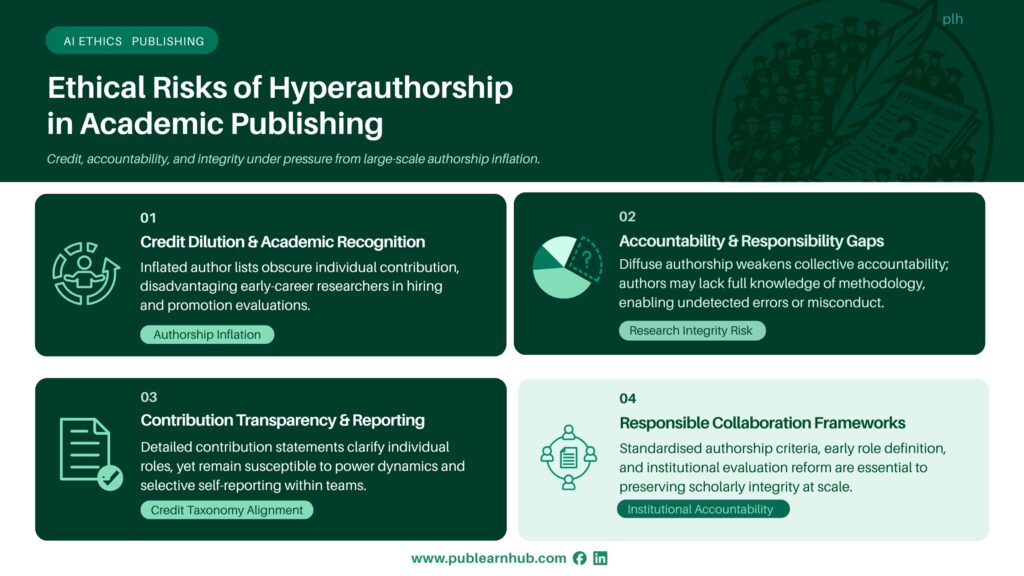
One of the primary ethical concerns associated with hyperauthorship is the dilution of credit. Academic careers often depend on publications as a key metric of success. When a paper has hundreds of authors, it becomes difficult to determine the extent of each individual’s contribution.
This can disadvantage early-career researchers who may have played a significant role but are listed among many others. Their contributions may be overlooked in hiring, promotion, or funding decisions, where evaluators struggle to assess individual impact.
At the same time, hyperauthorship can inflate the publication records of individuals who contributed minimally. This creates an imbalance in academic recognition and raises concerns about fairness in research evaluation systems.
Accountability and Responsibility Gaps
Authorship is not only about credit—it also implies responsibility. Every listed author is expected to stand by the integrity of the research. However, in hyperauthored papers, it is often unrealistic for all authors to have thoroughly reviewed every aspect of the work.
This creates accountability gaps. If errors, misconduct, or data inconsistencies are discovered, it may be unclear who is responsible. Some authors may not even be aware of specific methodological details or data sources, making it difficult to ensure collective accountability.
In extreme cases, this lack of clarity can be exploited. Individuals may accept authorship without fully engaging with the research, relying on the assumption that responsibility is diffused across a large group.
The Role of Contribution Transparency
To address these challenges, many journals and institutions are emphasizing the importance of detailed contribution statements. Instead of relying solely on author lists, these statements specify the exact role each contributor played in the research process—such as conceptualization, data analysis, writing, or supervision.
This approach helps restore clarity and fairness by making contributions visible. It allows evaluators to better understand individual roles and ensures that credit is allocated more accurately.
However, contribution statements are not a complete solution. They rely on honest reporting and may still be influenced by power dynamics within research teams. Senior researchers, for example, may receive disproportionate credit despite limited involvement.
Ethical Boundaries and Authorship Criteria
Clear authorship criteria are essential in managing hyperauthorship responsibly. Many guidelines suggest that authors should meet specific conditions, such as making a substantial contribution, participating in drafting or revising the manuscript, and approving the final version.
Despite these guidelines, their application varies widely across disciplines and institutions. In some fields, inclusive authorship is seen as a norm, while in others, stricter standards are enforced. This inconsistency creates confusion and increases the risk of unethical practices.
Establishing shared norms and enforcing them consistently is critical to maintaining the integrity of authorship.
The Impact on Research Integrity
Hyperauthorship does not inherently undermine research integrity, but it can create conditions where accountability is weakened. When responsibility is distributed too broadly, it becomes harder to detect and address errors or misconduct.
Moreover, the perception of inflated authorship can erode trust in the academic system. Readers, reviewers, and institutions may question whether author lists accurately reflect contributions, leading to skepticism about the credibility of published work.
Moving Toward Responsible Collaboration
The challenge is not to limit collaboration but to manage it responsibly. Large-scale research is essential for addressing complex global problems, and hyperauthorship is often a natural outcome of such efforts. The goal should be to ensure that collaboration does not come at the cost of ethical clarity.
Several practices can help achieve this balance:
- Defining authorship roles early in the research process
- Using transparent and standardized contribution frameworks
- Encouraging open communication within research teams
- Holding corresponding authors accountable for verifying contributions
Additionally, institutions and funding bodies can play a role by shifting evaluation criteria away from simple publication counts and toward more nuanced assessments of contribution and impact.
Conclusion
Hyperauthorship reflects the evolving nature of academic research—one that is increasingly collaborative, interdisciplinary, and global. While it brings significant benefits, it also challenges traditional notions of authorship, credit, and responsibility.
Addressing the ethical risks of hyperauthorship requires a combination of clear guidelines, transparent reporting, and cultural change within the academic community. By redefining how contributions are recognized and ensuring accountability at every level, academic publishing can adapt to this new reality without compromising its core principles.
In a system where collaboration is key, integrity must remain collective—but never diluted.