
Ethical Challenges of Third-Party Editing Services in Academic Publishing: Integrity, Transparency, and Authorship Boundaries
Reading time - 7 minutes
Introduction
In the increasingly competitive world of academic publishing, many researchers turn to third-party editing services to improve the quality of their manuscripts before submission. These services range from basic language polishing to substantive editing, statistical analysis support, and even manuscript restructuring. While such assistance can enhance clarity and readability—especially for non-native English speakers—it also raises complex ethical questions about authorship, transparency, and the integrity of scholarly work.
As the use of third-party editing services grows, academic publishers, editors, and institutions are being forced to confront a critical issue: where should the line be drawn between legitimate support and unethical contribution?
The Rise of Editing Services in Research
The global nature of research has created a demand for professional editing support. Researchers working in multilingual environments often face challenges in meeting the linguistic and stylistic expectations of international journals. Third-party services help bridge this gap, enabling researchers to present their ideas more clearly and effectively.
Beyond language editing, many services now offer advanced support, including formatting according to journal guidelines, improving argument structure, refining data presentation, and even suggesting citations. While these offerings can significantly improve a manuscript’s chances of acceptance, they also blur the boundaries between editing and authorship.
When Editing Becomes Authorship
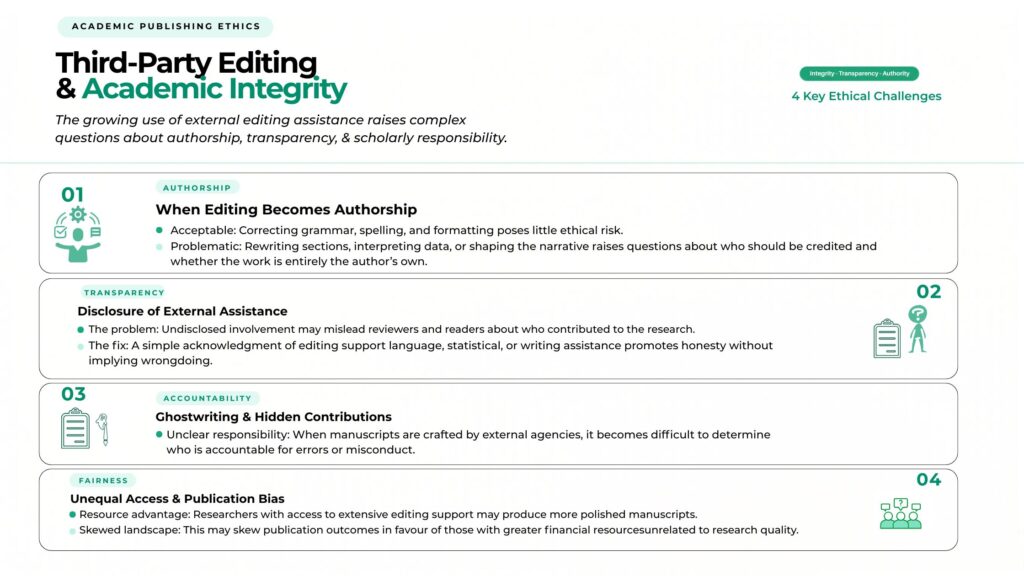
One of the most pressing ethical concerns is the extent of contribution made by third-party editors. Basic proofreading—correcting grammar, spelling, and formatting—is widely accepted and poses little ethical risk. However, when editors begin to rewrite sections, interpret data, or shape the narrative of the research, their role becomes more substantial.
At this point, questions arise: Should these contributors be acknowledged? Do they qualify for authorship? If their input influences the interpretation of results, can the work still be considered entirely the author’s own?
According to widely accepted authorship guidelines, significant intellectual contributions should be recognized. Yet, in practice, many third-party contributions go undisclosed. This creates a lack of transparency and may mislead reviewers and readers about who actually contributed to the research.
Ghostwriting and Hidden Contributions
A more concerning issue is the use of editing services for ghostwriting. In some cases, entire manuscripts are drafted or heavily rewritten by external agencies, while the listed authors have minimal involvement. This practice undermines the core principle of academic authorship—that credit should reflect actual intellectual contribution.
Ghostwriting not only raises ethical concerns but also introduces risks related to accountability. If issues arise—such as errors, misconduct, or data inconsistencies—it becomes unclear who is responsible. This lack of accountability can damage the credibility of both the authors and the journal.
Moreover, undisclosed third-party involvement can create unfair advantages. Researchers with access to extensive editing support may produce more polished manuscripts, potentially skewing the publication landscape in favor of those with greater resources.
Transparency as a Solution
To address these challenges, transparency is key. Journals and publishers are increasingly encouraging or requiring authors to disclose any third-party assistance received during manuscript preparation. This includes language editing, statistical consulting, and writing support.
Disclosure does not necessarily imply wrongdoing. On the contrary, it promotes honesty and allows editors and reviewers to better understand the context in which the research was prepared. A simple acknowledgment of editing support can go a long way in maintaining trust.
Some journals are also adopting contributor role taxonomies that go beyond traditional authorship, allowing for more nuanced recognition of different types of contributions. This helps ensure that all contributors are appropriately credited without inflating authorship.
Establishing Ethical Boundaries
Clear guidelines are essential to distinguish acceptable editing from unethical practices. Ethical third-party editing should:
- Focus on improving clarity, grammar, and presentation
- Avoid altering the scientific meaning or interpretation
- Refrain from generating original content or analysis
- Be transparently disclosed when used
Conversely, services that involve drafting content, interpreting results, or making substantive intellectual contributions should be treated with caution. In such cases, contributors may need to be acknowledged or even considered for authorship, depending on the extent of their involvement.
Institutions also play a role in educating researchers about responsible use of editing services. Early-career researchers, in particular, may not fully understand the ethical implications of outsourcing parts of their work.
The Role of Publishers and Editors
Publishers and journal editors are increasingly responsible for setting and enforcing standards حول third-party editing. Clear submission guidelines, mandatory disclosure statements, and editorial checks can help ensure compliance.
Some journals now require authors to confirm that their work is original and that any external assistance has been properly disclosed. Others conduct random audits or use tools to detect inconsistencies in writing style that may indicate undisclosed involvement.
However, enforcement remains challenging. Editing services operate globally, often with varying standards and levels of transparency. This makes it difficult to establish universal norms or monitor compliance effectively.
Balancing Support and Integrity
It is important to recognize that third-party editing services are not inherently unethical. When used responsibly, they can improve the accessibility and quality of research, particularly for scholars facing language barriers or limited institutional support.
The goal is not to eliminate these services, but to ensure that their use aligns with the principles of academic integrity. This requires a balance between providing support to researchers and maintaining clear boundaries حول authorship and contribution.
Looking Ahead
As academic publishing continues to evolve, the role of third-party editing services will likely expand. Advances in technology, including AI-assisted editing tools, will further complicate the landscape, introducing new questions about authorship and responsibility.
To navigate this complexity, the academic community must prioritize transparency, establish clear ethical guidelines, and foster a culture of accountability. By doing so, it can ensure that the use of external support enhances—rather than undermines—the credibility of scholarly research.
In the end, the integrity of academic publishing depends not only on what is published, but also on how it is created.