
Ethical Risks of Research Gap Framing in Academic Publishing: Novelty Pressure, Misrepresentation, and Scholarly Distortion
Reading time - 7 minutes
Introduction
In academic publishing, one of the most critical elements of any research paper is the identification of a “research gap.” This gap justifies the study, signals novelty, and positions the work within the broader scholarly conversation. However, as competition for publication intensifies, the way researchers frame these gaps is increasingly coming under ethical scrutiny. The pressure to demonstrate originality can sometimes lead to exaggerated, distorted, or even misleading representations of existing literature.
Research gap framing is not merely a rhetorical exercise—it shapes how knowledge is perceived, valued, and built upon. When done responsibly, it highlights genuine limitations in current understanding and opens pathways for meaningful contributions. But when manipulated, it can distort the academic record, undervalue prior work, and mislead readers about the true significance of a study.
The Pressure to Claim Novelty
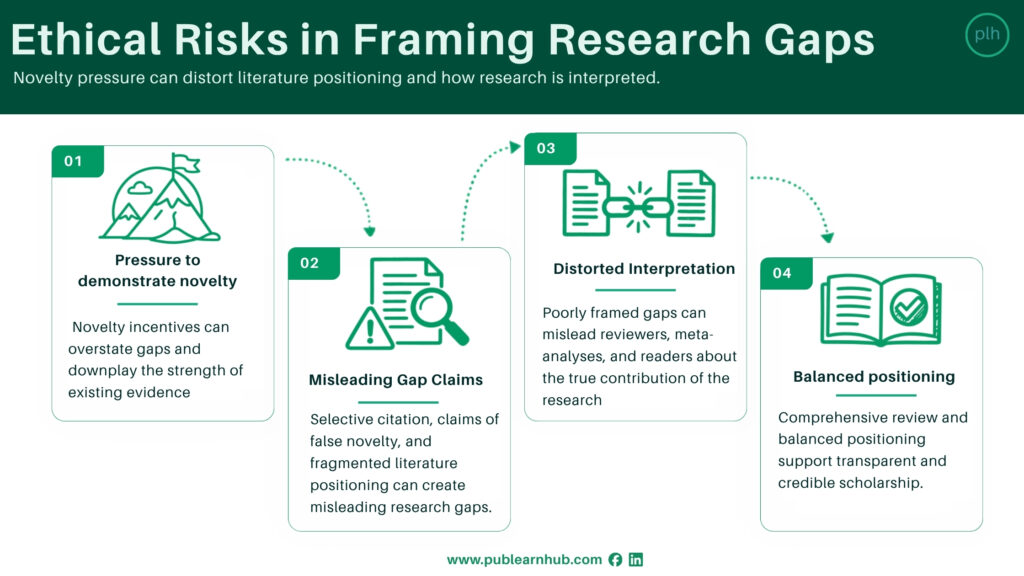
Modern academic publishing places a strong emphasis on novelty. Journals often prioritize research that appears innovative, disruptive, or significantly different from existing studies. As a result, authors may feel compelled to present their work as filling a unique and previously unaddressed gap—even when the reality is more nuanced.
This pressure can lead to selective citation practices, where authors intentionally overlook relevant studies to create the impression that a gap exists. In some cases, existing research is downplayed, mischaracterized, or framed as insufficient, even when it provides substantial insights. The result is a skewed representation of the scholarly landscape.
Such practices are not always intentional misconduct. They may arise from cognitive biases, limited literature searches, or disciplinary silos. However, regardless of intent, the outcome is the same: a distorted understanding of what is truly known and what remains to be explored.
Forms of Misleading Gap Framing
Ethical concerns in research gap framing often manifest in subtle but impactful ways. One common issue is gap inflation, where minor limitations in existing studies are exaggerated into significant deficiencies. For example, a study conducted in one geographic region may be presented as irrelevant to another, even when the findings are broadly applicable.
Another form is false novelty, where authors claim that no prior research exists on a topic despite the presence of related or adjacent studies. This can occur when researchers narrowly define their scope or ignore interdisciplinary work that addresses similar questions.
There is also the problem of gap fragmentation, where a well-established research area is artificially broken into smaller “gaps” to justify multiple publications. This practice not only inflates publication counts but also contributes to redundancy and fragmentation in the literature.
Consequences for the Scholarly Ecosystem
Misleading research gap framing has far-reaching implications. At the most immediate level, it misguides readers, reviewers, and editors about the contribution of a study. A paper presented as groundbreaking may, in reality, offer incremental insights that are already well understood.
Over time, these distortions accumulate, affecting how knowledge evolves. Meta-analyses and systematic reviews rely on accurate representations of prior research. If gaps are mischaracterized, these syntheses may draw flawed conclusions or overlook important connections.
Moreover, unethical gap framing can marginalize existing research, particularly work published in less prominent journals, non-English languages, or emerging disciplines. By ignoring or downplaying such contributions, the academic system reinforces existing hierarchies and limits intellectual diversity.
The Role of Peer Review and Editorial Oversight
Peer reviewers and editors play a crucial role in identifying and addressing issues in gap framing. However, detecting such problems is not always straightforward. Unlike data fabrication or plagiarism, misleading gap framing often involves interpretation and nuance.
Reviewers must critically assess whether the claimed gap is genuine and supported by a comprehensive review of the literature. This requires not only subject expertise but also awareness of broader research trends and interdisciplinary connections.
Editors, on the other hand, must ensure that journal policies encourage balanced and accurate literature representation. This may include requiring authors to justify their claims of novelty more rigorously or to acknowledge closely related work explicitly.
Promoting Responsible Gap Framing
Addressing the ethical risks of research gap framing requires a shift in both practice and culture. Authors must move away from viewing the research gap as a marketing tool and instead treat it as a transparent reflection of the current state of knowledge.
One important step is comprehensive literature engagement. Researchers should strive to include diverse sources, including studies from different regions, languages, and disciplines. This not only strengthens the credibility of their work but also fosters a more inclusive scholarly ecosystem.
Another key practice is nuanced positioning. Instead of claiming absolute novelty, authors can frame their contributions in terms of refinement, extension, or contextual application. This approach acknowledges prior work while still highlighting the value of the new study.
Journals can also support ethical practices by providing clear guidelines on how research gaps should be articulated. Encouraging transparency over exaggeration can help shift incentives away from novelty-driven distortion.
Rethinking Incentives in Academic Publishing
Ultimately, the issue of research gap framing is closely tied to the incentive structures of academic publishing. As long as novelty is disproportionately rewarded, researchers will face pressure to present their work in ways that maximize perceived originality.
A more balanced evaluation system—one that values rigor, replication, and incremental contributions—can reduce this pressure. Recognizing that scientific progress often occurs through small, cumulative advances rather than dramatic breakthroughs is essential for maintaining integrity.
Conclusion
Research gap framing is a foundational element of academic writing, but it carries significant ethical responsibilities. When used responsibly, it guides meaningful inquiry and strengthens the coherence of the scholarly record. When misused, it distorts knowledge, misleads stakeholders, and undermines trust in research.
As the academic community continues to evolve, greater attention must be paid to how gaps are identified and communicated. By promoting transparency, inclusivity, and honesty in literature positioning, researchers and publishers can ensure that the pursuit of novelty does not come at the cost of truth.