
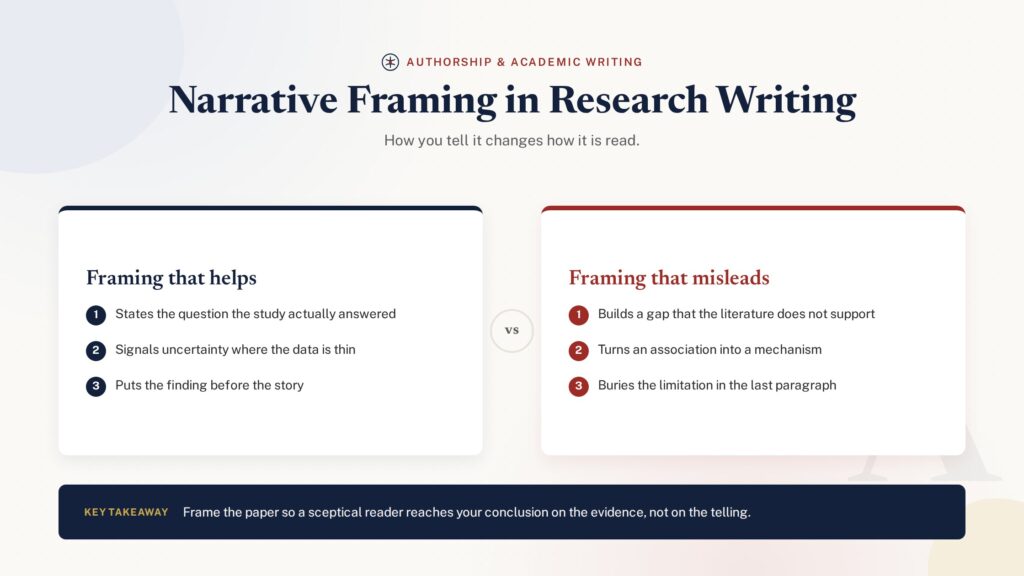
Narrative Framing in Academic Publishing: How Storytelling Shapes Research Interpretation
Reading time - 7 minutes
Introduction
Academic publishing is often viewed as a purely objective process, driven by data, methodology, and evidence. However, beneath the surface lies a powerful and often overlooked element: narrative framing. The way research is presented—how findings are introduced, contextualized, and discussed—can significantly influence how it is interpreted by readers, reviewers, and policymakers.
Narrative framing refers to the structure and language used to tell the “story” of research. From the introduction to the discussion section, authors make choices about what to emphasize, what to downplay, and how to connect their findings to broader questions. While storytelling is essential for clarity and engagement, it also introduces subtle dynamics that can shape perception in ways that are not always neutral.
The Role of Storytelling in Research
At its core, research is not just about generating data—it is about communicating meaning. A well-written paper guides the reader through a logical progression: identifying a problem, reviewing existing knowledge, presenting new findings, and explaining their significance. This structure inherently involves storytelling.
Effective narrative framing can make complex ideas accessible, highlight the importance of findings, and connect individual studies to larger scientific debates. It helps readers understand not just what was discovered, but why it matters.
However, the same tools that enhance clarity can also influence interpretation. The framing of a research question, the choice of background literature, and the tone of the discussion all contribute to how results are perceived.
Subtle Influence on Interpretation
Narrative framing can shape interpretation in several ways. For instance, emphasizing novelty in the introduction may lead readers to view findings as more groundbreaking than they actually are. Similarly, selectively highlighting supporting studies while minimizing conflicting evidence can create a skewed picture of the research landscape.
The discussion section is particularly influential. Authors may frame results as confirming a hypothesis, even when the evidence is mixed, or present limitations in a way that minimizes their impact. These choices are not necessarily intentional manipulations, but they can still affect how the research is understood.
Even language plays a role. Words like “significant,” “robust,” or “promising” carry connotations that go beyond their technical meaning. Subtle shifts in wording can influence whether findings are perceived as strong, tentative, or inconclusive.
The Pressure to Tell a Compelling Story
One reason narrative framing becomes influential is the pressure to produce compelling research narratives. Journals, reviewers, and readers often favor clear, coherent stories with strong conclusions. This can create incentives for authors to shape their narratives in ways that enhance impact, even when the underlying data is more nuanced.
For example, studies with clear, positive results are easier to frame as compelling stories than those with ambiguous or mixed findings. As a result, researchers may unintentionally simplify or streamline their narratives, reducing the visibility of uncertainty or complexity.
This pressure is not limited to authors. Editors and reviewers may also favor manuscripts that present a strong narrative, reinforcing the cycle. Over time, this can contribute to a research culture where storytelling subtly outweighs balanced interpretation.
Risks of Over-Framing
While narrative framing is necessary, excessive or unbalanced framing can lead to several issues. One risk is overinterpretation, where conclusions extend beyond what the data supports. This can mislead readers and influence subsequent research based on inflated claims.
Another risk is selective emphasis, where certain findings are highlighted while others are overlooked. This can create a distorted understanding of the research, particularly in fields where evidence is mixed or evolving.
There is also the issue of reproducibility. When narratives present findings as more definitive than they are, it can lead to unrealistic expectations for replication. Subsequent studies may struggle to reproduce results that were originally framed with greater certainty than warranted.
Encouraging Balanced Narratives
Addressing the challenges of narrative framing does not mean eliminating storytelling from academic writing. Instead, it requires a more balanced and transparent approach.
Authors can start by clearly distinguishing between results and interpretation. Presenting data objectively and then discussing its implications separately helps maintain clarity. Explicitly acknowledging uncertainty, limitations, and alternative explanations can also strengthen the credibility of the narrative.
Including a broader range of literature—both supporting and conflicting—can provide a more balanced context for findings. This not only improves accuracy but also demonstrates a comprehensive understanding of the field.
Reviewers and editors play a critical role as well. By evaluating not just the data but also how it is framed, they can encourage more balanced and transparent narratives. Constructive feedback on language, tone, and emphasis can help refine manuscripts without compromising their clarity.
The Role of Training and Awareness
Many researchers receive extensive training in methodology and analysis but relatively little guidance on narrative construction. Increasing awareness of narrative framing as a critical component of academic writing can help researchers make more deliberate and responsible choices.
Workshops, guidelines, and editorial policies can support this effort by highlighting best practices for balanced storytelling. Encouraging reflective writing—where authors consider how their framing might influence interpretation—can also promote more responsible communication.
Looking Forward
As academic publishing continues to evolve, the importance of narrative framing is likely to grow. In an increasingly crowded research landscape, the ability to communicate findings clearly and effectively is more important than ever. At the same time, maintaining accuracy and integrity remains essential.
The challenge lies in recognizing that storytelling is not inherently at odds with objectivity—but it must be handled carefully. By fostering awareness, encouraging balance, and prioritizing transparency, the academic community can ensure that narrative framing enhances, rather than distorts, the communication of knowledge.
In the end, how research is told shapes how it is understood. And in a system built on shared understanding, that makes narrative framing not just a writing skill, but a responsibility.