
Ethical Risks of AI-Driven Plagiarism Paraphrasing in Academic Publishing: Originality, Detection, and Integrity
Reading time - 7 minutes
Introduction
As artificial intelligence becomes more integrated into academic workflows, its role in writing and editing research papers continues to expand. Among its many applications, AI-powered paraphrasing tools are gaining popularity for their ability to reword text quickly and improve language quality. While these tools can support non-native speakers and streamline writing, they also introduce a complex ethical challenge: the risk of AI-driven plagiarism paraphrasing.
Unlike traditional plagiarism, which involves directly copying text, paraphrasing tools can transform existing content into seemingly original language while retaining the same underlying ideas and structure. This raises a critical question for academic publishing: when does paraphrasing cross the line from acceptable writing assistance into unethical misrepresentation?
The Rise of AI Paraphrasing Tools
AI-based paraphrasing tools are designed to rewrite sentences while preserving their meaning. Researchers may use them to improve clarity, avoid repetitive phrasing, or meet language standards required by journals. In many cases, these tools are used with good intentions—particularly by authors who face linguistic barriers or tight deadlines.
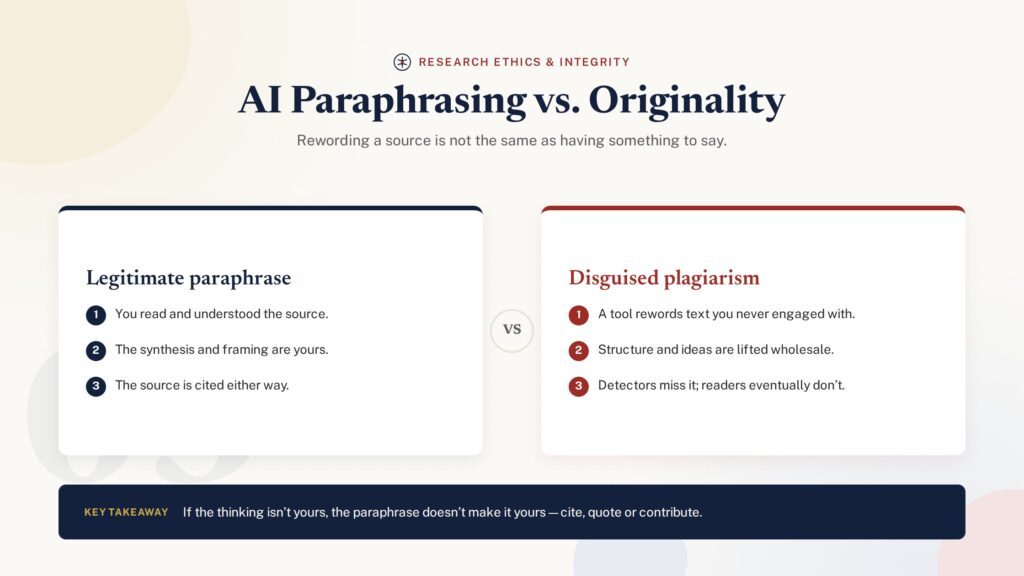
However, the same technology can be misused. Entire sections of previously published work can be rephrased in seconds, creating content that appears new but is conceptually identical to the original. This form of “disguised plagiarism” is harder to detect and often falls into a grey area of academic ethics.
Why AI Paraphrasing Poses Ethical Risks
The core issue lies in originality. Academic publishing values not just new wording, but new ideas, interpretations, and contributions. When AI is used to rephrase existing content without proper citation, it undermines the principle of intellectual honesty.
Even when sources are cited, excessive reliance on paraphrased material can dilute the author’s own voice and contribution. A paper that heavily depends on reworded content may meet technical originality thresholds but still lack genuine scholarly value.
There is also the issue of intent. AI tools make it easier to bypass plagiarism detection systems by altering sentence structures and vocabulary. This creates an uneven playing field, where some authors may exploit technology to avoid detection while others adhere to stricter ethical standards.
Challenges in Detection
Detecting AI-driven paraphrased plagiarism is significantly more difficult than identifying direct copying. Traditional plagiarism detection tools rely on text similarity, which becomes less effective when wording is substantially altered.
As a result, journals and editors face new challenges in maintaining research integrity. A paper may pass plagiarism checks while still being heavily derived from existing work. This not only affects the credibility of individual articles but also weakens trust in the publishing system as a whole.
Emerging detection methods, such as semantic analysis and AI-based comparison tools, aim to identify deeper similarities in meaning and structure. However, these technologies are still evolving and are not yet widely standardized across journals.
The Grey Area: Assistance vs Misconduct
Not all use of AI paraphrasing is unethical. When used responsibly, these tools can support language refinement and improve readability—especially for researchers who are not fluent in English. The challenge lies in distinguishing legitimate assistance from misuse.
Ethical use generally involves:
- Paraphrasing one’s own ideas for clarity
- Improving language without altering the original meaning
- Properly citing all sources, regardless of how they are reworded
Unethical use, on the other hand, includes:
- Rewriting others’ work without attribution
- Using AI to mask copied content
- Generating large portions of a manuscript from existing literature without original contribution
This grey area makes it essential for journals to provide clear guidelines on acceptable AI use.
Implications for Authors and Journals
For authors, the misuse of paraphrasing tools can have serious consequences. If detected, it may lead to manuscript rejection, retraction, or damage to professional reputation. More importantly, it undermines the credibility of their research.
For journals, the challenge is maintaining high standards of originality while adapting to rapidly evolving technologies. Editors must balance the benefits of AI-assisted writing with the need to uphold ethical publishing practices.
There is also a broader impact on the research ecosystem. If AI-driven paraphrasing becomes widespread without proper oversight, it could lead to a flood of low-quality, derivative publications. This would make it harder to identify truly innovative research and could slow scientific progress.
Toward Responsible Use and Policy Development
Addressing the risks of AI-driven paraphrasing requires a combination of policy, education, and technology. Journals should establish clear guidelines on the use of AI tools, including when and how they should be disclosed. Transparency is key—authors should openly state whether AI tools were used in the writing process.
Training and awareness are equally important. Researchers, especially early-career authors, need to understand that paraphrasing is not just about changing words, but about engaging critically with existing literature and contributing new insights.
On the technological side, publishers can invest in advanced detection tools that go beyond surface-level similarity. Combining human editorial judgment with AI-based analysis may offer the most effective approach.
Preserving the Integrity of Scholarly Writing
At its core, academic publishing is built on trust—trust that authors are presenting original work, that sources are properly acknowledged, and that the research contributes meaningfully to knowledge. AI paraphrasing tools, while useful, have the potential to erode this trust if misused.
The goal should not be to reject these tools outright, but to integrate them responsibly. By setting clear ethical boundaries and fostering a culture of transparency, the academic community can harness the benefits of AI without compromising integrity.
As technology continues to reshape how research is written and reviewed, the definition of originality must evolve—but its importance remains unchanged. In the end, true scholarship is not measured by how well ideas are reworded, but by how meaningfully they advance understanding.