
Ethical Risks of Reviewer Report Recycling in Academic Publishing: Efficiency, Fairness, and Contextual Integrity
Reading time - 7 minutes
Introduction
Peer review is widely regarded as the backbone of academic publishing, ensuring that research is rigorously evaluated before entering the scholarly record. However, as submission volumes grow and reviewer fatigue intensifies, new practices are emerging to improve efficiency. One such practice is reviewer report recycling—where previously written peer review reports are reused, partially or fully, for evaluating similar manuscripts. While this approach may appear practical, it raises important ethical concerns about fairness, context, and the integrity of the review process.
Reviewer report recycling can take several forms. In some cases, reviewers reuse segments of earlier feedback when assessing manuscripts on similar topics. In others, journals may transfer reviewer reports between submissions, especially when manuscripts are resubmitted to different journals or within cascading review systems. Although this can reduce duplication of effort, it also introduces risks that are often overlooked.
The Efficiency Argument
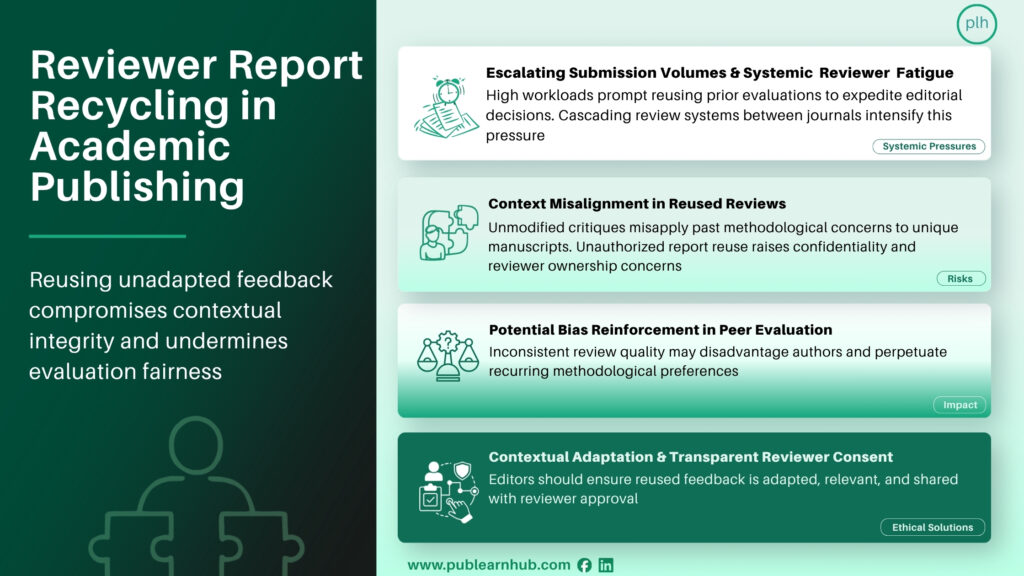
The primary justification for reviewer report recycling is efficiency. Reviewing a manuscript is time-consuming, requiring careful reading, critical analysis, and constructive feedback. With increasing pressure on reviewers, reusing well-articulated comments can seem like a reasonable way to reduce workload.
For journals, recycled reports can speed up editorial decisions. If a manuscript has already undergone detailed review elsewhere, transferring those insights can help editors make quicker, more informed judgments. This is particularly useful in cases where a paper has been rejected by one journal but remains scientifically sound.
From a systemic perspective, report recycling may also reduce reviewer fatigue. By minimizing redundant reviewing efforts, the academic community can allocate its limited reviewing capacity more effectively.
The Problem of Context Misalignment
Despite its apparent benefits, reviewer report recycling can compromise the contextual integrity of peer review. Every manuscript, even on similar topics, has unique research questions, methodologies, and contributions. Feedback that was relevant in one context may not apply accurately to another.
When reviewers reuse comments without fully adapting them, there is a risk of misaligned critiques. For example, a methodological concern raised in a previous review may not be applicable to the new manuscript, yet it may still be included out of convenience. This can lead to confusion for authors and potentially unfair evaluations.
Context misalignment also affects tone and specificity. Peer review is most valuable when it provides tailored, constructive guidance. Generic or recycled comments may appear superficial, reducing the perceived quality and usefulness of the review.
Fairness and Bias Concerns
Reviewer report recycling can also introduce fairness issues. If some manuscripts receive carefully tailored reviews while others are assessed using reused comments, the consistency of the review process is undermined. Authors may feel disadvantaged if their work is not evaluated on its own merits.
There is also a risk of reinforcing bias. Recycled critiques may carry forward assumptions or perspectives that were shaped by previous manuscripts. Over time, this can create patterns of bias, particularly in fields where certain methodologies or approaches are repeatedly favored or criticized.
Additionally, authors are typically unaware when reports have been recycled. This lack of transparency raises ethical questions about whether the review process is being conducted with the level of care and originality that authors expect.
Confidentiality and Ownership Issues
Another critical concern is confidentiality. Peer review reports are often considered confidential communications between reviewers and journals. Reusing these reports, especially across different submissions or journals, may violate expectations of privacy.
There is also the issue of intellectual ownership. Reviewers invest time and expertise in crafting their feedback. If their reports are reused or shared without clear consent, it raises questions about who owns that intellectual contribution and how it can be ethically reused.
In some cases, journals may transfer reviewer reports with the reviewer’s permission. However, without standardized policies, practices can vary widely, leading to inconsistencies and potential ethical breaches.
When Is Report Recycling Acceptable?
Not all forms of reviewer report recycling are inherently problematic. The key lies in how the practice is implemented. Limited reuse of general insights—such as commonly observed methodological concerns—can be acceptable if they are carefully adapted to the specific manuscript.
Similarly, transferring reviewer reports between journals can be ethical when done transparently and with consent. Authors should be informed that previous reviews are being considered, and reviewers should have the option to approve or decline the reuse of their reports.
The problem arises when recycling becomes a shortcut rather than a thoughtful practice. Blindly reusing feedback without contextual adaptation undermines the purpose of peer review.
Best Practices for Ethical Implementation
To address these challenges, journals and reviewers must adopt clear and responsible practices. First, contextual adaptation should be mandatory. Any reused content must be carefully revised to reflect the specifics of the manuscript under review.
Second, transparency is essential. Authors should be informed if recycled or transferred reports are being used in the evaluation process. This builds trust and allows authors to better understand the basis of editorial decisions.
Third, reviewer consent must be prioritized. Journals should seek explicit permission before reusing or sharing reviewer reports, ensuring that reviewers retain control over their intellectual contributions.
Fourth, editorial oversight is crucial. Editors should carefully evaluate recycled reports to ensure they are relevant, fair, and constructive. This includes checking for inconsistencies, outdated comments, or inappropriate carryovers from previous reviews.
Finally, clear policies should be established. Journals need to define when and how report recycling is permitted, providing guidance to both reviewers and authors.
Striking a Balance
Reviewer report recycling reflects a broader tension in academic publishing: the need to balance efficiency with integrity. While reducing reviewer workload is an important goal, it should not come at the expense of fairness or quality.
Peer review is not just a procedural step—it is a critical process that shapes the direction and credibility of research. Each manuscript deserves careful, context-specific evaluation, even in a system under strain.
As academic publishing continues to evolve, practices like reviewer report recycling will likely become more common. The challenge is to ensure that they are implemented thoughtfully, transparently, and ethically. Only then can the peer review system maintain its role as a trusted gatekeeper of scholarly knowledge.