
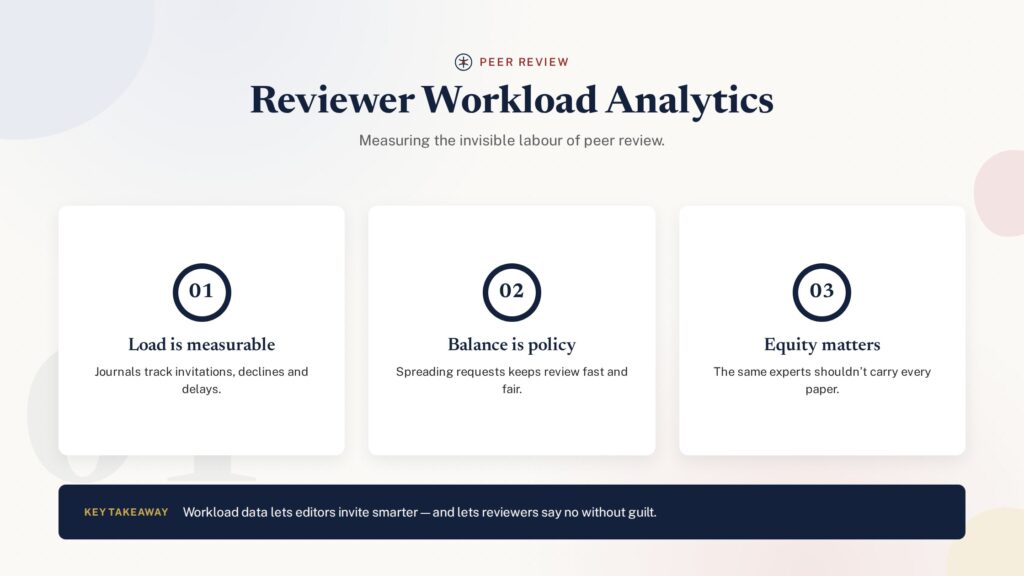
Reviewer Workload Analytics in Academic Publishing: Balancing Efficiency, Equity, and Review Quality
Reading time - 7 minutes
Introduction
The peer review system is the backbone of academic publishing, yet it continues to face a persistent and growing challenge: reviewer overload. As submission volumes rise globally, a relatively small pool of active reviewers is repeatedly called upon, leading to fatigue, delays, and sometimes declining review quality. While discussions around peer review efficiency often focus on editorial strategies or incentives, a newer and increasingly important approach is emerging—reviewer workload analytics.
By leveraging data-driven insights, journals and publishers can better understand reviewer behavior, distribution of assignments, turnaround times, and overall capacity. Reviewer workload analytics has the potential to transform how peer review is managed, making it more equitable, efficient, and sustainable. However, its implementation also raises important ethical and operational considerations.
What Is Reviewer Workload Analytics?
Reviewer workload analytics refers to the systematic collection and analysis of data related to peer review activities. This includes metrics such as:
- Number of review invitations sent and accepted
- Frequency of assignments per reviewer
- Average review completion time
- Decline rates and reasons
- Subject-area expertise alignment
- Quality indicators (e.g., editorial ratings of reviews)
By analyzing these patterns, editorial teams can gain a clearer picture of how reviewer responsibilities are distributed and identify inefficiencies or imbalances in the system.
Why Workload Analytics Matters
One of the most pressing issues in academic publishing today is reviewer fatigue. A small percentage of researchers often carry a disproportionate share of the reviewing burden. This imbalance can lead to delayed reviews, rushed evaluations, or outright refusal to participate.
Workload analytics helps address this by:
- Ensuring fair distribution: Editors can avoid repeatedly assigning manuscripts to the same reviewers while others remain underutilized.
- Improving turnaround times: Identifying reviewers who consistently deliver timely feedback allows for more strategic assignments.
- Enhancing review quality: Overburdened reviewers may provide less thorough evaluations. Balanced workloads support more thoughtful and detailed reviews.
- Supporting editorial decision-making: Data insights enable editors to move beyond intuition and make evidence-based assignment choices.
Ultimately, workload analytics contributes to a healthier peer review ecosystem, benefiting authors, reviewers, and publishers alike.
Key Applications in Editorial Workflows
Reviewer workload analytics can be integrated into editorial systems in several practical ways:
- Smart Reviewer Assignment
Editorial platforms can use workload data alongside expertise matching to recommend reviewers who are both qualified and currently underutilized. This reduces over-reliance on a small reviewer pool. - Dynamic Workload Thresholds
Journals can set thresholds for the number of active or recent reviews assigned to a single reviewer. Once the limit is reached, the system can temporarily exclude them from new invitations. - Predictive Availability Modeling
By analyzing past behavior, systems can predict the likelihood of a reviewer accepting an invitation or completing it on time. This minimizes delays caused by declined or ignored invitations. - Reviewer Recognition and Support
Analytics can identify highly active reviewers who may be at risk of burnout. Journals can then offer recognition, incentives, or temporary relief from assignments. - Portfolio-Level Insights for Publishers
Large publishers managing multiple journals can use aggregated data to identify cross-journal imbalances and redistribute reviewer demand more effectively.
Ethical and Practical Challenges
While the benefits are clear, implementing reviewer workload analytics is not without challenges.
Privacy and Data Transparency
Reviewers may be concerned about how their activity data is collected, stored, and used. Transparency is essential—reviewers should know what metrics are tracked and how they influence editorial decisions.
Over-Reliance on Quantitative Metrics
Not all aspects of peer review can be captured through numbers. A reviewer who completes fewer reviews may still provide exceptionally high-quality feedback. Relying solely on metrics risks undervaluing such contributions.
Potential Bias in Data Interpretation
Workload analytics must be carefully designed to avoid reinforcing biases. For example, early-career researchers or those from underrepresented regions may appear less active, not due to unwillingness but due to fewer invitations.
Reviewer Autonomy
Automated systems should not override human judgment. Editors must retain the flexibility to make decisions based on context, expertise, and nuanced understanding of reviewer capabilities.
Balancing Efficiency with Fairness
A key strength of workload analytics lies in its ability to promote fairness—but only if implemented thoughtfully. Journals must strike a balance between optimizing efficiency and respecting the voluntary nature of peer review.
Best practices include:
- Combining quantitative data with qualitative assessment
- Regularly reviewing and updating workload models
- Providing opt-out options for reviewers who wish to limit assignments
- Ensuring inclusive reviewer recruitment to expand the pool
- Communicating clearly with reviewers about expectations and data use
By adopting a balanced approach, publishers can avoid turning peer review into a purely transactional system.
The Future of Reviewer Management
As academic publishing continues to evolve, reviewer workload analytics is likely to become a standard feature of modern editorial systems. When combined with AI-driven tools, these analytics could further enhance reviewer matching, predict bottlenecks, and streamline workflows.
However, the future of peer review will not be defined by technology alone. Human judgment, academic integrity, and community trust will remain central. Workload analytics should be seen as a support tool—one that empowers editors and respects reviewers rather than replacing their roles.
Conclusion
Reviewer workload analytics represents a significant step forward in addressing one of the most persistent challenges in academic publishing. By providing data-driven insights into reviewer activity, it enables more equitable distribution of work, improves efficiency, and supports higher-quality peer review.
Yet, its success depends on careful implementation. Ethical considerations, transparency, and respect for reviewer autonomy must guide its adoption. When used responsibly, workload analytics can help create a more sustainable and resilient peer review system—one that continues to uphold the standards of scholarly communication in an increasingly demanding research landscape.