
Best Preprint Servers in 2026: 20 Platforms Compared
Reading time - 9 minutes
Preprint servers are free online repositories where you post a complete manuscript before, or alongside, peer review. Almost all of them are free, assign a DOI and publish within days, so the real decision is which one your field actually reads. This guide compares 20 preprint servers and then tells you how to pick one.
The table below covers field, operator, size, cost, DOI, screening and, most usefully, whether the server can push your manuscript straight into a journal submission system. That last column decides the choice more often than anything else, and most lists leave it out.
On this page
- 20 preprint servers compared
- How to choose a preprint server
- Five policies that catch authors out
- What happens after you post
- Frequently asked questions
20 preprint servers compared
Sizes are shown as orders of magnitude rather than live counts, because exact totals change weekly. Where a server does not publish a policy, the cell says so rather than guessing.
| Server | Field | Run by | Since | Size | Cost | DOI | Screening | Direct journal transfer |
|---|---|---|---|---|---|---|---|---|
| Discipline specific | ||||||||
| bioRxiv | Biology, around 25 subject categories. No reviews, case reports or standalone protocols. | Cold Spring Harbor Laboratory | 2013 | 100,000+ | Free | Yes | Plagiarism, non-scientific content, public health risk. Usually live within 72 hours. | Yes, 249 integrated journals |
| medRxiv | Human health research. Excludes case reports, narrative reviews, preclinical and veterinary work. | Cold Spring Harbor Laboratory | 2019 | 10,000+ | Free | Yes | Strictest here. Verifies ethical oversight and clinical trial registration. Typically 2 to 4 days. | Yes, around 144 integrated journals |
| arXiv | Physics, mathematics, computer science, quantitative biology, quantitative finance, statistics, electrical engineering, economics | Cornell University | 1991 | 1,000,000+ | Free | Yes, prefix 10.48550 | Moderated for topicality. New authors need an endorsement first. | Varies by journal |
| ChemRxiv | Chemistry | ACS with RSC, Chinese Chemical Society, Chemical Society of Japan, GDCh and TIB | 2017 | 10,000+ | Free | Yes, prefix 10.26434, versioned | Not published in detail | To ACS journals, but see the warning below |
| PsyArXiv | Psychology | Society for the Improvement of Psychological Science | 2016 | 10,000+ | Free | Yes | Light moderation, OSF platform | No |
| SocArXiv | Social sciences | Center for Open Science | 2016 | 10,000+ | Free | Yes | Light moderation, OSF platform | No |
| TechRxiv | Engineering, computing, technology | IEEE | 2020 | 10,000+ | Free | Yes | Not published in detail | Not published in detail |
| engrXiv | Engineering | Open Engineering Inc | 2016 | 1,000+ | Free | Yes | Light moderation | No |
| EarthArXiv | Earth and planetary science | California Digital Library | 2017 | 1,000+ | Free | Yes | Light moderation | No |
| agriRxiv | Agriculture and allied sciences | CAB International with Open Access India | 2017 | 100+ | Free | Yes, one DOI across versions | Scope, text overlap, completeness | No, and no withdrawal once posted |
| Advance | Humanities and social sciences | SAGE | 2018 | Not published | Free | Yes, a new DOI suffix per version | Scope, text overlap, ethical and legal compliance | Not published in detail |
| CrimRxiv | Criminology | University of Manchester | 2020 | 100+ | Free | Yes | Not published in detail | No |
| Multidisciplinary | ||||||||
| Research Square | All fields | Research Square R and D | 2018 | 100,000+ | Free | Yes | Author information, declaration statements, risk to human health | Yes, through In Review at participating journals |
| Preprints.org | All fields | MDPI | 2016 | 124,000+ | Free | Yes, issued by Crossref | Scientific content, author background, ethical compliance. Usually under 24 hours. | Not published in detail |
| OSF Preprints | All fields. The platform underneath PsyArXiv, SocArXiv, EdArXiv and many others. | Center for Open Science | 2017 | 1,000,000+ | Free | Yes | Light moderation | No |
| Zenodo | All fields, plus datasets, code and software | OpenAIRE and CERN | 2011 | 100,000+ | Free | Yes | None, deposit is open | No |
| SSRN | Accounting, economics, finance, humanities, law and more | Elsevier | 1994 | 1,000,000+ | Open access repository | Not published in detail | Not published in detail | Connects to Elsevier journals through First Look |
| Authorea | All fields | Atypon | 2013 | 10,000+ | Free | Yes, a DOI per version | Scholarly nature, legal and ethical compliance | Not published in detail |
| Regional | ||||||||
| SciELO Preprints | All fields. Latin America, Iberia, South Africa. | SciELO | 2020 | 10,000+ | Free | Yes | Not published in detail | No |
| AfricArXiv | All fields. African research. | Center for Open Science | 2018 | 100+ | Free | Yes, one DOI across versions | Spam filter and scope check | No |
| ChinaXiv | All fields. Chinese research. | National Science Library, Chinese Academy of Sciences | 2016 | 10,000+ | Free | Yes | Not published in detail | No |
| Jxiv | All fields. Japanese research. | Japan Science and Technology Agency | 2022 | 100+ | Free | Yes | Not published in detail | No |
How to choose a preprint server
Nearly every server above is free, assigns a DOI and posts within days. Cost and speed will not decide it for you. Three things will.
1. Where does your field already look?
A preprint is worth exactly as much as the audience that sees it. A biology paper on Zenodo is technically published and practically invisible. The same paper on bioRxiv lands in front of the people who follow that literature, cite it and review for its journals.
Pick the server your field already reads, even when a general server is easier to use:
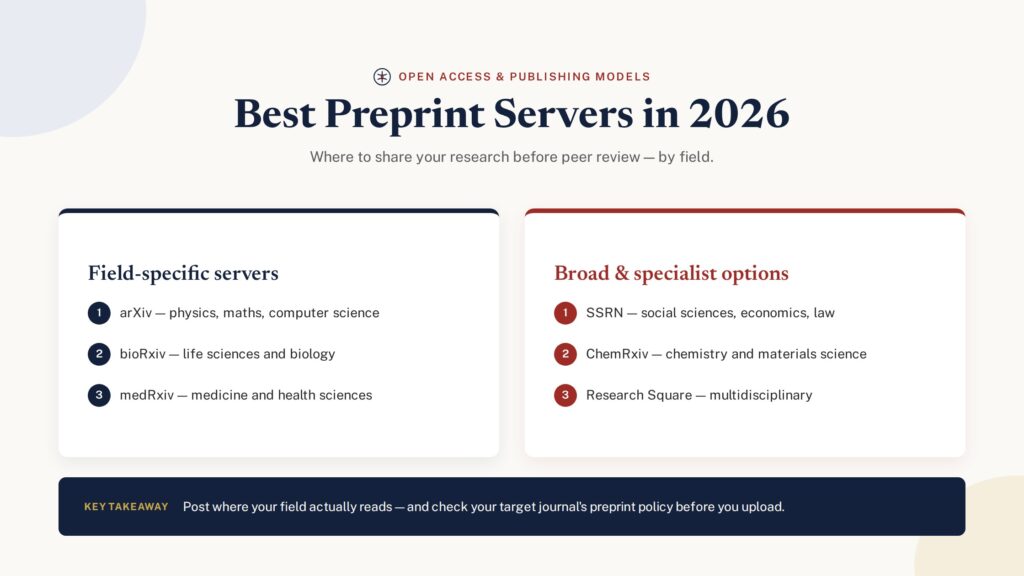
- Biology, genomics, neuroscience: bioRxiv
- Clinical or public health research on humans: medRxiv, but read the ethics requirement below before you start
- Physics, mathematics, computer science, statistics, economics: arXiv, and arrange your endorsement early
- Chemistry: ChemRxiv
- Psychology: PsyArXiv
- Sociology, political science and other social sciences: SocArXiv, or Advance for humanities-leaning work
- Engineering: TechRxiv if you publish in IEEE venues, otherwise engrXiv
- Earth, environmental and planetary science: EarthArXiv
- Agriculture: agriRxiv, noting it does not allow withdrawal
- Criminology: CrimRxiv
- Nothing above fits: Research Square or Preprints.org
2. Are you about to submit to a journal?
If you are, journal integration is worth more than any other column in the table. bioRxiv can send your manuscript straight to any of 249 integrated journals, medRxiv to around 144, and Research Square posts the preprint as part of submitting through In Review at participating journals. You upload once instead of twice, and the preprint later carries a link to the published version.
If you are heading for an Elsevier journal, SSRN connects through First Look. If you are heading for an ACS journal, read the ChemRxiv warning below first.
3. Does your target journal accept preprinted work?
Most journals now do. A minority still treat a preprint as prior publication, and some accept preprints only under particular licences. Check the journal’s stated policy before you post rather than after, because posting is close to irreversible. If you are weighing up sending the same manuscript to more than one venue, our guide to simultaneous submission to multiple journals covers where the line sits.
Five policies that catch authors out
Directories list attributes. They rarely tell you which of those attributes will cause you a problem three months from now. These five do.
You cannot delete a preprint. bioRxiv and medRxiv will not remove a posted manuscript. You can add a withdrawal statement, and on medRxiv the original stays accessible carrying a watermark. agriRxiv has no withdrawal route at all. Treat posting as permanent and post only work you would defend in its current state.
arXiv needs an endorsement for your first submission. If you are new to arXiv, or posting into a category you have not used before, an established author in that category has to endorse you. That takes days, and it is nobody’s priority but yours. Arrange it before your deadline rather than during it.
medRxiv asks for more paperwork than the others. Any research using human subjects, samples or data needs a statement of ethical oversight from an independent dedicated body. An online tool or an audit body does not satisfy the requirement. Prospective interventional studies need a trial ID from an ICMJE recognized registry. Budget time for both.
Your licence choice can conflict with your journal. Most servers offer a range from no reuse without permission through to CC0. bioRxiv and medRxiv offer six options each, while Preprints.org applies CC BY 4.0 to everything. Choose the licence your target journal is comfortable with, because changing it after posting is awkward at best. Our overview of preprint copyright and author rights goes through what each option actually permits.
ChemRxiv’s direct transfer to ACS journals is not working at the time of writing. ChemRxiv’s own dashboard warns that preprints sent by Direct Journal Transfer to ACS journals are not routing correctly, and asks authors to submit to the journal directly while it is investigated. Post the preprint, then submit separately, and check the notice before relying on the transfer.
What happens after you post
Posting is not the end of the process, and a few mechanics are worth knowing before you commit.
You can post new versions. Every server here supports revising a manuscript, but they handle the identifier differently, and that difference matters when someone cites you. bioRxiv keeps a single DOI and gives each version its own URL. agriRxiv and AfricArXiv keep one DOI across all versions. Advance, Authorea and Preprints.org issue a new DOI for each version. If you expect to revise substantially, prefer a server whose versioning your citing readers will be able to follow.
The preprint and the journal article coexist. When the peer reviewed version appears, the preprint does not disappear. Most servers add a link from the preprint to the published article once a DOI match is found, which is part of why posting is worth doing even when you are confident of acceptance. Readers who find the preprint get routed onward.
Cite the DOI, not the URL. A preprint DOI is permanent. A server URL may not be, particularly for the smaller regional servers. When you list a preprint on a CV, in a grant application or in a reference list, use the DOI.
Expect comments, and decide in advance how you will handle them. Several servers carry public commenting. Feedback on a preprint is not peer review and carries no obligation, but a substantive correction posted publicly is worth addressing in your next version rather than leaving to stand.
Check what your funder requires. A growing number of funders accept preprints in progress reports and grant applications, and some open access policies now count a deposited preprint toward compliance. Others do not. Confirm before assuming the preprint satisfies a mandate.
Frequently asked questions
What are preprint servers? A preprint server is an online repository that hosts complete manuscripts before they have been peer reviewed. It timestamps the work, assigns a citable DOI and makes it publicly readable, usually within a few days and at no cost to the author.
Are preprint servers free? Every server in the table above is free to post to. A small number of adjacent platforms that combine preprinting with open access publishing do charge an article processing fee, but that fee is for publication, not for the preprint itself.
Which preprint server is the best? There is no single best one. The best server is the one your field reads, which is why the list above is grouped by discipline rather than ranked. If your work spans fields, or none of them fit, Research Square and Preprints.org accept everything.
Do preprints count as publications? Not as peer reviewed publications. They are citable through their DOI, many funders now accept them in grant applications, and they establish priority for a finding. They do not replace a journal article on a CV.
Can a preprint be rejected? Yes. Servers screen rather than peer review, but they do decline submissions that fall outside scope, fail plagiarism checks, lack required ethical approvals or could pose a public health risk. medRxiv screens most strictly of the servers listed here.
How long does it take for a preprint to appear? Preprints.org usually posts in under 24 hours, bioRxiv typically within 72 hours, and medRxiv in 2 to 4 days because of its additional ethics and trial registration checks. Weekends and holidays add time everywhere.
Before you post
Pick the server your field reads, check that your target journal accepts preprinted submissions, choose a licence that will not create a problem later, and use journal integration if your server offers it. If your paper is already under review, our explanation of journal embargo periods covers when you are free to self-archive.
For the fullest reference list of servers and their policies, ASAPbio maintains a searchable preprint server directory covering policies and practices across platforms.
Details in this comparison were verified against each server’s own documentation in September 2026. Policies change, so confirm anything decision critical on the server’s site before you post.