
Reviewer Reputation Systems in Academic Publishing: Building Trust, Incentives, and Accountability in Peer Review
Reading time - 7 minutes
Introduction
Peer review remains the backbone of academic publishing, yet it continues to face persistent challenges—reviewer fatigue, inconsistent quality, lack of accountability, and limited recognition for reviewers’ contributions. While efforts such as open peer review, reviewer training, and incentive programs have attempted to address these issues, a growing concept is gaining attention: reviewer reputation systems. These systems aim to evaluate, track, and reward reviewer performance over time, introducing a structured layer of trust and transparency into the peer review ecosystem.
What Are Reviewer Reputation Systems?
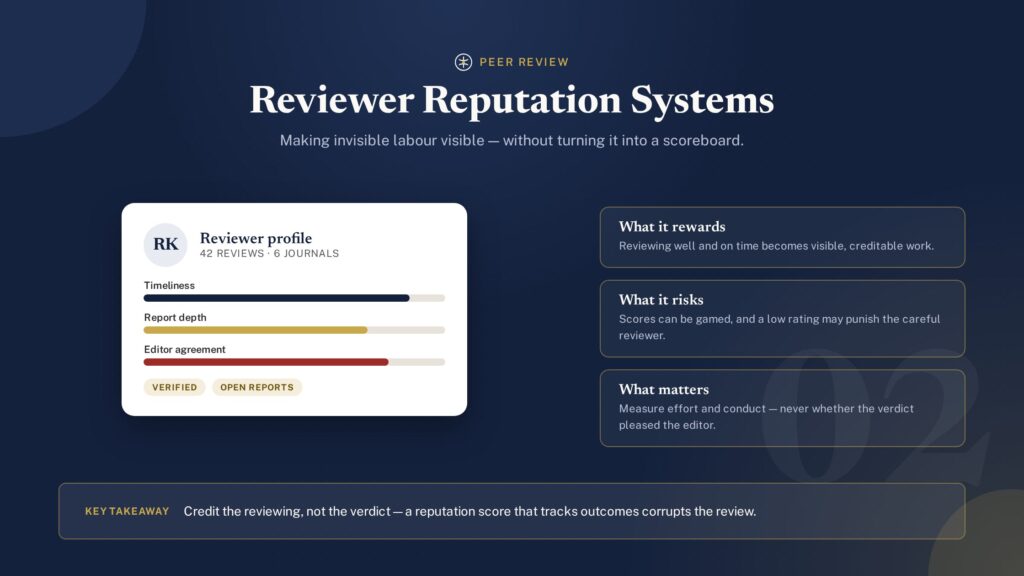
A reviewer reputation system is a framework that assigns measurable indicators to a reviewer’s performance based on factors such as review quality, timeliness, expertise, and editorial feedback. Much like reputation scores in digital platforms (e.g., marketplaces or collaborative communities), these systems aim to create a track record that reflects a reviewer’s reliability and contribution to scholarly communication.
Rather than treating peer review as an invisible and often thankless task, reputation systems make reviewer contributions visible, quantifiable, and potentially portable across journals and publishers.
Why Reputation Systems Are Emerging Now
Several trends are driving interest in reviewer reputation systems:
- Increasing submission volumes have intensified pressure on editorial teams to find dependable reviewers.
- Reviewer fatigue has made it harder to secure timely and high-quality reviews.
- Concerns about review quality—including superficial or biased reviews—have highlighted the need for accountability.
- Digital infrastructure advancements now allow platforms to track and analyze reviewer behavior at scale.
In this context, reputation systems offer a data-driven approach to improving peer review efficiency and integrity.
Key Components of a Reviewer Reputation System
An effective reviewer reputation system typically includes multiple performance indicators:
- Quality of Reviews
Editors may rate reviews based on depth, clarity, constructiveness, and relevance. Some systems also use text analysis to assess thoroughness. - Timeliness
Meeting deadlines is critical in publishing workflows. Reputation scores often incorporate turnaround times and responsiveness. - Consistency and Reliability
Reviewers who regularly accept invitations and complete reviews are valued more highly. - Expertise Matching
Systems may evaluate how well a reviewer’s expertise aligns with the manuscript topic, often using publication history or keyword matching. - Editorial Feedback
Editors’ qualitative feedback can be converted into structured ratings, adding a human judgment layer to the system. - Community Recognition
In some models, authors or co-reviewers can provide feedback on the usefulness of reviews, though this must be carefully managed to avoid bias.
Benefits of Reviewer Reputation Systems
- Improved Review Quality
When reviewers know their work contributes to a visible reputation score, they may be more motivated to provide thoughtful and thorough evaluations. - Better Reviewer Selection
Editors can rely on reputation data to identify high-performing reviewers, reducing the uncertainty and time involved in reviewer selection. - Incentivization and Recognition
Reputation systems can be linked to rewards such as certificates, public acknowledgments, editorial board invitations, or even career recognition. - Increased Accountability
Tracking reviewer performance discourages unethical behavior, such as superficial reviews or conflicts of interest. - Portability Across Platforms
In the long term, reputation scores could become portable across journals and publishers, creating a unified reviewer profile that reflects contributions across the scholarly ecosystem.
Challenges and Risks
Despite their promise, reviewer reputation systems raise several important concerns:
- Risk of Oversimplification
Reducing complex intellectual contributions to numerical scores may overlook nuance and discourage diverse reviewing styles. - Bias in Evaluation
Editorial ratings may be subjective, and systemic biases could influence how reviewers are assessed—especially across disciplines, regions, or career stages. - Gaming the System
Reviewers might prioritize speed over quality or accept only “easy” reviews to maintain high scores, undermining the system’s purpose. - Privacy and Transparency Concerns
Not all reviewers may be comfortable with their performance being tracked or shared, particularly in sensitive or controversial fields. - Inequality Among Reviewers
Early-career researchers or those from underrepresented regions may face challenges in building reputation scores, potentially reinforcing existing inequalities.
Design Principles for Responsible Implementation
To ensure fairness and effectiveness, reviewer reputation systems should be designed with the following principles:
- Transparency: Clearly define how scores are calculated and used.
- Multidimensional Metrics: Avoid relying on a single score; use a combination of qualitative and quantitative indicators.
- Context Sensitivity: Account for disciplinary differences and varying norms in peer review practices.
- Opt-In Participation: Allow reviewers to choose whether to participate in reputation tracking.
- Regular Auditing: Continuously monitor the system for bias, unintended consequences, and misuse.
Integration with Existing Publishing Workflows
Reviewer reputation systems are most effective when integrated seamlessly into editorial management platforms. They can support:
- Automated reviewer recommendations based on past performance
- Dashboard insights for editors to track reviewer pools
- Recognition programs tied to performance milestones
- Training and feedback loops to help reviewers improve over time
When combined with other innovations—such as AI-assisted reviewer matching or open peer review—reputation systems can significantly enhance the overall efficiency and credibility of the publishing process.
The Future of Reviewer Reputation
Looking ahead, reviewer reputation systems could evolve into a core component of academic identity, similar to author profiles and citation metrics. They may also intersect with broader trends such as:
- Decentralized scholarly platforms, where reputation is community-driven
- Blockchain-based verification, ensuring tamper-proof reviewer records
- Cross-publisher collaborations, enabling standardized reputation frameworks
However, their success will depend on careful governance, community trust, and a commitment to fairness and inclusivity.
Conclusion
Reviewer reputation systems represent a promising step toward a more transparent, accountable, and efficient peer review process. By recognizing and rewarding the critical work of reviewers, these systems can help address long-standing challenges in academic publishing.
Yet, like any evaluative framework, they must be implemented thoughtfully to avoid reinforcing biases or reducing complex scholarly contributions to simplistic metrics. If designed responsibly, reviewer reputation systems have the potential to transform peer review from an invisible obligation into a recognized and valued pillar of academic life.