
Research Redundancy Detection in Academic Publishing: Identifying Overlap Without Stifling Innovation
Reading time - 7 minutes
Introduction
As the volume of academic publications continues to grow exponentially, one increasingly important challenge for journals and editors is managing research redundancy. While replication and validation are essential components of scientific progress, excessive or unintentional overlap between studies can clutter the scholarly record, dilute novelty, and strain editorial resources. This has led to growing interest in research redundancy detection—the process of identifying when new submissions significantly overlap with existing literature.
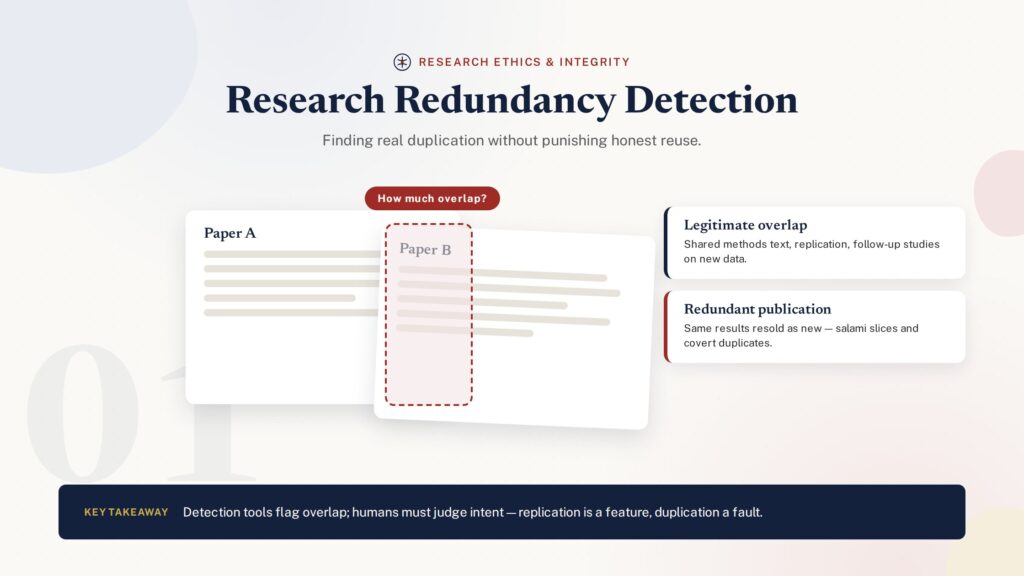
Unlike plagiarism, which involves direct copying or unattributed use of others’ work, redundancy often exists in a more subtle space. It may involve similar research questions, overlapping datasets, repeated methodologies, or marginally altered findings presented as new contributions. The challenge lies in distinguishing between meaningful replication and unnecessary duplication.
Understanding Research Redundancy
Research redundancy occurs when a study does not provide sufficient new knowledge beyond what is already published. This does not necessarily imply misconduct. In many cases, redundancy arises from fragmented research efforts, lack of awareness of existing studies, or pressure to publish frequently.
For example, multiple studies may explore the same hypothesis using nearly identical methods and datasets, yet present their findings as independent contributions. In other cases, authors may slightly modify variables or sample sizes without introducing meaningful conceptual advancement. Over time, such redundancy can lead to an inflated body of literature where true innovation becomes harder to identify.
However, not all overlap is problematic. Replication studies, meta-analyses, and cross-context validations are essential for confirming results and strengthening evidence. The key issue is not overlap itself, but whether the overlap contributes to or merely repeats existing knowledge.
Why Redundancy Detection Matters
The implications of unchecked redundancy are significant. First, it affects research efficiency. Editors and reviewers spend valuable time evaluating submissions that may offer limited novelty. This contributes to reviewer fatigue and delays in the publication process.
Second, redundancy impacts knowledge clarity. When multiple similar studies flood the literature, it becomes difficult for researchers to identify which findings are genuinely new or impactful. This can lead to confusion, especially in fields where decisions depend on synthesizing large volumes of evidence.
Third, redundancy influences research evaluation systems. Metrics such as publication counts and citation rates may be artificially inflated by repetitive studies, distorting assessments of research productivity and impact.
Tools and Techniques for Detection
Advances in technology are making redundancy detection more feasible. While traditional plagiarism detection tools focus on textual similarity, newer systems are being developed to analyze deeper patterns within research content.
These include:
- Semantic similarity analysis, which evaluates whether two studies address the same research question or hypothesis, even if phrased differently.
- Methodological comparison tools, which identify overlaps in experimental design, data sources, and analytical approaches.
- Citation pattern analysis, which examines whether a submission heavily mirrors the reference structure of existing work.
Artificial intelligence plays a growing role in these systems by identifying conceptual overlaps that go beyond surface-level text matching. However, these tools are not foolproof and require human interpretation to avoid false positives.
The Challenge of Defining “Novelty”
A central difficulty in redundancy detection is defining what counts as sufficient novelty. Academic disciplines vary widely in their expectations. In some fields, incremental advancements are valued, while in others, only highly original contributions are prioritized.
For instance, a small variation in methodology may be significant in one context but trivial in another. Similarly, applying an existing model to a new population or dataset may or may not constitute a meaningful contribution, depending on the research question.
This subjectivity makes it challenging to create universal standards. Editors must rely on a combination of guidelines, expert judgment, and contextual understanding when evaluating potential redundancy.
Risks of Over-Policing Redundancy
While detecting redundancy is important, there is also a risk of over-correction. Excessive scrutiny may discourage legitimate replication studies, which are crucial for verifying results and ensuring scientific reliability.
If researchers fear rejection due to perceived overlap, they may avoid conducting replication work altogether. This could weaken the robustness of scientific evidence, as findings remain untested across different contexts.
There is also a risk of penalizing interdisciplinary research. Studies that bridge multiple fields may appear redundant within one discipline but offer novel insights when viewed across domains.
Toward Balanced Editorial Practices
To address these challenges, academic publishing must adopt balanced approaches to redundancy detection. One key strategy is to clearly differentiate between redundancy and replication. Journals should explicitly state their policies on acceptable overlap and encourage submissions that validate or extend existing findings.
Another important step is transparent reporting. Authors should be encouraged to clearly position their work in relation to existing literature, explicitly stating what is new and how it differs from prior studies. This helps editors and reviewers assess novelty more effectively.
Editorial training and guidelines can also improve consistency in decision-making. By providing reviewers with criteria for evaluating overlap, journals can reduce subjectivity and ensure fair assessments.
Additionally, technology should be used as a support tool, not a decision-maker. Automated systems can flag potential overlaps, but final judgments should always involve human expertise and contextual evaluation.
Encouraging Meaningful Contributions
Ultimately, the goal of redundancy detection is not to limit publication, but to encourage meaningful and impactful research. By filtering out unnecessary duplication, journals can create space for innovative ideas and high-quality studies.
At the same time, the academic community must recognize the value of replication and incremental progress. Not every study needs to be groundbreaking to be valuable. The focus should be on whether a study adds clarity, depth, or reliability to existing knowledge.
Conclusion
Research redundancy is an inevitable byproduct of a growing and competitive academic ecosystem. While it poses challenges to efficiency, clarity, and evaluation, it can be managed through thoughtful detection and balanced editorial practices.
By combining technological tools with human judgment, and by clearly distinguishing between duplication and contribution, academic publishing can maintain a healthy balance between innovation and validation. In doing so, it ensures that the expanding body of research remains both meaningful and trustworthy.