
Negative Peer Review Tone in Academic Publishing: Professionalism, Bias, and Its Impact on Research Quality
Reading time - 7 minutes
Introduction
Peer review is widely regarded as the backbone of academic publishing, ensuring that research meets standards of quality, rigor, and credibility. While much attention is given to the content of peer review—methodology critiques, data evaluation, and conceptual feedback—an often overlooked aspect is the tone of reviewer comments. The way feedback is communicated can significantly influence authors, editorial decisions, and even the broader research culture.
Negative or unprofessional peer review tone refers to feedback that is dismissive, harsh, vague, or unnecessarily critical without offering constructive guidance. While critical evaluation is essential to peer review, the manner in which criticism is delivered can either strengthen the research process or undermine it.
The Importance of Tone in Peer Review
Peer review is not just an evaluative process—it is also a form of scholarly communication. Ideally, reviewer comments should help authors improve their work, clarify ambiguities, and strengthen arguments. Constructive feedback is specific, respectful, and actionable.
However, when tone becomes overly negative or dismissive, it shifts the purpose of peer review from improvement to discouragement. Comments such as “this paper lacks any value” or “the methodology is completely flawed” without further explanation do little to guide authors. Instead, they create confusion and frustration.
Tone also plays a role in editorial interpretation. Editors often rely on reviewer reports to make decisions. If feedback is emotionally charged or exaggerated, it can influence editorial judgment in ways that may not accurately reflect the quality of the manuscript.
Causes of Negative Reviewer Tone
Several factors contribute to unprofessional tone in peer review. One of the most common is time pressure. Reviewers, who often volunteer their time, may rush through manuscripts and provide brief, blunt feedback rather than detailed, constructive comments.
Another factor is anonymity. While anonymous peer review is designed to protect reviewers and encourage honest feedback, it can sometimes reduce accountability. Without identity disclosure, some reviewers may feel less constrained in their language.
Cognitive bias also plays a role. If a reviewer disagrees with the research approach, theoretical framework, or findings, this disagreement can manifest as overly harsh criticism. In some cases, competition within the field may influence tone, particularly in highly competitive research areas.
Finally, a lack of reviewer training contributes to the problem. Many researchers become reviewers without formal guidance on how to provide effective and professional feedback. As a result, tone varies widely across reviews.
Impact on Authors and Research Culture
The effects of negative peer review tone extend beyond individual manuscripts. For authors—especially early-career researchers—harsh or dismissive feedback can be discouraging and demotivating. It may reduce confidence, delay revisions, or even deter researchers from submitting future work.
In extreme cases, repeated exposure to negative reviews can contribute to a toxic research environment where criticism is perceived as personal rather than constructive. This undermines collaboration and openness within the academic community.
Negative tone can also affect the quality of revisions. When feedback is unclear or overly critical without guidance, authors may struggle to understand how to improve their work. This can lead to superficial revisions or missed opportunities for meaningful enhancement.
At a broader level, peer review tone influences the culture of academic publishing. A system that tolerates unprofessional communication risks normalizing it, creating a cycle where new reviewers adopt similar behaviors.
Distinguishing Criticism from Unprofessionalism
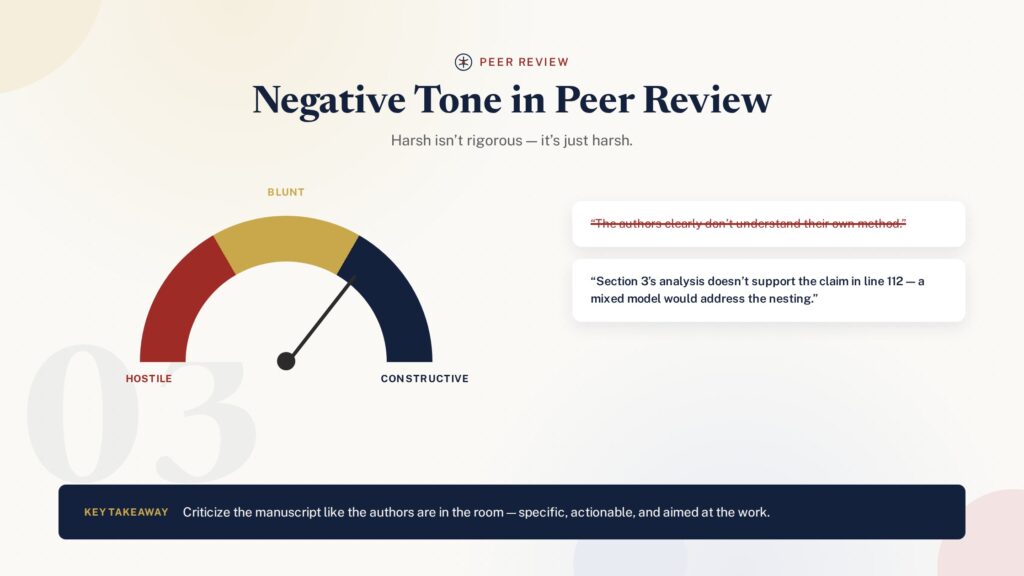
It is important to note that critical feedback is not inherently negative. Rigorous critique is essential for maintaining research quality. The key distinction lies in how criticism is expressed.
Constructive criticism:
- Focuses on specific issues
- Provides explanations and suggestions
- Maintains a respectful and professional tone
Unprofessional criticism:
- Uses vague or dismissive language
- Lacks actionable guidance
- Includes personal or эмоционально charged remarks
For example, stating “the methodology lacks clarity in sampling design” is constructive, whereas “the methodology is poorly done” is vague and unhelpful.
The Role of Editors and Journals
Editors play a crucial role in managing reviewer tone. They act as intermediaries between reviewers and authors, and they have the authority to moderate or filter comments before sharing them.
Many journals are now implementing editorial screening of reviews, ensuring that feedback meets standards of professionalism before it reaches authors. In cases where tone is inappropriate, editors may request revisions from reviewers or exclude certain comments altogether.
Journals can also establish clear reviewer guidelines that emphasize respectful communication, specificity, and constructive intent. Providing examples of good and bad feedback can help set expectations.
Additionally, some publishers are introducing reviewer training programs to improve the quality and tone of peer review. These programs focus on best practices, including how to deliver critical feedback effectively.
Encouraging a Constructive Review Culture
Improving peer review tone requires a cultural shift within academia. Reviewers must recognize that their role is not only to evaluate but also to mentor and support the development of research.
One approach is to encourage reviewers to adopt a “collaborative mindset”, viewing the review process as a partnership aimed at improving the manuscript. This perspective can naturally lead to more constructive and respectful feedback.
Another strategy is feedback transparency. In open peer review systems, where reviewer comments may be published alongside articles, there is greater accountability for tone and content. This visibility can encourage more thoughtful and professional communication.
Recognition and incentives for high-quality reviews can also play a role. When journals acknowledge reviewers who provide detailed and constructive feedback, it reinforces positive behavior.
Moving Forward
Negative peer review tone is a subtle but impactful issue in academic publishing. While it does not directly affect data or methodology, it shapes the human experience of research—how authors perceive feedback, how editors make decisions, and how the academic community interacts.
Addressing this issue requires a combination of clear policies, editorial oversight, reviewer training, and cultural change. By prioritizing professionalism and constructive communication, academic publishing can create a more supportive and effective peer review system.
In the end, the goal of peer review is not just to judge research, but to improve it. The tone of that judgment matters more than we often realize.