
Shadow Retractions in Academic Publishing: When Problematic Research Remains Uncorrected
Reading time - 7 minutes
Introduction
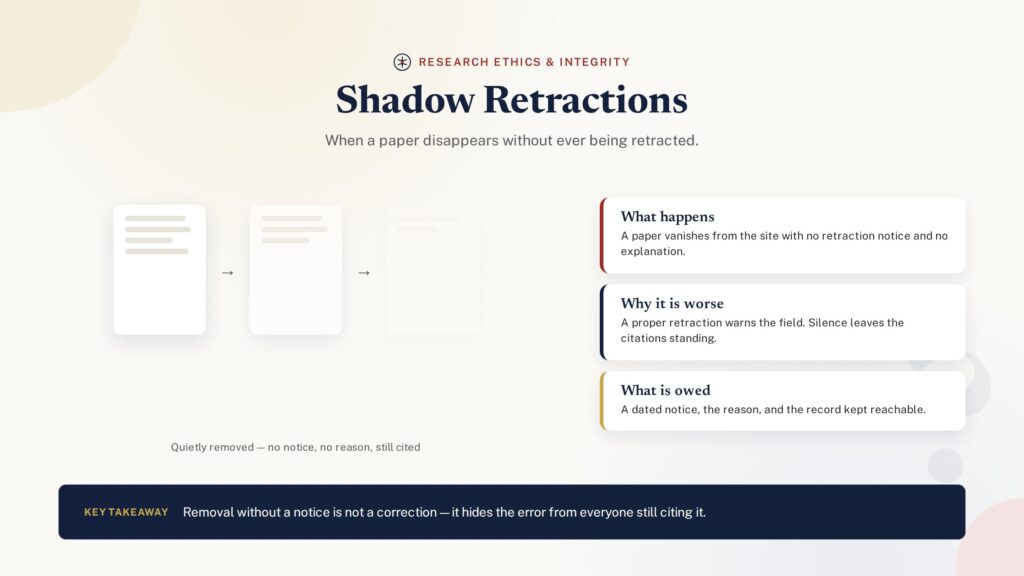
Retractions are often seen as the ultimate mechanism for correcting the academic record. When a study is found to be flawed, fraudulent, or ethically compromised, a formal retraction signals to the scholarly community that its findings should no longer be trusted. However, not all problematic research is formally retracted. A growing concern in academic publishing is the phenomenon of “shadow retractions”—cases where flawed or unreliable studies remain in the literature without clear correction, despite known issues.
Unlike formal retractions, shadow retractions occur quietly. Papers may be widely criticized, contradicted, or even discredited in subsequent research, yet they continue to exist in journals without any official notice. This creates a misleading impression of validity and raises serious questions about the completeness and reliability of the scholarly record.
What Are Shadow Retractions?
Shadow retractions refer to situations where a study is effectively invalidated in practice but not formally retracted or corrected by the journal. This can happen in several ways. For example, serious methodological flaws may be identified after publication, but the journal may choose not to act due to insufficient evidence of misconduct. In other cases, concerns may be raised informally—through social media, post-publication commentary, or follow-up studies—without triggering a formal editorial response.
As a result, the paper remains accessible and citable, often without any indication that its findings are disputed. Over time, such studies can continue to influence research, policy, and public understanding, despite their questionable reliability.
Why Do Shadow Retractions Occur?
There are multiple reasons why problematic research may not be formally retracted. One key factor is the high threshold for retraction. Journals typically require clear evidence of misconduct, major error, or ethical violation before issuing a retraction. If concerns fall into a grey area—such as questionable methodology or irreproducible results—they may not meet the criteria for formal action.
Legal and reputational considerations also play a role. Retractions can have serious consequences for authors and institutions, and journals may hesitate to take action without strong, defensible grounds. In some cases, disputes between authors, reviewers, and editors can delay or prevent corrective action altogether.
Another contributing factor is resource limitation. Investigating post-publication concerns requires time, expertise, and coordination. Not all journals have the capacity to thoroughly examine every claim, leading to inconsistent responses across the publishing landscape.
The Impact on Research Integrity
The presence of shadow retractions poses significant risks to research integrity. One major issue is the continued citation of flawed studies. Researchers conducting literature reviews or meta-analyses may unknowingly include unreliable papers, thereby propagating errors into new work.
This is particularly problematic in fields with real-world implications, such as medicine, public health, or environmental science. Decisions based on flawed research can lead to ineffective or even harmful outcomes.
Shadow retractions also contribute to information asymmetry. Researchers who are deeply engaged in a field may be aware of controversies surrounding certain papers, while others—especially early-career researchers or those from different disciplines—may not. This uneven awareness creates disparities in how research is interpreted and used.
Furthermore, the lack of visible correction undermines trust in academic publishing. If readers cannot rely on journals to clearly signal problematic research, confidence in the entire system may erode.
The Role of Post-Publication Discourse
In many cases, shadow retractions are sustained or challenged through post-publication discourse. Platforms such as academic forums, commentary sections, and independent review sites allow researchers to critique published work openly. While these discussions are valuable, they are often fragmented and not systematically integrated into the formal publishing record.
This creates a disconnect between informal critique and formal correction. A paper may be widely criticized in the academic community, yet a reader accessing the original article may see no indication of these concerns.
Bridging this gap is essential for improving transparency and ensuring that critical evaluations are visible to all readers.
Possible Solutions and Safeguards
Addressing shadow retractions requires a more flexible and responsive approach to post-publication correction. One potential solution is the use of editorial expressions of concern. These notices can be issued when serious questions arise but do not yet meet the threshold for retraction. They provide a visible signal to readers without prematurely assigning blame.
Another approach is to integrate post-publication review systems directly into journal platforms. By linking formal articles with ongoing commentary and critique, journals can create a more dynamic and transparent research ecosystem.
Citation alerts and flags can also help. Digital tools can notify readers when a cited paper has been challenged, corrected, or contradicted by subsequent research. This ensures that users are aware of evolving evidence even if the original article remains unchanged.
Importantly, journals should adopt clear policies for handling post-publication concerns, including timelines for investigation and criteria for different types of corrective action. Consistency in these processes is key to maintaining trust.
Rethinking the Binary Model of Correction
The issue of shadow retractions highlights a broader limitation in academic publishing: the binary nature of correction systems. Currently, papers are often treated as either valid or retracted, with little room for nuance in between.
In reality, research exists on a spectrum of reliability. Some studies may be partially flawed, context-dependent, or superseded by new evidence. Recognizing this complexity requires more graduated forms of correction and communication.
Conclusion
Shadow retractions represent a hidden vulnerability in the academic publishing system. When problematic research remains uncorrected, it distorts the scholarly record, misleads readers, and undermines trust.
Addressing this issue is not simply about increasing the number of retractions, but about improving the visibility and responsiveness of post-publication correction mechanisms. By embracing more transparent, flexible, and nuanced approaches, academic publishing can better reflect the evolving nature of knowledge.
In a system built on credibility, what remains uncorrected can be just as impactful as what is formally retracted.