
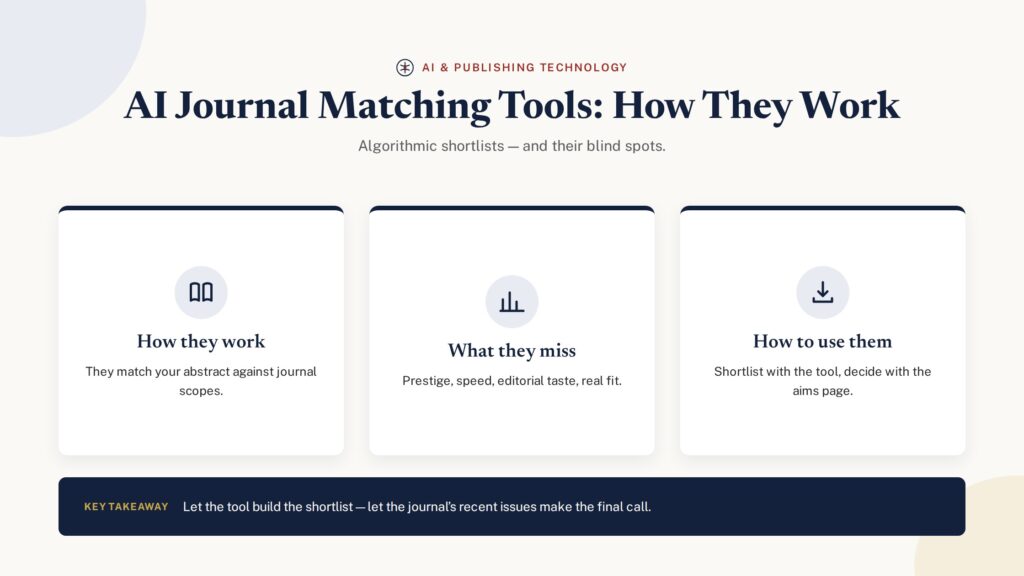
AI-powered journal matching tools scan your manuscript’s abstract and compare it against thousands of journal databases to suggest where you might submit, using natural language processing to weigh scope, subject overlap, and acceptance signals. They’re a useful starting point for narrowing a submission list, but they’re not a substitute for reading a journal’s aims and scope yourself.
How do AI journal matchers actually work?
Most tools, including Elsevier’s JournalFinder, Springer’s Journal Suggester, and Jane (Journal/Author Name Estimator), work the same basic way. You paste in your title and abstract, and the system extracts key terms and topics, then compares them against a database of journal scope statements and past published articles. The output is a ranked list of journals with a rough fit score.
What signals do they weigh?
- Topical overlap between your abstract and the journal’s published articles.
- Keyword and terminology matching against the journal’s stated scope.
- Some tools factor in acceptance rate, turnaround time, and open-access status.
What these tools get right
The biggest value is speed and breadth. A researcher manually scanning journal scope pages might check a dozen familiar titles; a matching tool can compare an abstract against thousands of journals in seconds, including niche or interdisciplinary titles a researcher might never think to check. That’s especially useful for work that straddles two fields, where the obvious flagship journals aren’t always the best fit.
Where they fall short
These tools match on surface-level topic and keyword overlap, not on the things that actually determine whether a journal is a good fit: editorial priorities, methodological preferences, or how a journal’s reviewers tend to respond to certain kinds of arguments. A tool can rank a journal highly on keyword overlap while missing that the journal rarely publishes your specific study design.
The predatory journal risk
Because most matchers pull from broad indexing databases, some will surface low-quality or predatory journals alongside legitimate ones, particularly for tools with less curated source lists. A high fit score is not the same as a vetted recommendation.
How to use a journal matcher well
- Treat the ranked list as a starting shortlist, not a final decision.
- Read the aims and scope page of every suggested journal yourself.
- Check the journal against a predatory-publishing checklist before submitting.
- Look at a handful of recently published articles to confirm topical and methodological fit.
- Cross-check acceptance rate and turnaround time claims against the publisher’s own data where available.
Frequently asked questions
Are AI journal matchers free to use?
Most major publisher tools, including Elsevier’s JournalFinder and Springer’s Journal Suggester, are free. Some third-party matchers offer a free tier with paid upgrades for more detailed analysis.
Can a journal matcher tell me if a journal is predatory?
Not reliably. Most matchers rank by topical fit, not editorial legitimacy. Cross-check any suggested journal against a resource like Think. Check. Submit., or your institution’s approved journal list, before submitting.
Should I trust the acceptance rate shown by a matching tool?
Treat it as a rough estimate. Acceptance rates shown in matching tools are often self-reported by publishers or pulled from outdated data, so confirm current figures on the journal’s own submission guidelines page where possible.
Last updated: August 8, 2026.
For related reading, see our guides on how to choose the right journal and journal impact factors and rankings. If a suggested journal looks unfamiliar, our guide on predatory conferences explained covers the same warning signs that apply to predatory journals.
Automated tools help with more than journal matching — they’re also the first line of screening for originality, and they don’t always get it right. See When AI Plagiarism Detectors Get It Wrong for common false-positive triggers.