
Hitting submit feels like the end of the process. It’s actually the start of a multi-stage pipeline that most authors never see the inside of, which is exactly why the wait feels so opaque. Here’s what’s happening at each stage, and roughly how long each one takes in practice.
Stage 1: Editorial screening
Before your manuscript reaches a single reviewer, an editor (sometimes with help from an editorial assistant) checks it against basic fit and quality criteria: does it match the journal’s scope, does it follow the submission format, does it clear a plagiarism check, and does it meet a baseline quality bar. This is also where desk rejections happen — papers rejected before review, usually because they’re out of scope or clearly not ready, not because the science is wrong.
This stage typically takes anywhere from a few days to two weeks. Journals with high submission volume and low acceptance rates screen harder here specifically to protect reviewer time.
Stage 2: Reviewer assignment
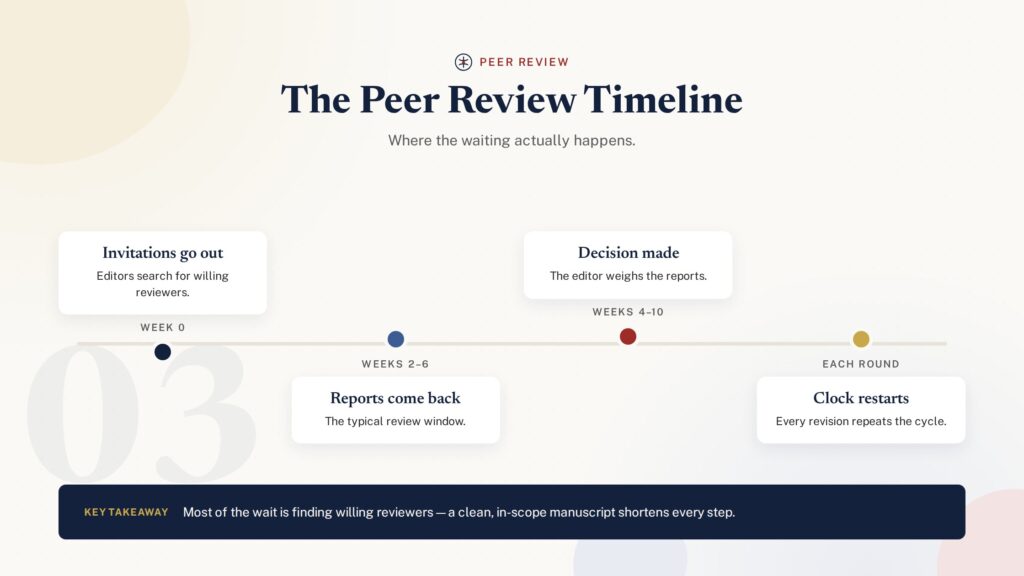
Once a paper clears screening, the editor has to find reviewers willing to take it on. This is usually the least predictable stage, because it depends entirely on who says yes. Editors often need to invite five or more potential reviewers to land two or three who accept, since reviewing is unpaid and most researchers are already over capacity.
This step can take anywhere from a few days to several weeks, and it’s the stage most likely to stall a submission with no visible progress.
Stage 3: The review period
Once reviewers accept, they’re typically given two to four weeks to submit their report, though this varies widely by field and journal. Reviewers assess the work’s validity, significance, and clarity, and write up comments for both the editor and the author.
This is usually the longest single stage, and it’s common for at least one reviewer to need a deadline extension. Editors generally wait for all assigned reviews before moving forward, so one slow reviewer can hold up the whole timeline.
Stage 4: Decision and revisions
With reviews in hand, the editor weighs the recommendations (which don’t always agree with each other) and makes a call: accept, minor revision, major revision, or reject. Most papers that eventually get published go through at least one round of revision first — an outright accept on first submission is genuinely rare in most fields.
If revisions are requested, the clock effectively resets: authors typically get several weeks to months to respond, and revised manuscripts often go back to the same reviewers for a second look before a final decision.
How long does it actually take, realistically
Added end to end, a first decision (accept, reject, or revise) commonly lands somewhere between six weeks and four months from submission, and that’s before counting revision rounds. A paper that needs major revisions can easily take six months to a year from submission to final acceptance. Fields with smaller reviewer pools, or journals with high submission volume relative to editorial staff, tend to sit at the slower end of that range.
None of this is a sign anything has gone wrong. The honest answer to “why hasn’t my paper moved” is usually “it’s sitting in one of these stages doing exactly what it’s supposed to be doing” — the process is just genuinely slow, not broken.
Frequently asked questions
How do I know which stage my paper is in?
Most journal submission systems (like Editorial Manager or ScholarOne) show a status label such as “With Editor,” “Under Review,” or “Reviewers Assigned.” If your system doesn’t show this, it’s reasonable to email the editorial office after a reasonable wait rather than guessing.
Is it okay to follow up if I haven’t heard anything?
Yes, particularly if you’ve passed the journal’s stated average review time. A brief, polite status inquiry is normal and won’t hurt your paper’s chances.
Why did my paper get desk rejected so quickly?
A fast rejection (within days) almost always means a scope or formatting mismatch caught at editorial screening, not a judgment on the science. It’s usually worth revising for fit and submitting elsewhere rather than treating it as a research-quality signal.
Last updated: August 13, 2026.
For related reading, see our guides on corresponding author responsibilities and self-citation thresholds in academic publishing. If you’re weighing where to submit in the first place, our AI journal matching tools breakdown covers how to shortlist journals before you enter this pipeline.