
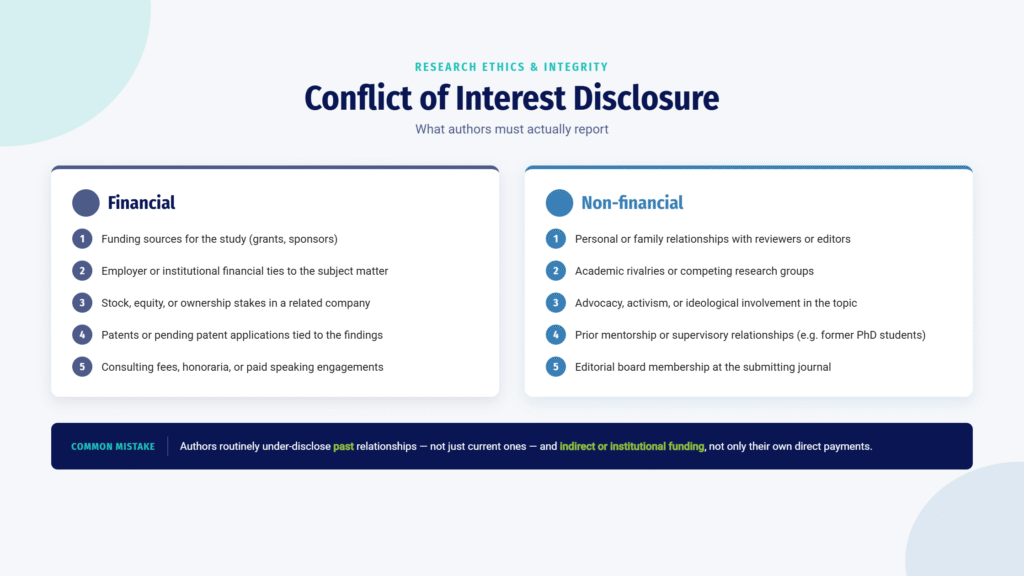
This conflict of interest disclosure checklist exists because most authors read “conflict of interest” as shorthand for “did a company pay you.” That’s only half the picture. Journals ask authors to disclose two separate categories, financial and non-financial, and it’s almost always the second category that gets left off the form by accident rather than by intent. This is a working checklist of what actually needs to be reported, and the specific edge cases that trip authors up most often.
[rank_math_toc]
What Counts as a Financial Conflict of Interest
These are the items most authors expect, though the list is longer than “did I get paid directly.”
Funding sources for the study. Grants, sponsors, or any organization that financed the research need to be named, even if they had no editorial input into the results.
Employer or institutional financial ties. If your employer holds a financial stake in the subject matter, that’s disclosable, separate from your personal compensation.
Stock, equity, or ownership stakes in a company connected to the findings, including through a spouse or immediate family member.
Patents or pending patent applications tied to the findings, whether filed personally or through your institution.
Consulting fees, honoraria, or speaker fees from any organization with an interest in how the research is received.
What Counts as a Non-Financial Conflict of Interest
This is the category most authors under-report, usually because it feels less concrete than a dollar amount.
Personal or family relationships with reviewers or editors handling the manuscript, including close friendships, not just family ties.
Academic rivalries where a competing lab or research group has a professional stake in your findings being right or wrong.
Advocacy or ideological involvement in the subject matter, such as sitting on the board of an organization whose position the research supports.
Prior mentorship relationships with an editor or reviewer, in either direction, even years after the relationship ended.
Editorial board membership at the journal you’re submitting to, or at a closely competing journal.
Conflict of Interest Disclosure Checklist: What Authors Forget
A few specific situations account for most of the disclosure gaps journals catch after the fact:
Relationships that form after submission. If you join an advisory board or start a consulting arrangement while your manuscript is still under review, most journals require an updated disclosure, not just the one filed at submission.
Indirect institutional pressure. A department that relies on funding from an industry partner can create a conflict for every author in that department, even those with no personal financial tie.
Former advisors or students on the editorial board. This relationship rarely feels current enough to disclose, but most COI policies don’t put a time limit on mentorship ties.
Unpaid advisory roles. No money changing hands doesn’t mean no conflict. Unpaid seats on a company’s scientific advisory board are still reportable.
When and How to Disclose
Disclosure isn’t a one-time form. Most journals require it at initial submission, again if anything changes before acceptance, and a final confirmation at proof stage.
Medical and life-sciences journals following ICMJE guidance typically require the ICMJE Disclosure Form specifically, rather than a free-text statement. When in doubt about whether something qualifies, the safer move is almost always to disclose it and let the editor decide it’s irrelevant, rather than omit it and have a reader or reviewer flag it later.
FAQ
Does a past collaboration count as a conflict? Often yes, particularly if it was within the last few years or if the collaboration is ongoing in any form. Journal policies vary on the exact cutoff, so check the specific submission guidelines.
What if I’m genuinely unsure whether something is a conflict? Disclose it briefly and let the editor make the call. Under-disclosure is treated far more seriously than an editor deciding a disclosed item doesn’t rise to the level of a conflict.
What happens if an undisclosed conflict is discovered after publication? It can trigger a correction, an expression of concern, or in serious cases a retraction, separate from any judgment on the validity of the research itself.
For the mechanics of actually writing the disclosure statement itself, see our guide on editorial conflicts of interest and disclosure best practices, and for how disclosure obligations connect to the submitting author’s other duties, see corresponding author responsibilities. For the official reporting standard most journals point to, ICMJE maintains the ICMJE Disclosure of Interest form and guidance.