
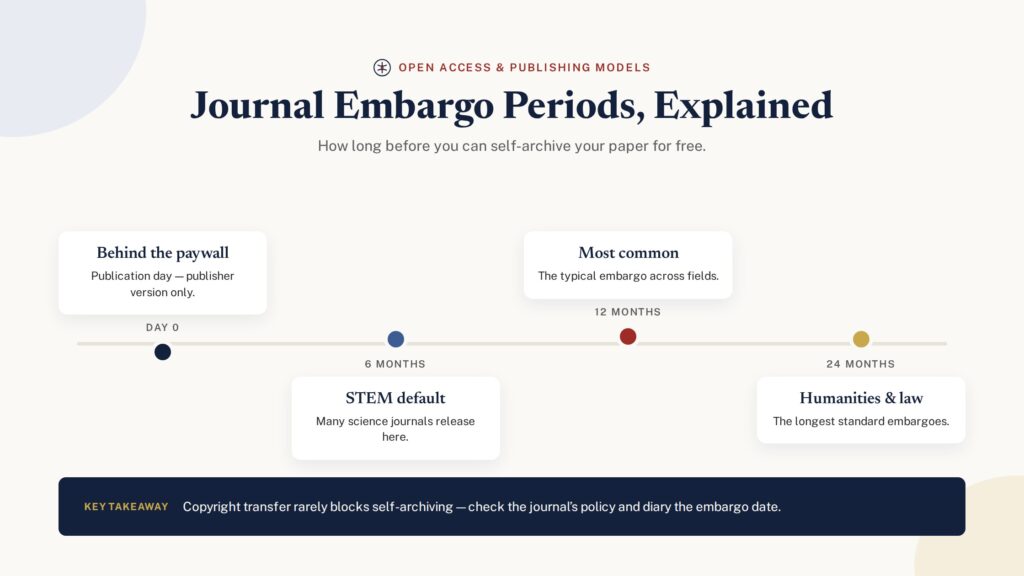
If you’ve ever been told you can share your accepted manuscript “after the embargo lifts,” you’ve run into one of the more confusing rules in academic publishing. An embargo period is the fixed window a publisher requires between a paper’s official publication and the date an author is allowed to make a free copy publicly available — most commonly through green open access self-archiving in an institutional or subject repository.
What an Embargo Period Actually Controls
It does not stop you from publishing. It controls when the accepted, peer-reviewed version (not always the final typeset PDF) can be legally deposited somewhere readers can access it for free, outside the paywall the publisher maintains during the embargo window.
Typical Embargo Lengths
- 6 months — common in STEM fields, especially where funders mandate rapid open access
- 12 months — the most common default across many subscription journals, particularly in social sciences and humanities
- 24 months — used by some humanities and law journals, where citation half-life is longer
- Zero embargo — a growing number of publishers, including several major society journals, now allow immediate green OA deposit with no wait at all
How to Find Your Actual Embargo Period
Publisher-wide defaults exist, but the number that matters is the one attached to your specific journal, which is usually listed in the author-facing sharing or self-archiving policy on the journal’s own site, or searchable through your institution’s library “publisher policy” lookup tools. Funder mandates can also override a publisher’s default — several major funders now require zero or six-month embargoes as a condition of grant funding, regardless of what the journal’s standard policy says.
Common Mistake: Confusing the Embargo With the Copyright Transfer
Authors often assume that once they’ve signed a copyright transfer agreement, they’ve given up the right to share their own work entirely. In most cases that’s not true — the copyright transfer typically still leaves you the right to self-archive the accepted manuscript once the embargo period ends. Check your specific publishing agreement rather than assuming either extreme.
Frequently Asked Questions
What happens if I share my paper before the embargo ends?
Most publishers can request removal from the repository and, in repeat cases, may flag the author for future submissions — check your specific agreement.
Does the embargo apply to the published PDF or my own manuscript?
Almost always your own accepted manuscript (the peer-reviewed version before final typesetting), not the publisher’s formatted PDF.
Can my funder override the journal’s embargo policy?
Yes — many funder open access mandates set a maximum embargo (often six months or zero) that supersedes the journal’s own default.
Is gold open access affected by embargoes?
No — gold OA (typically via an article processing charge) makes the final published version freely available immediately, with no embargo at all.
Where you self-archive matters too. Our comparison of the best preprint servers ranks 20 platforms by field, cost and journal integration.