
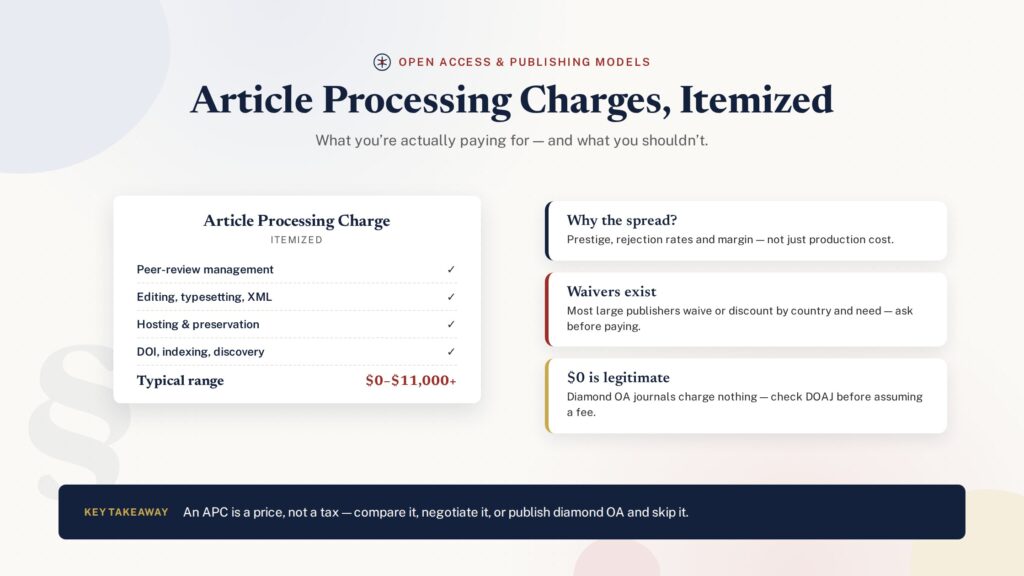
Open access publishing flipped who pays for a paper’s production cost — instead of libraries paying for subscriptions to read it, someone pays upfront to make it free for everyone else. That someone is usually the author, via an article processing charge (APC). The fee ranges wildly, from a few hundred dollars to well over ten thousand, and most authors approve the invoice without ever seeing an itemized breakdown of what it’s actually funding.
What an APC is supposed to cover
An APC isn’t a submission fee — legitimate journals never charge to review a paper, only to publish an accepted one. Once a manuscript clears peer review, the fee is meant to cover several things: coordinating the review process itself (editors, reviewer management systems, sometimes small reviewer honoraria), copyediting and typesetting the final version, hosting and long-term digital preservation so the paper stays accessible for decades, indexing in databases like Crossref and DOAJ, and a margin for the publisher.
In practice, the split between those categories is rarely disclosed, and it varies enormously by publisher. A well-resourced nonprofit OA publisher and a large commercial hybrid journal can charge wildly different amounts for what looks like the same service on paper.
Why the price range is so wide
At the low end, many diamond and community-run OA journals charge nothing at all, funded instead by institutions, societies, or grants. Mid-tier fully open access journals commonly land somewhere in the low-to-mid thousands of dollars. At the high end, prestige hybrid journals — the ones that publish both subscription and OA content — often charge the most for OA, sometimes well past ten thousand dollars, partly because the OA fee is subsidizing infrastructure that subscription revenue used to cover.
That gap means the fee correlates more with a journal’s brand and business model than with how much editorial work actually went into your specific paper. Two papers of similar length and complexity can carry APCs several times apart depending purely on where they land.
Who actually pays
Authors rarely pay out of pocket. Funding bodies increasingly require or budget for OA publication as a condition of the grant, and many universities maintain APC funds or negotiate “transformative agreements” that bundle subscription and OA publishing costs together (worth checking with your library before you assume you’re on the hook personally). Corresponding authors at well-funded institutions in wealthier countries end up subsidizing, in effect, waiver programs for authors elsewhere.
Fee waivers exist — and they’re underused
Most reputable OA publishers offer full or partial waivers for authors affiliated with low- and middle-income countries, and some extend discretionary waivers for genuine financial hardship regardless of location. The catch is that waiver policies are rarely advertised prominently, and asking feels awkward to a lot of first-time authors. It shouldn’t: applying for a waiver is a normal, expected part of the submission process at any journal serious about equitable access, and it’s typically requested before or during submission, not after acceptance when it’s harder to unwind.
Red flags worth knowing
A few patterns are worth watching for specifically because they show up disproportionately among predatory or low-quality publishers: an APC that’s due immediately upon submission rather than after acceptance, aggressive email solicitation promising unusually fast review timelines, and total silence about what the fee covers when asked directly. None of these alone is proof of a scam, but together they’re a pattern worth slowing down for.
Is the fee worth it
The honest answer depends on what you’re buying. A high APC at a journal with a strong reputation, wide indexing, and genuinely rigorous review can be worth it for the visibility and credibility it buys your work. The same fee at a journal that can’t clearly explain its review process is a worse deal regardless of the number attached. Before paying, it’s reasonable to ask a journal directly for typical review turnaround times, rejection rates, and where the paper will be indexed — publishers with nothing to hide answer these plainly.
Frequently asked questions
Is it normal to negotiate an APC?
Yes, more than most authors realize. Waiver requests are standard, and some publishers will discount or waive fees case-by-case even outside formal programs, especially for early-career researchers or authors from underfunded labs.
Does a high APC mean a journal is more prestigious?
Not reliably. Price correlates loosely with brand recognition and hybrid-journal overhead, not directly with editorial rigor. Some highly regarded journals charge modestly; some obscure ones charge a lot.
What’s the difference between an APC and a submission fee?
A submission fee is charged just to have a paper reviewed, win or lose — this is unusual and a red flag at most journals. An APC is only charged after acceptance, to publish the final, approved version.
Last updated: August 14, 2026.
For related reading, see our guides on AI journal matching tools and the peer review timeline. If you’re weighing where authorship responsibilities sit once a paper is accepted, our corresponding author responsibilities breakdown covers what happens next.
Article processing charges aren’t the only financial-sounding detail authors misunderstand at submission time — the embargo period attached to green open access self-archiving trips people up just as often. See Journal Embargo Periods Explained for typical lengths and how to check yours.