Editorial Process & Author Guidance

Manuscript submission, editorial workflow, and practical guidance for authors.

Registered Reports Explained for Researchers

Digital Archives and Their Importance in Academic Research

Registered Reports Explained for Researchers Reading time – 7 minutes Introduction Publication bias toward positive results has long distorted the research record. To address this, many journals are adopting registered reports, a publishing model that evaluates research before results are known. This article explains how registered reports work, why journals support them, and what researchers […]

Registered Reports Explained for Researchers Read More »

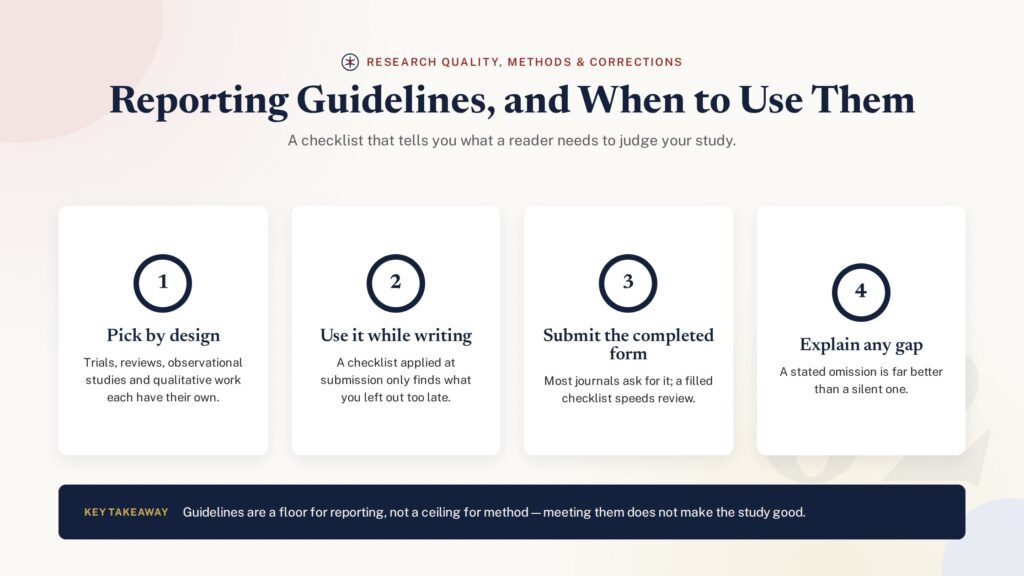
Reporting Guidelines in Academic Publishing Explained

Digital Archives and Their Importance in Academic Research

Reporting Guidelines in Academic Publishing Explained Reading time – 7 minutes Introduction Incomplete or unclear reporting is one of the most common reasons manuscripts face rejection or major revision. To address this, journals increasingly require authors to follow reporting guidelines—structured frameworks that ensure research is reported transparently and consistently. This article explains what reporting guidelines

Reporting Guidelines in Academic Publishing Explained Read More »

Version Control in Research Publishing Explained

Digital Archives and Their Importance in Academic Research

Version Control in Research Publishing Explained Reading time – 7 minutes Introduction Modern research publishing involves multiple manuscript versions: drafts, preprints, revised submissions, and published articles. Without proper version control, confusion, errors, and ethical issues can arise. This article explains how version control works in research publishing and how authors can manage manuscript updates effectively.

Version Control in Research Publishing Explained Read More »

How to Communicate with Journal Editors Professionally

Digital Archives and Their Importance in Academic Research

How to Communicate with Journal Editors Professionally Reading time – 7 minutes Introduction Effective communication with journal editors can clarify expectations, resolve issues, and improve publication outcomes. Poor communication, however, can harm credibility. When to Contact Editors Appropriate times include: Pre‑submission inquiries Clarifying editorial decisions Addressing ethical issues How to Write Professional Emails Effective messages

How to Communicate with Journal Editors Professionally Read More »

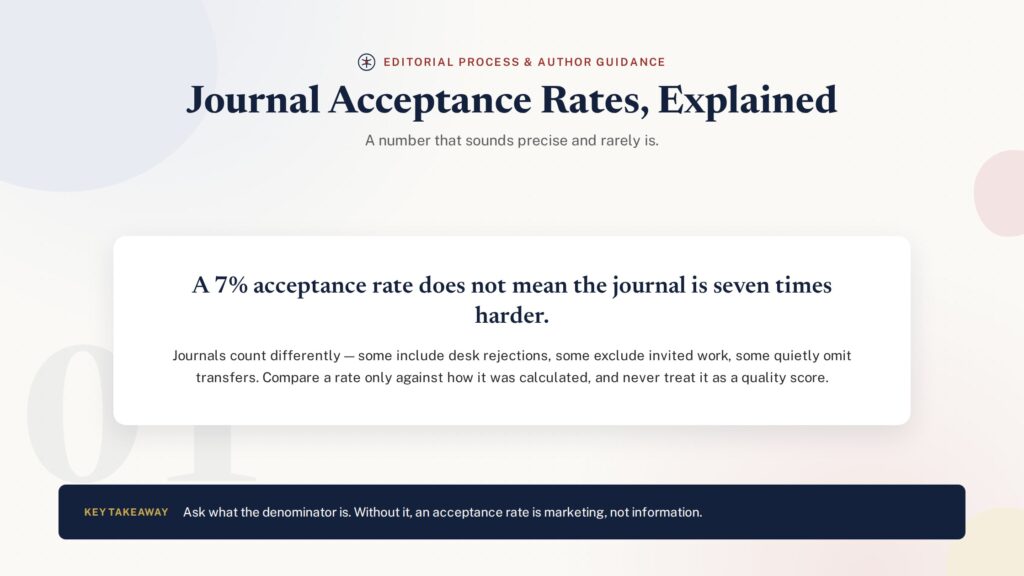
Journal Acceptance Rates Explained for Researchers

Digital Archives and Their Importance in Academic Research

Journal Acceptance Rates Explained for Researchers Reading time – 7 minutes Introduction Acceptance rates are often cited as indicators of journal quality, but they can be misleading when taken at face value. This article explains what acceptance rates actually indicate and how authors should interpret them responsibly. What Are Acceptance Rates? Acceptance rates reflect: The

Journal Acceptance Rates Explained for Researchers Read More »

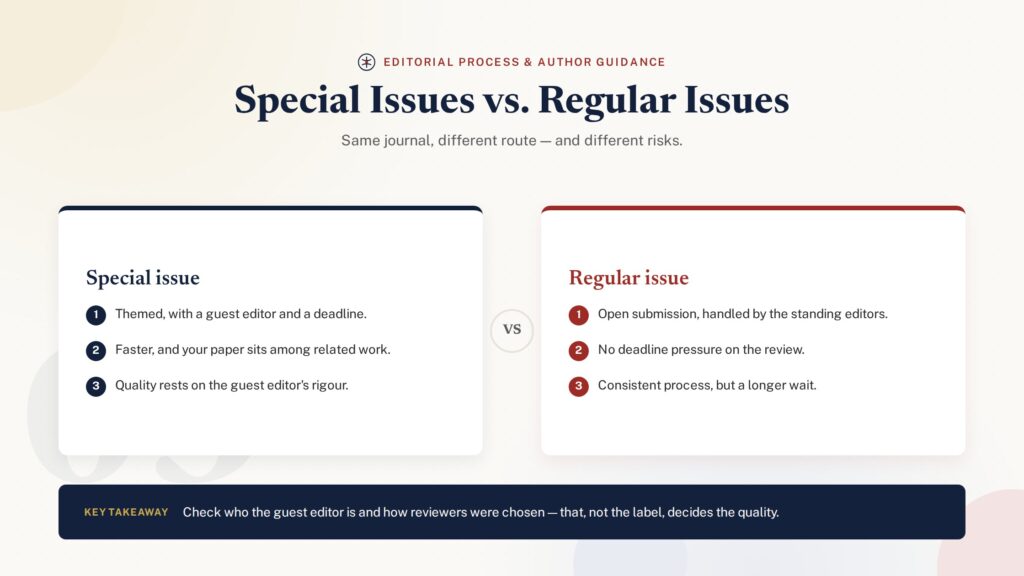
Special Issues vs Regular Issues: A Guide for Early‑Career Researchers

Digital Archives and Their Importance in Academic Research

Special Issues vs Regular Issues: A Guide for Early‑Career Researchers Reading time – 7 minutes Introduction Early‑career researchers often wonder whether submitting to special issues offers advantages over regular journal issues. While special issues can provide visibility, they also carry risks. This article compares both options to help early‑career researchers make informed decisions. What Are

Special Issues vs Regular Issues: A Guide for Early‑Career Researchers Read More »

Editorial Rejections in High‑Impact vs Mid‑Tier Journals Explained

Digital Archives and Their Importance in Academic Research

Editorial Rejections in High‑Impact vs Mid‑Tier Journals Explained Reading time – 7 minutes Introduction Authors often assume that a rejection means the same thing across all journals. In reality, editorial rejections vary significantly depending on whether a journal is high‑impact or mid‑tier. Understanding these differences helps researchers interpret decisions correctly and refine submission strategies. This

Editorial Rejections in High‑Impact vs Mid‑Tier Journals Explained Read More »

Manuscript Transfers Between Journals Explained

Digital Archives and Their Importance in Academic Research

Manuscript Transfers Between Journals Explained Reading time – 7 minutes Introduction Many publishers now offer manuscript transfer options when a paper is rejected. While these systems can save time, they are not always the best choice for authors. How Manuscript Transfer Systems Work Transfers may include: Manuscript files Reviewer reports Editorial comments Author consent is

Manuscript Transfers Between Journals Explained Read More »

Understanding Desk Revision Requests from Journal Editors

Digital Archives and Their Importance in Academic Research

Understanding Desk Revision Requests from Journal Editors Reading time – 7 minutes Introduction Not all editorial decisions fit neatly into “accept,” “revise,” or “reject.” Increasingly, authors receive desk revision requests, where editors ask for changes before sending a manuscript to peer review. These decisions often confuse authors and are sometimes misinterpreted as rejections. In reality,

Understanding Desk Revision Requests from Journal Editors Read More »

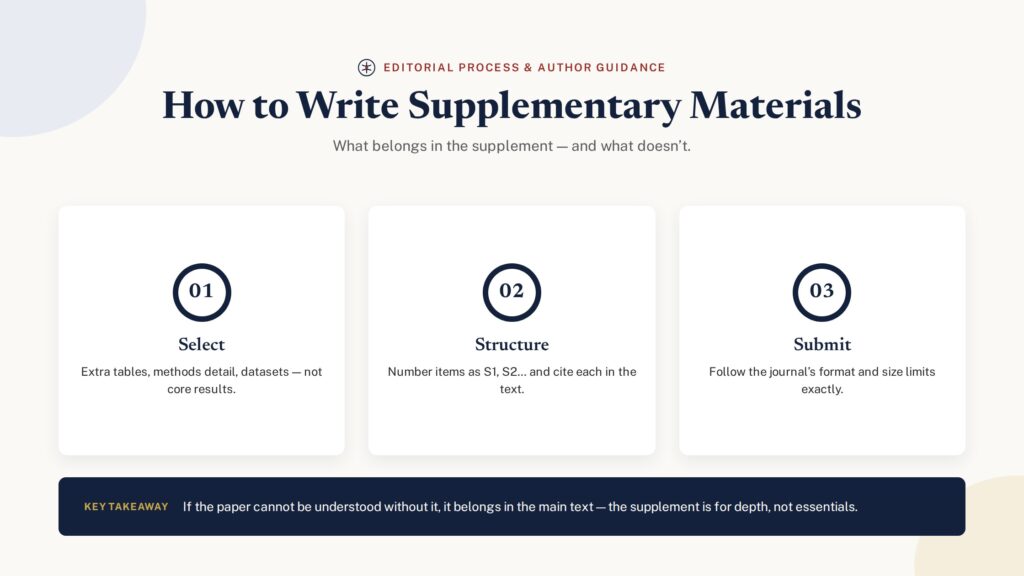
How to Write Supplementary Materials for Academic Journals

Digital Archives and Their Importance in Academic Research

How to Write Supplementary Materials for Academic Journals Reading time – 7 minutes Introduction Supplementary materials have become an essential part of academic publishing. As journals limit main‑text length, authors increasingly rely on supplements to provide detailed methods, extended data, and additional analyses. However, poorly structured supplementary materials can confuse reviewers and weaken submissions. This

How to Write Supplementary Materials for Academic Journals Read More »