
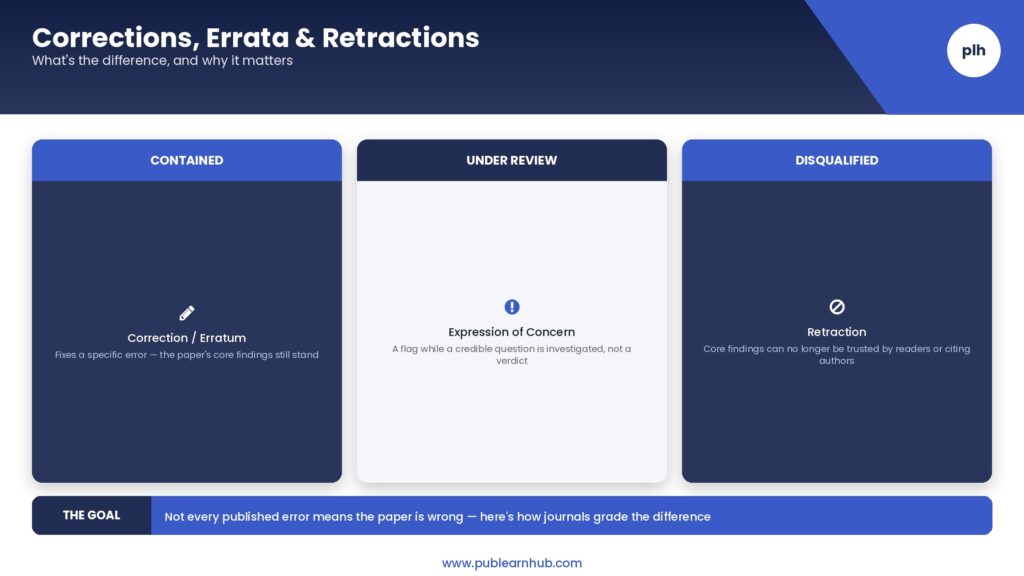
Corrections and retractions are how the scientific record fixes itself after publication. A published paper isn’t necessarily a finished paper. Errors surface after publication more often than most readers realize, and journals have a specific, graded set of tools for handling them. The trouble is the terminology gets used loosely — “correction,” “erratum,” and “retraction” get thrown around interchangeably even though they mean very different things for how much a reader should trust the underlying work.
Corrections and errata: the same thing, two names
An erratum (plural: errata) is a publisher-issued correction for a mistake introduced during the publishing process itself — a typo, a mislabeled figure, a formatting error that wasn’t in the original submission. A corrigendum is the equivalent term for an author-introduced error — something the authors got wrong in the original manuscript, like a miscalculated value or an incorrectly cited source. Many journals now just use “correction” as an umbrella term for both, since the distinction rarely matters to readers. What matters is the severity: a correction is issued when the underlying error doesn’t undermine the paper’s overall conclusions, just a specific detail within it.
What triggers a correction
Corrections get issued for things like: a data value that was transcribed incorrectly but doesn’t change the result’s direction or significance, a figure or table that doesn’t match the text, an author’s name spelled wrong or omitted, funding or conflict-of-interest information that was left out, or a citation that points to the wrong source. The common thread is containment — the error is real, but the paper’s core findings and conclusions still stand once it’s fixed.
Expression of concern: the middle ground
Between a correction and a retraction sits a less-known category: the expression of concern. Editors issue one when there’s a credible question about a paper’s validity — a possible data integrity issue, an institutional investigation underway, or a serious allegation that hasn’t been resolved yet — but the paper hasn’t been formally proven wrong or fraudulent. It’s a flag, not a verdict, and it can eventually resolve into either a correction (if the concern turns out to be minor or explainable) or a retraction (if it’s confirmed serious).
Retraction: when the paper can no longer be trusted
A retraction removes a paper’s standing as part of the reliable scientific record, even though the paper typically stays online, watermarked “RETRACTED.” Retractions happen when the core findings are unreliable — due to honest error serious enough to invalidate the conclusions, data fabrication or falsification, plagiarism, duplicate publication, or unresolved authorship and ethics violations. The key distinction from a correction: a retraction means the paper’s central claims can no longer be trusted, not just that one detail was wrong.
Who can issue each one
Authors can request a correction or retraction themselves — self-reporting an honest error is viewed far more favorably than having it discovered by someone else. Journal editors can also initiate any of these independently, often prompted by reader letters, editorial board review, or tools like statistical error-detection software. Institutions sometimes trigger a retraction following a formal misconduct investigation, in which case the journal usually retracts once the institution’s findings are shared with them.
How corrections and retractions affect the paper’s standing
A correction leaves a paper’s citability and reliability essentially intact — cite the corrected version and move on. A retraction is a different story: most citation databases visibly flag the paper as retracted, and citing a retracted paper without acknowledging the retraction is itself considered poor practice. An expression of concern sits in between — it doesn’t disqualify the paper, but a careful reader or citing author should note the unresolved concern and treat the findings cautiously until it’s resolved.
Why this system exists
None of this is about punishing honest mistakes. Research is cumulative and self-correcting by design, and a functioning correction system is a sign the process is working, not a sign something is broken. The reputational cost of a well-handled correction is genuinely small; the reputational cost of an error that surfaces years later, uncorrected, is much larger. Fields with higher correction rates aren’t necessarily sloppier — they’re often just more actively scrutinized.
Frequently asked questions
Does a correction mean the paper is unreliable?
No. A correction specifically means the core findings remain valid after the fix. If the findings themselves were in doubt, the outcome would be an expression of concern or a retraction instead.
Can a retracted paper ever be “un-retracted”?
It’s rare but not unheard of, usually only when a retraction is later shown to have been issued in error (for example, following a successful appeal or a corrected institutional finding). The retraction notice and the original retracted status typically remain part of the public record either way.
How long does the correction or retraction process usually take?
It varies widely — a straightforward erratum can be issued within weeks, while a retraction tied to a misconduct investigation can take a year or more, since it often depends on an external institutional inquiry finishing first.
Last updated: August 17, 2026.
COPE (the Committee on Publication Ethics) publishes detailed retraction guidelines that most major journals follow when deciding between corrections and retractions. For related reading, see our guide on the peer review timeline and self-citation in research. If you’re curious how these issues get caught in the first place, our salami slicing breakdown covers one of the more common patterns editors watch for.
Duplicate publication is closely related to another ethics issue authors sometimes stumble into before a paper is even accepted: submitting the same manuscript to two journals at once. See Simultaneous Submission to Multiple Journals: Why It’s Off-Limits for what counts as a violation and how to avoid it.